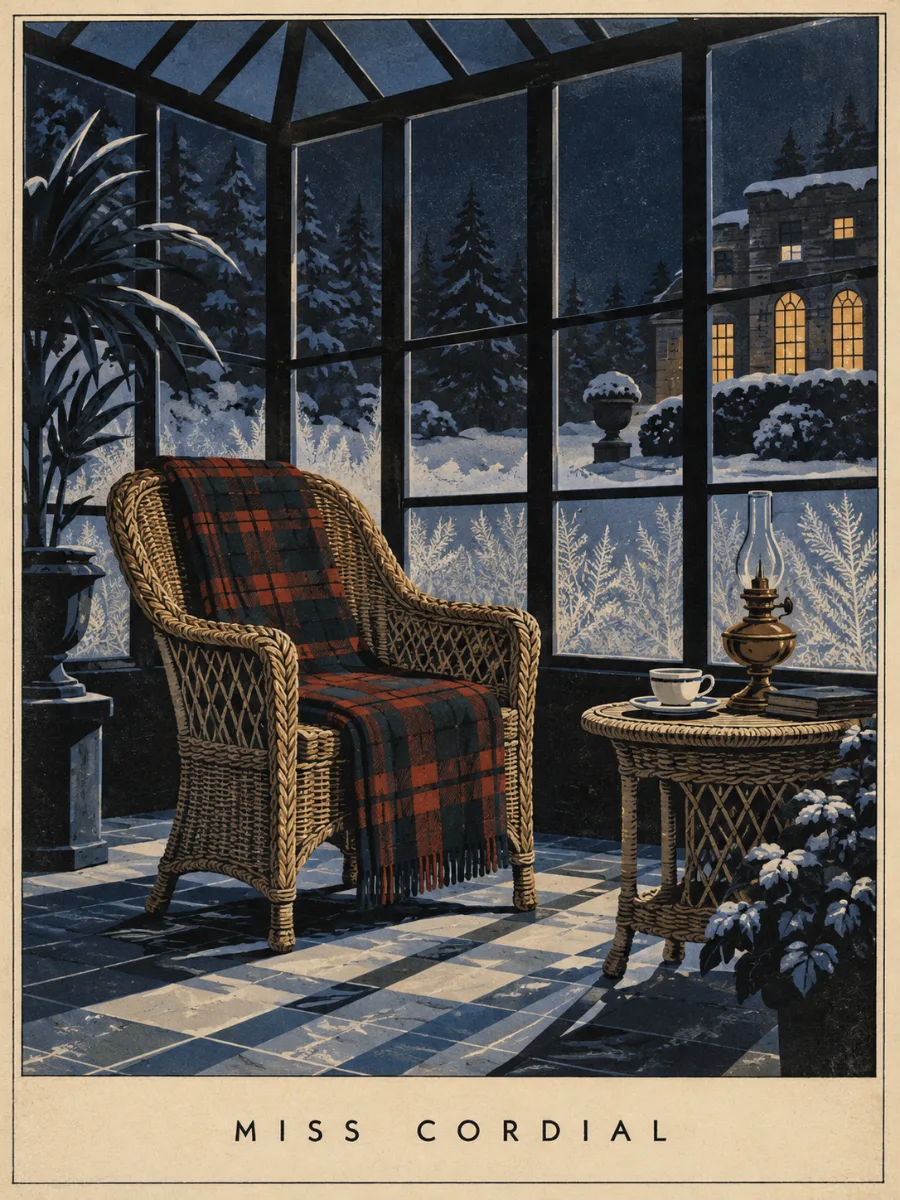
First the Lamp Goes Down
At the press house there is an October rule that nobody explains: first the lamp goes down and then the man, and never alone. On the night Mercedes comes back after twenty-three years, she goes down alone. Aristide Valmont had arrived the day before to value the property, and he stays because the cellar does not tell the same story as the family.
First the Lamp Goes Down
Chapter 1
I
The smell arrived before the house did. It was a sweet, thick smell of warm fruit, and it came up the hill on the afternoon air. Aristide Valmont walked the last kilometre slowly, his case in one hand and his hat in the other. He reached the gate of the Anzuela press house at half past four. He was sweating in a manner that struck him as unsuitable for October.
A big man was out in the yard unloading baskets from a waggon. His hands were purple to the wrist and he did not wipe them to greet him.
"You'll be the valuer."
"Aristide Valmont, at your service."
"Higinio Reinares," he answered, and pointed out the house with his chin. "My wife will show you your room. I warn you that for these three days this place is a shambles and that nobody is going to look after you properly."
"I haven't come to be looked after, monsieur. I have come to count vats, and for that a chair and a candle will do me."
Higinio looked him up and down, in no sort of hurry.
"What did you call me?"
"Monsieur. It is 'sir' in my language and it has been escaping me for thirty years. I am from Neuchâtel, which is in Switzerland and is of no interest to anybody."
"You call me Higinio."
"I shall call you whatever you like."
The man nodded once. For the first time he seemed to consider that this short broad gentleman might actually be good for something.
"Well, the vats are down below," he said. "And down below I go first, which is how it is done here and always has been."
The Anzuela press house was a stone building of two storeys with the yard attached to one side. It had been making wine for two hundred years and had had no alterations since the war. Valmont put down his case, took out his notebook and spent the next two hours behind Higinio, noting things down patiently with a pencil in his hand.
He counted eleven oak vats in the press hall, and the beam press, and the two stone troughs, and then noted the area of the threshing floor, the state of the roof and the two yoke of oxen left in the stable. And at the very end Higinio drew back a wooden bar and opened a door that stood under the outside staircase.
"The cellar," he announced.
Out of the opening came a sweet gust that literally filled Valmont's mouth with saliva. Down below, in the darkness, something was working tirelessly: a continuous small murmur, like rain inside a tin.
"What's that?"
"The must. It's boiling." Higinio lit an oil lamp off its hook and went down two steps with it ahead of him, and only then went down himself. "This year it's boiling as I've never seen it. September came hot and the fruit came in with a great deal of sugar."
There were eight stone steps, and down below the floor was of beaten earth, hard and swept, and the air had a weight to it that Valmont could not put a name to and naturally attributed to the smell. There were four big vats built into the far wall. On top of each one the lid stood raised and a brown foam rose and broke of itself. The noise down there was a great deal louder than above.
"It smells like a blessing," said Valmont. "I confess to you that I had never been in a cellar in full work."
"It smells of money." Higinio raised the lamp towards the ceiling. "There you have the big vat, which holds twelve hundred cántaros and is the only one worth anything. The other three are old."
Valmont went on measuring with his tape and noting things down methodically, and in passing he looked at what he usually looks at: the floor, the corners and the walls. In the yard wall, at waist height, there was a square hole the size of a handkerchief.
"And what is this for?"
"The air hole. The air from the yard comes in through there. Without air you can't so much as stand about down here."
"I see…"
Valmont put his hand up to the hole and held it there a moment. Then he wiped his fingers with his handkerchief, although he had not dirtied them on anything. He wrote down air hole, yard and said nothing more.
When they came out, Higinio put the bar back across the door.
"Do you always bar it?"
"Always. Nobody but me goes down there, and at this time of year I go down as little as I can."
Mercedes Reinares appeared at seven, when Valmont was in the kitchen copying out his figures. She came in without knocking, with an oilcloth-covered ledger under her arm, and put it on the table in front of him.
"You're the expert. I'm the sister who left."
"Delighted, madame."
"Mademoiselle, and it makes no difference." She sat down opposite and opened the ledger at a folded page. "I'm going to save you a week. The big vat gave eight hundred and twenty cántaros last year. The sales book shows six hundred and ninety. A hundred and thirty cántaros are missing and they are nowhere at all."
"That is a question for the books, madame, and I have come to make a valuation. Why are you telling me?"
"Because you are the only person in this house who owes me nothing and whom I owe nothing. And because somebody inside this house is stealing."
She said it in a polite, clear voice, without raising it in the slightest, and in the kitchen doorway Efrén Bidaurre stopped short with two press mats over his shoulder.
"Say my name, if you're going to say it," the foreman asked, very quietly.
"I haven't said it yet, and it seems to me there's no need to either."
"Then say it or hold your tongue, because I've been here twelve years."
"Twelve years," Mercedes repeated, "is exactly how long I've gone without setting foot in this house. Don't come to me with seniority."
Efrén went off without answering. Mercedes closed the ledger and sat looking at the empty doorway, and it seemed to Valmont that the woman was very tired under that good coat.
They dined at ten, when the pickers had gone off to the village, and in the end there were seven at table. Sabina Ozcoz served and ate standing up half the time. Bruna Reinares, the youngest, talked about the capital and about a school where she taught, and corrected her brother every time he got a name wrong, with a schoolmistress's patience that struck Valmont as the cruellest thing at that table. Doña Práxedes, who was the dead father's sister and was seventy-two, ate very slowly and appeared to be listening to nothing.
"The division is simple," Bruna observed. "Three equal shares. The will says so and there is nothing more to discuss."
"The division is simple on paper," Higinio answered. "There aren't three shares here. There is a cellar here, and a cellar divided in three is nothing."
"I don't want the cellar," said Mercedes. "I want my third in money."
"My third in money," Higinio repeated very slowly, his fork motionless. "And where does it come from."
"From selling."
Nobody said anything for a good long while. Sabina took away her husband's plate, which was untouched, and carried it off without asking him.
"And does the figure the gentleman puts down bind us?" Sabina asked from the sideboard.
"It binds all three of you, madame. You signed for a third expert in front of the lawyer last month, and what I write down is not disputed by anybody."
"What he writes down is what each of us gets," said Mercedes. "You were there, Higinio."
"I was there."
"Monsieur Valmont, how long do you take?" Bruna asked.
"Four days, if nobody gets in my way. Tomorrow I should like to spend the whole morning in the cellar. With light and without hurrying. I need to measure the vats inside and I want to see the floor."
Doña Práxedes slowly lifted her head from her plate, for the first time in the whole of dinner.
"In October one does not go down to the cellar," she said.
Bruna laughed and put a hand on her aunt's arm.
"Auntie, the gentleman isn't going down there to dance."
"In October one does not go down," the old woman repeated. "My brother said so and he must have known something. First the lamp goes down and then the man, and if the lamp goes out you come up and you say nothing. And never alone."
"He'll go down with me and with a light," Higinio settled it. "The way I go down and the way my father went down, and let's hear no more about it."
And they immediately talked about something else. Valmont had straightened the salt cellar on the table without noticing. He wiped his hands with his handkerchief and said nothing. In that house the only person who had smiled with her mouth shut was the woman who meant to sell.
Before going up he met Nieves in the passage, Higinio's daughter. She was eleven and was carrying a cat under one arm, the way one carries a bundle.
"Good night, mademoiselle."
"Good night." The child showed him the animal. "This one won't go down!"
"And where is it that he won't go down, mademoiselle?"
"To the cellar. He sits at the very top and stays there and won't go down even if you throw something at him. He's stupid."
"It is quite possible," said Valmont, "that this animal is the only clever creature in the house."
The child laughed and ran off, and he went up to bed. From his window he could see the yard, and in the yard a heap of vine prunings, and behind it the sierra, already black. He stayed a while with the window open listening to the murmur of the must, which could be heard perfectly well from there, and then shut it because it was cold.
At half past six in the morning he was woken by a woman screaming in the courtyard.
When he came down they were all there already. Mercedes Reinares was lying on her back on the floor of the press hall, between the press and the mats. She had her coat on and her shoes on. Her hands were open at her sides, with a ring on the left one and a little wristwatch on the wrist. Her face was very dark and her lips were a colour that was no colour at all.
Valmont squatted down beside her and did not touch her.
The floor of the press hall was flagged, and it was dry and swept, and in the whole hall not a handful of loose earth was to be seen, neither by the press nor under the mats. The heels of Mercedes's shoes had earth on them. The back of the coat, from the shoulders to the waist, had earth on it. A leather purse showed in the left pocket. And the right-hand pocket of the coat had been turned inside out and hung down like a tongue.
"Who found her?"
"I did." Bruna was pressed against the wall, with both hands over her mouth. "At a quarter to six. I came down to put the coffee on and I saw her there, just as she is now."
"Have you moved her? Have you touched her clothes?"
"I haven't touched her. I wasn't able to touch her, monsieur, I swear it."
Higinio was standing three paces away, with no coat, in the previous day's shirt and with his boots on. He had not opened his mouth since Valmont came down into the courtyard, and his face was the colour of ash.
Doctor Loza arrived at half past eight on a motorcycle, and took a good twenty minutes to say anything. He was a young man from the capital, and it could be seen that he was calling to mind things he had studied and had never seen.
"There is no wound," he declared at last. "There is no blow to the head. She has no mark whatever on her neck, and that I can tell you for certain, because it is the first thing I looked at."
"And what did she die of, then, doctor? Tell me as you would tell a colleague."
"She suffocated." Loza passed a hand over the back of his neck, visibly uncomfortable. "There is no other way of putting it. This woman suffocated, and there is no water, and no rope, and she has nothing in her mouth."
"Go on, I beg you."
"She has earth under her nails. All eight front nails." The doctor lifted a sleeve and put it back. "And she has two bruises under the armpits, one on each side, and the shoulder seam unpicked. This woman has been dragged by the arms."
"Before or after?"
"After." Loza shut his bag. "After for certain, and don't ask me how long after, because I don't know. I'm not signing this, monsieur. Let the Guardia Civil come up for this."
Higinio Reinares turned round and walked out of the press hall. He leaned on the trough in the yard, and from inside he could be heard being sick for a long while. Sabina went straight out after him with a cloth. Nobody made any remark. It seemed to everybody that this was what a brother was owed, and they went on looking at the floor while the big man was sick in the yard of his own house.
Valmont went out into the courtyard and stood a moment looking at the door under the outside staircase.
The bar was in place. It was in place on the outside, across its two irons, exactly as Higinio had left it the previous afternoon in front of him.
He wiped his hands with his handkerchief, very slowly, and did not say a word.
First the Lamp Goes Down
Chapter 2
II
Sergeant Olarra came up from Solmena at noon with two men and an oilcloth folder, and in twenty minutes he had practically taken over the house.
He was a man of fifty, with a weathered face and very large hands. He had the habit of repeating the other man's last word before answering him, and it seemed to Valmont that this was not slowness but a fairly skilful way of gaining time.
"And what are you doing here?"
"Court-appointed expert, sergeant. On the standing list. I have been appointed here for the division of the estate."
"I see." Olarra looked at him for exactly as long as was needed. "I've read reports of yours off the Solmena list. Stay if you like, and stay quiet."
He put his two men on the two doors, sat down at the kitchen table and began with Higinio.
"What time did you get up?"
"At six."
"At six. And what time did you go to bed?"
"At half past eleven, with everybody."
"And in between?"
"In between I slept, sergeant. I've had twenty days of harvest and I go down like a sack."
Olarra wrote that down slowly and without raising his head, and Valmont, who was standing by the window with his valuation notebook in his hand, understood that the sergeant already had an idea and that he liked the idea.
"You sleep very well for a man with all that on him."
"What I had on me was a harvest. Now I have something else on me."
"Your sister wanted to sell this house."
"My sister wanted her share in money. It isn't the same thing, and you know it as well as I do."
"It isn't the same thing." Olarra raised his eyes at last. "And what is the share worth?"
"Ask the gentleman there, that's what they brought him for."
"I'm asking you."
"I don't know, and I'll tell you why I don't know. I have never had money, sergeant. I have had vats, and a vat doesn't split down the middle."
When he went out Higinio had to lean on the doorframe for a moment. His hands were shaking and he carried them open, as though they were in his way. Olarra watched him go with a great deal of interest.
"There you have it," he remarked. "That man loses the house and wins his case with a woman's death. For me, that's more than enough."
"What I have there is a man who was sick this morning and has not eaten all day," Valmont answered. "I don't yet know what the sign is a sign of, sergeant, and until I do I would rather not give it a name."
Valmont found Efrén Bidaurre in the yard, loading empty press mats, and watched him work for a while before saying anything. Then he took out his handkerchief and wiped his hands.
"A hundred and thirty cántaros," he said.
The foreman went on loading.
"That is some six thousand pesetas at this year's price," Valmont went on. "It is not a fortune. It is enough to make a man do something foolish early in the morning."
"Are you a valuer or a policeman?"
"I am an expert, monsieur, and an expert is paid to count things and not to believe what he is told. And this morning I counted a bar in place on the outside of a door that Señor Higinio barred yesterday in front of me. Who put it back?"
Efrén set the mats down on the ground. He stood a moment looking at the sierra, with his hands on his hips, and when he spoke he spoke drily, without any emotion, exactly as though giving a work report.
"I put it back. At a quarter past six in the morning."
"Tell me it slowly, I beg you."
"I came out to harness up and I saw the cellar door standing wide open. Right open, with the bar thrown on the ground." He shrugged. "And I've spent two winters taking wine out of the big vat and selling it in Solmena, and Señorita Mercedes had announced it in the kitchen the night before, in front of you, and I heard her from the door. I thought somebody had gone down to look."
"And what did you do?"
"Put the bar up and go off for the pickers. So as to have the morning."
"You didn't look inside?"
"I didn't look." For the first time he raised his voice. "If I had looked inside, monsieur, we wouldn't be talking about this at all now. She'd have been on the floor and I'd have been shouting."
"And it didn't strike you as odd that the door was open?"
"It struck me as bad for me. Which is a different thing from odd."
Valmont carefully noted the time in his notebook, underneath the area of the threshing floor.
"They are going to hang the theft on you, monsieur Bidaurre."
"The theft is mine and I'm not going to deny it. Let them hang it on me and have done."
"One more thing. Did you see anybody in the courtyard at a quarter past six?"
"I saw nobody. The house was shut and there was no light in any window." He loaded the mats on to his shoulder again. "Señorita Bruna says she came down at a quarter to six to put the coffee on. Well, the kitchen was dark when I went past it."
Doña Práxedes received him in her room, sitting in a wing chair with a checked rug over her knees and her hands on top of the rug.
"You're the one who measures."
"I am the one who measures, madame. And today I should like to measure something that is not in the inventory. Why did your niece leave this house twenty-three years ago?"
The old woman was silent for so long that Valmont thought she had not heard him.
"Ask the other two," she said at last. "They will give you two different answers and neither of the two is the right one, and both of them believe their own."
"And the right one, madame?"
"The right one goes with me, my boy." The rug shifted on her knees. "My brother Cosme had three things: this house, a very bad temper and a daughter who took after him. Of the three, the one that mattered to him was the house, and don't make me say any more about a dead man who was my brother."
Sabina Ozcoz gave hers in the kitchen, without stopping peeling.
"She went off after a man. The way they all go."
"What man?"
"One of the cooper's lads, who was here about the vats. A fellow called Tobías." The knife did not stop. "She was twenty-one and nothing else was talked of here across three villages. She went and never wrote again, not even for her mother's funeral."
"And the lad?"
"The lad drowned that same autumn in the trough in the yard, in two handspans of water. And don't ask me anything else, because I wasn't of this house then and everything I know I've been told."
Bruna gave hers in the passage, standing, with her arms folded.
"She left because my father threw her out." She spoke fast and very clearly, as though in class. "My father was a man who never forgave a thing twice, and that night there was a scene in the courtyard, and the next morning Mercedes was gone."
"Did you see her go?"
"I was fifteen and they kept me shut in my room." Her mouth moved in an odd way. "If it is of any use to you, monsieur, I have spent twenty-three years knowing that something happened that night and that nobody in this house will ever say what."
"And do you know what?"
"I know my part, and my part is of no use to you."
"Allow me to be the judge of that, mademoiselle."
"Allow me to be the judge, since the part is mine," Bruna answered, and went off down the passage without any explanation.
In the middle of the afternoon Valmont was measuring the yard wall from the outside, with the tape hooked over a nail, when he became aware of somebody behind him.
"Shall I help?"
It was Nieves. She still had the cat under her arm.
"You will be doing me a great favour. Hold this here and don't move."
The child held the tape with both hands and an enormous seriousness.
"Is it true that somebody killed my aunt?"
"I don't know yet. What do you think?"
"I think nobody knew her." She shifted her weight from one foot to the other. "She came on Thursday and she died on Saturday. I only talked to her once."
"And what did the two of you talk about?"
"About the smell. She asked me if I liked it and I said that smell makes me ill."
Valmont stopped writing.
"It makes you ill?"
"Last year I was ill for eight days." She said it proudly, like somebody showing a scar. "I was sick and my head hurt terribly, and don Fermín came and said it was the smell and that they should take me out into the country. And they took me out and it passed."
"And this year?"
"Not this year, because my mother—"
"Nieves."
Sabina was standing in the yard doorway with a tub on her hip. She had not raised her voice, but the child let go of the tape as though it burned.
"Let the gentleman work and go and fetch water."
The child ran off. Sabina stayed a moment longer than she needed to, looking at the nail where Valmont had hooked the tape, and then went into the house.
Valmont wound up the tape very slowly, wiped his hands with his handkerchief and stood looking at the wall. At the height of his waist, covered by a heap of vine prunings stacked against the stone, was the air hole.
He had the cellar opened at five in the afternoon.
Down went Olarra, one of his men with a carbide lamp, and Efrén, and Valmont behind them all. The door had stood open since midday and even so, on the third step, the sweet smell closed over them like a hand.
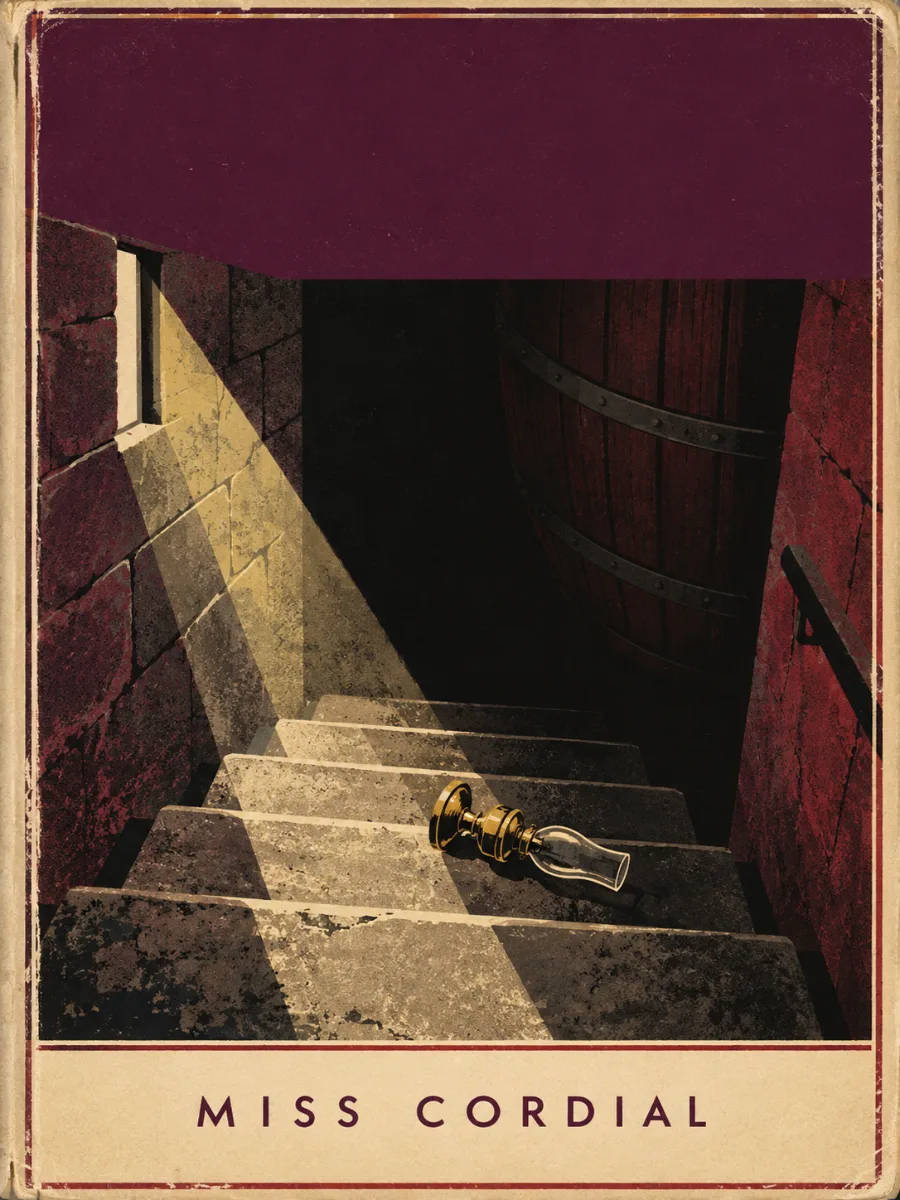
On the fifth step there was a brass oil lamp lying on its side.
Valmont squatted down and lifted it delicately with two fingers by the handle. The glass was whole. He tilted it and the oil moved inside with the sound of a full glass.
"It's full," said Olarra.
"It is full to the top, sergeant. And the wick has burned what a wick burns in five minutes."
"Somebody put it out for her."
"Somebody or something," Valmont answered, and put it back where it was.
On that step and the next there were three burnt matches. They were burnt right through, halfway down the stick, and the three of them lay together.
Below, in the beaten earth, the marks read like a line of writing. A pair of small shoes went straight down to the bottom. On top of them, treading on them, a man's boots went down and came up again, and the ones coming up were very close together and very deep at the heel, with the short stride of somebody carrying a weight.
Valmont looked at them for a long while, with his hands behind his back, and said nothing of what he was thinking. Sergeant Olarra looked at the same marks beside him and breathed through his mouth.
On the stair post there was an esparto rope coiled in a figure of eight. It was one handspan short of dry: the end was dark, wet and had earth stuck to it.
"Sergeant, whose rope is that?"
"The house's," said Efrén from behind. "It never leaves that post. You tie it round your waist to go down and clean the vats inside, and whoever goes down always has somebody up top holding on."
Valmont went down the three steps he had left and reached the floor of the cellar, and the moment he had both feet down there it seemed to him that the whole place was pressing on him. The carbide lamp, which above had given a white light, burned low and yellow down there. His heart began to knock in his throat in a way he found deeply disagreeable.
"Monsieur," said Efrén, "you don't stay down here."
"Only a moment."
Beside the big vat, two paces from where Mercedes Reinares must have fallen, a flagstone was missing from the floor.
It had been lifted and stood on edge against the wall, and beside it, in the earth, lay a carpenter's chisel with the handle turned upwards. In the hollow, half buried and with its lid towards the ceiling, could be seen a tin box the size of a biscuit tin.
Valmont crouched down, and did not get up again as quickly as he had crouched.
First the Lamp Goes Down
Chapter 3
III
The box was opened on the kitchen table, in front of six people and two guardias, and inside there was nothing worth four pesetas.
There was a steamer ticket from Vigo to Buenos Aires, third class, in the name of Mercedes Reinares Otazu. There was another exactly like it in the name of Tobías Ibarreta Sáiz. Neither had been punched and both had the same date printed on them, a date of twenty-three years before. Underneath there were eight hundred pesetas in old notes, tied with a bootlace, and a horn-handled clasp knife with worn scales.
For a good long while nobody touched anything.
"I know that knife," said doña Práxedes.
"Whose is it, madame?"
"The boy's." The old woman did not put out her hand. "I saw him cut bread with it two hundred times at this very table."
Olarra turned the notes over with a pencil and left them as they were.
"Buried under a flagstone," he said. "And what do we call this?"
"This is called the luggage of a woman who never left," Valmont answered. "She put it there twenty-three years ago and came back for it last Thursday. It is the only thing she came to this house for."
Bruna Reinares got up from her chair and went out of the kitchen.
He found her in the yard, beside the trough, with her arms folded and no coat on, and he stood a long while beside her without saying anything to her. It was cold and evening was already coming down over the sierra.
"Give me the letter, mademoiselle."
Bruna did not turn round.
"What letter?"
"The one you took out of the right-hand pocket of her coat on Saturday morning." Valmont took out his handkerchief and wiped his hands. "You came down at a quarter to six, by your own account, and you did not cry out until half past. You were alone with your sister for three quarters of an hour, mademoiselle. The pocket had been turned inside out, and a woman does not turn her own pocket inside out in order to die."
"Anybody could have done that to her."
"They could. But whoever turned that pocket out left the ring, the watch and the purse, so they were looking for one particular thing and knew what it was. There is one person in this house who could have known. And that person has not slept since Saturday." He put the handkerchief away. "I am asking you before I ask the sergeant. It is all I can do."
Bruna put her hand up inside her sleeve, took out a paper folded in four and gave it to him without looking at it.
It was half a sheet of exercise-book paper, in the large round hand of a girl who writes slowly so that it will come out well.
Father: Mercedes is going away tonight with Tobías, the cooper's lad. They are going on the five o'clock bus. I have not told anybody. Bruna.
"I was fifteen," she said.
"So I see."
"I sent it to the inn at Solmena, which was where my father put up for the fair, by the baker's boy and two reales." Her teeth were chattering and it was not from cold. "My father came back that night. And in the morning the lad was in that trough, there where you have your hand, and my sister had gone."
"And what did you believe?"
"What was I to believe? The same as I have believed for twenty-three years." Her voice broke for the first time. "That my father killed him, and that he killed him because I wrote that letter, and that if I had held my tongue that boy would be alive and my sister would have come back at Christmas."
"And why did you take it out of her pocket?"
"Because she had kept it." Bruna looked at Valmont at last, and she had the face of a woman of sixty. "Twenty-three years in a drawer, in another country, and she brings it back. On Thursday she showed it to me and said: tomorrow you and I will talk. And on Saturday she was dead on the floor of the press hall. Tell me what you would have done."
"The same, very probably," said Valmont. "And I should have been just as wrong as you."
Doña Práxedes received him for the second time that day, with the rug over her knees and the lamp already lit.
"Sit down, this is a long story."
"I have all night, madame."
"It was the fourteenth of October." The old woman said it as one gives a date of birth. "The mule boy found him at seven in the morning, face down in the trough, with his best clothes on. There are two handspans of water in that trough, monsieur, and in summer not even that."
"A man drowns in two handspans of water if he is unconscious."
"That is exactly what my brother said." Doña Práxedes smoothed the rug. "Don Anselmo came, who was the doctor in those days and had been forty years in the village, and he spent a proper while with the body. And then he stood up and said something in front of me that I have not forgotten. He said: this boy has no water in his chest."
Valmont went very still.
"And what did your brother answer?"
"He answered that he should write it down and go home. And don Anselmo wrote it down and went home, because he owed my brother for the mending of his roof and because that is how things are done in villages." The old woman raised one finger. "Drowned. There it is written and there it will stay."
"And your niece?"
"My niece took the five o'clock bus in the morning, two hours before the body turned up." She fell silent. "That is why nobody in this house has spoken of it in twenty-three years. Because she left first. And whoever leaves first no longer needs anybody to accuse them."
"Madame, did your brother go down to the cellar in October?"
Doña Práxedes looked at him as though he had asked her the time in the middle of a funeral.
"And what has that to do with it?"
"I don't know yet. Do me the favour."
"My brother never again went down to that cellar alone in October in the whole of his life." The old woman frowned. "Neither he nor anybody in this house. With the light in front and another man behind holding on, and as little as possible. He gave the order that same autumn and he said it once, and in this house once was enough. I always believed it was because of the boy, so as not to tread where—" She stopped. "Out of respect, that is. So as not to go making merry with a recent death."
"And did he ever explain why?"
"My brother did not explain. My brother gave orders."
Higinio was called into the kitchen at eight, and Valmont asked the sergeant to let him begin.
He put three things on the table: the esparto rope, the brass oil lamp and his own valuation notebook, open at the page for the cellar.
"Monsieur Reinares, in the earth of your cellar there are two sets of marks. One is of a woman's shoes going down and never coming up again. The other is of a man's boots, size forty-four, going down with a normal stride and coming up with a short one, driving in the heel." Valmont turned the notebook towards him. "You take a forty-four. The rope has a handspan of it wet and dirty, and it has not rained for three days. Your sister has two bruises under her arms."
Higinio was staring at the lamp and not touching it.
"I am going to ask you one single thing and I beg you to answer me. Did you bring her out of the cellar?"
"I brought her out."
Sabina, who was in the doorway with a cloth in her hand, shut her eyes.
"Tell me about it."
"I went down and she was at the bottom, next to the flagstone, face down." He spoke looking at the lamp. "I spoke to her and she didn't answer me. I turned her over and her face was cold already. And I wasn't going to leave her there, monsieur, on the ground, with the must overhead making that noise. I took her under the arms and dragged her up the eight steps and put her in the press hall, on the clean floor."
"At what time?"
"At a quarter to six. Thereabouts."
"At a quarter to six your sister Bruna was already in the press hall with the body," said Valmont very gently. "And at a quarter past six Efrén Bidaurre found the cellar door standing wide open and barred it."
Higinio did not answer.
"Why did you not say so on Saturday morning?"
"Because the moment you say that, everything else is said as well."
Olarra got up from the table and settled his belts, and it seemed to Valmont that he had spent two days waiting for that moment.
"Higinio Reinares, you are coming with me to Solmena."
"Sergeant—"
"Monsieur Valmont, this man loses the house if his sister is paid out, this man was with the body before anybody else, this man moved it, shifted it and hid it, and this man has lied to me twice in two days." Olarra picked up the oilcloth folder. "With that, I have no more thinking to do."
"Ce n'est pas possible."
He said it in a low voice and almost to himself, and it was the only thing he said in his own language the whole time he was in that house.
"Talk to me in Christian," said Olarra.
"Forgive me." Valmont put his handkerchief away. "Sergeant, if you take him away tonight, tomorrow that man will sign whatever is put in front of him. He has not slept for four days. Give me until tomorrow afternoon."
"No."
Sabina Ozcoz dropped the cloth and put herself in front of the door.
"My husband went down to bring her out because she's his sister. Anybody would do that."
"Anybody would say so, señora. He did not say so."
Valmont went out into the yard while they argued inside.
It was dark and there was a dry cold. He struck his lighter and knelt down in front of the heap of vine prunings. He moved them aside with both hands, in no hurry at all, until he had the stone in view.
The air hole was a handspan and a half across. Around the opening, driven into the wooden frame, there were four holes. All four were empty and in all four the wood at the bottom was pale and clean, the colour wood has when it has just been split.
From one of them hung a thread of sacking.
Valmont stood up, brushed off his knees and wiped his hands with his handkerchief for a great deal longer than was necessary. Then he went back into the kitchen, where the sergeant already had Higinio on his feet.
"Sergeant, do me one last favour before you take him."
"Say it."
"Come down to the cellar with me." Valmont smoothed his moustache with the back of his thumb. "And have somebody bring me a candle and one of the poles you beat the olives with."
First the Lamp Goes Down
Chapter 4
IV
They all went down as far as the cellar door, and it occurred to nobody to ask why.
Valmont went in front with a three-metre beating pole. Behind him, Sergeant Olarra and his two men, and behind them Higinio without handcuffs, and Sabina glued to her husband, and Bruna, and Efrén, and at the end doña Práxedes on the child's arm. Doctor Loza arrived when they were all there already and stayed on the bottom step of the outside staircase, with his bag in his hand, not knowing what he had brought it for.
Valmont tied a candle to the end of the pole with two turns of twine. He lit it, and the flame went up straight and yellow in the still air of the courtyard.
"Sergeant, would you do me the favour of drawing the bar?"
Olarra drew it. The door opened on the black staircase and up out of it came the sweet smell and the small noise of the must, which that night could be heard more than ever.
Valmont put the pole through the opening and lowered the candle step by step, very slowly, counting them aloud so that everybody should count with him.
"One. Two. Three."
The flame was still straight.
"Four."
The flame shrank, turned blue at the bottom, stretched once and went out.
No draught put it out, because there was no draught. It went out on its own, in the way a candle goes out under a glass.
Nobody said anything. Sergeant Olarra took half a step back instinctively, without noticing that he had.
Valmont raised the pole, lit the candle again in the courtyard, and the flame caught first time and stood straight and still. He lowered it again. At the fourth step it went out in exactly the same way.
"The must eats the air," he said, and drew out the pole. "It eats it while it ferments and gives back another that is no use. That other air is heavier than ours and does not rise: it stays down there, lying on the floor, like water in a cistern. At this moment, in that cellar, there is a metre and a half of something that cannot be seen, makes no sound and smells of nothing, because on top of it everything smells of fruit."
"On Saturday I went right down to the bottom," said Valmont, "with the door open since midday, and I was there half a minute and came up with my heart bolting. Today the door has been shut since yesterday. That is why today it goes out on the fourth step and on Saturday it would not have gone out until the sixth."
"That would kill a man," said Efrén, very low.
"That kills a man in three minutes, and he never knows it. First his light goes out and then he goes out. That is why the lamp goes down first and the man afterwards, madame," he added, and turned to doña Práxedes. "And that is why in October one does not go down. Your brother knew it perfectly well. What he never did was say why."
"And the cat won't go down either," said Nieves, very quietly.
"The cat won't go down either, mademoiselle. The cat is the only one in this house who does not need to have it explained to him."
The old woman had both hands on the head of her stick and did not answer.
"Let us go to the kitchen," said Valmont. "This is told sitting down."
They all sat round the table except Valmont, who stayed standing with his back to the fire and the three things in front of him: the lamp, the rope and the open tin box.
"Señorita Mercedes went down to that cellar on Friday night, alone, at half past one or two. She went down to fetch this out," he said, and put a finger on the box. "She buried it at twenty-one and came back for it at forty-four, and she had one night only, because on Saturday morning I was going down to measure the vats and look at the floor. I said so myself at this table, in front of her and in front of all of you."
He wiped his hands with his handkerchief and went on.
"She took the lamp off the hook in the kitchen and the chisel off the carpenter's bench, and drew the bar, and went down. On the fifth step her lamp went out. There it is, full of oil to the neck and with a new wick in it."
He lifted the lamp by its handle and set it down again.
"And then she did what any of us would have done. She struck a match. It went out. She struck another. It went out. She struck a third. All three are down there, on the same step, burnt halfway down the stick." Valmont looked at those who were sitting, one by one. "You would have gone up. She did not go up, because she did not know. This woman left here a week before it was ever said in this house that in October one does not go down. She is the only person in the world that rule never reached."
Bruna covered her face with both hands.
"She went down the three steps she had left in the dark, counting them from memory, and reached the floor. And on the floor, gentlemen, the bad air came up over her head. She had time to kneel, to get the chisel into the joint and to lift the flagstone with her hands, and that is why she has earth under all eight nails. She fell face down beside it. My belief is that she never knew she was dying."
"And who killed her?" Olarra asked.
"Nobody killed her, sergeant. I have been wanting to tell you so for two days and I could not, because until this afternoon I had no candle."
The sergeant opened the oilcloth folder and shut it again.
"Everything that looked to you like a crime was done after that woman was dead," Valmont went on. "And it was not done by one person. It was done by four, and not one of the four knew what the other three were doing. That is what has kept me standing in front of that door for two days."
He leaned on the back of an empty chair.
"I never ask myself who could have done it. I ask myself what sort of person did this in precisely this way. And here the sum would not come out, because here there are four ways of doing things and they are nothing like one another."
He raised one finger.
"Somebody drags a body up eight steps by the armpits, which is a brutal thing, and then lays it on its back on the clean flagstones and puts its hands at its sides. The one who does the brutal thing and the one who arranges the hands are the same person and are two different people. That is a brother. And that brother has spent two days grey in the face and being sick in the yard, sergeant, and you and I have been reading it as remorse. It is not remorse. It is the same air, in a small dose."
Higinio had his eyes fixed on the table.
"Somebody, twenty minutes later, turns one of her pockets inside out and does not touch the ring or the watch or the money she had on her. That is not a thief. That is somebody who knew what paper they were looking for, because it had been shown to them the night before."
"It was me," said Bruna, without uncovering her face.
"Somebody, at a quarter past six, sees the door open, does not look inside, bars it and goes off for the pickers to gain a morning. That man is not thinking about a corpse. He is thinking about a hundred and thirty cántaros of wine and about Monday."
"And that's me," said Efrén.
"That is you, and you will answer for it in Solmena, which is where it belongs." Valmont raised a fourth finger. "And the fourth is still missing. The fourth touched neither the body, nor the pocket, nor the door. The fourth went out into the yard one night with a pair of pincers to pull a board off a wall."
Sabina Ozcoz got up from her chair so fast that she knocked it over.
"Señora, do me the favour of sitting down."
"I haven't pulled anything off."
"The board is among the vine prunings, with the sacking still nailed to it and the four nails bent," said Valmont, and he did not raise his voice at any point. "In the frame of the air hole there are four holes and the wood at the bottom of them is pale. That board was put up three or four months ago and taken off the night before last."
The woman stayed on her feet, with her hands hanging.
"Last year your daughter spent eight days being sick, with migraine, and don Fermín told you it was the smell of the must and that you should take her out into the country," Valmont went on. "The child sleeps over the yard. And the air hole of the cellar opens on to the yard, under her window."
"I covered it in July," said Sabina.
"With a board and a sack."
"With a board and a sack." The tears began to fall, and she went on standing there and did not wipe them. "So that the child wouldn't be ill again. That is all I did. A hole a handspan and a half across in a wall of my own house."
"And through that hole a handspan and a half across the cellar breathed," said Valmont. "Sit down, I beg you. Not one of us here would have done anything else."
Sabina sat down and began to weep on the table, and her husband put a hand on her back and left it there.
"There is one last thing," said Valmont, "and it is from twenty-three years ago."
Doña Práxedes raised her head.
"On the fourteenth of October a young man of twenty-four who was about to leave for America went down to that cellar to fetch a tin box that was buried under a flagstone. It was October and the must was fermenting, and in those days there was no rule and nobody had told him either."
Nobody in the kitchen was breathing.
"Señorita Mercedes found him down there. She dragged him up, exactly as her brother dragged her up on Saturday, and came out into the courtyard with him in her arms, shouting. And your father came down into that courtyard and saw what there was: a dead man, a daughter with her case packed, and a cellar that had just killed a man."
"And he put him in the trough," said Bruna.
"He put him in the trough. That is why don Anselmo said in front of this lady that the boy had no water in his chest, and that is why he wrote it down and did not press the matter." Valmont made a very short pause. "And he told his daughter that the Guardia Civil would say it had been her, and that there was no way of proving otherwise, and that she should take the five o'clock bus."
"And why?" Bruna asked. "Why did he tell his own daughter that?"
"Because a cellar that kills a man is worth nothing, mademoiselle, and everything this house had was sunk in that cellar." Valmont looked at the valuation notebook, still open on the table. "Your father chose. And afterwards, so that it should not happen again, he forbade going down in October, and he never explained why, and so you all obeyed for twenty-three years. It worked, gentlemen. It worked on everybody except the one person who was not here."
Doña Práxedes passed her handkerchief under her eyes, once only, and put it away again.
"Sergeant," said Valmont, "write down accidental death and sleep well."
Olarra took a good while to answer. Then he took out his pencil and wrote three words.
The house emptied slowly. They took Sabina off to bed, and Bruna went out after her aunt, and the two men put out the lamp in the courtyard.
Valmont was left alone in the kitchen with Higinio Reinares, who had not moved from his chair.
"Monsieur, I have one question left and it has nothing to do with the sergeant."
"Ask it."
"You went down to that cellar with a candle and with a rope tied to the post." Valmont sat down opposite him, for the first time since he had come to the house. "A man who wakes up and finds his sister missing runs down in the dark shouting her name. He does not tie a rope round his waist. A man who ties a rope round his waist already knows what he is going to find, and has known it for some time."
Higinio was looking at the brass lamp on the table.
"I saw the light under the door from my window," he said.
"At what time?"
"Getting on for two."
"And you went down at ten past five?"
"At ten past five."
Valmont said nothing. Outside, the must could be heard.
"Three hours," said Higinio. "I sat on the edge of the bed for three hours, with my boots on. And I'll tell you the truth, monsieur, because it makes no difference now. I never once thought about the air. I thought she was down there rummaging and that she was going to take whatever it was, and that once she had it she would go, and that if I didn't go down she might leave this house and never come back."
"I see."
"And I went down when it was getting light because I couldn't stand it any longer." His face moved once and then was still. "Three hours. How long do you think a person lasts down there?"
"Three minutes," said Valmont.
And he added nothing, because there was nothing to add and because it seemed to him that the man was going to have to live with that sum until the end, and that he needed no help whatever in doing it.
He left the next day on the eleven o'clock bus.
He left the nine sheets of the valuation on the dining-room table, with the vats, the threshing floor, the roof, the two yoke of oxen and the cellar, each with its price beside it. He gave Bruna Reinares back half a sheet of exercise-book paper folded in four and told her it was hers. And to doña Práxedes, who walked him to the gate leaning on her stick, he said one more thing, which had no bearing on anything.
"I announced at that table that on Saturday I would go down to look at the floor, madame. Your niece had one night."
"You weren't to know."
"No, madame. I was not to know." He put on his hat. "That is what is always said in this house."
From the crossroads, while he waited for the bus, the courtyard of the Anzuela press house could be seen over the wall.
The cellar door stood wide open, and had stood open since dawn, and in the yard wall the opening of the air hole was clear of vine prunings. Higinio Reinares appeared in the courtyard with a lighted candle in his hand. He stopped at the top of the steps, put it in front of him, and went down the first step very slowly, watching it.
Valmont stood watching him go down until the bus came.
The end
First the Lamp Goes Down
What did this story leave you with?
Read next