Three Things Put Straight
A landslip cuts off a house on a mountain pass with seven people inside it and twelve degrees of frost. In the morning the mistress of the house is found dead in the conservatory, sitting in her chair, and nobody has come in or gone out all night. Aristide Valmont, a court-appointed expert whom the snow has turned off his road, stands looking at three things somebody put straight that did not need putting straight at all.
Three Things Put Straight
Chapter 1
I
The motor car stopped half a league short of the pass, in front of a wall of snow that stood higher than its bonnet.
"This is as far as I go," said the driver. "As far as I go, and we won't argue about it, because I have a wife."
Aristide Valmont got out and stood a good while looking at the road. The snow had come down off the bank in a single block, cleanly, as though somebody had cut it out with an enormous spade. On the other side the road went on climbing among the pines, very white and very still.
"How much further to the house?"
"Twenty minutes on foot. Less, if you weren't carrying that case."
He was carrying a case, and he carried it himself, changing hands every fifty paces. Halfway up the hill he came level with a heavy-set man walking ahead of him with a doctor's bag.
"I've been hearing you puff since the bend down below," the man remarked. "Roine. Doctor, from Betanes, at your service."
"Valmont. And I've been puffing for years, don't be alarmed."
The doctor looked at him sideways without breaking his stride.
"You're not from here."
"From Neuchâtel. Switzerland."
"Well, you speak better than half of Betanes."
"I've had thirty years of practice. At the beginning it showed in my r's." Valmont changed the case to his other hand. "Now it only shows in my being too polite."
"They'll take that for something else round here."
"I know. I generally make use of it."
"Are you going up to the Vallongo house? There's nothing else to go to along this road."
"I was going to Sarnia, to value a house. Now, evidently, I am going to the Vallongo house."
The doctor laughed briefly and without conviction. His face was flushed from the climb and he had several days of untidy beard.
"It's not a bad place to be shut up in, I assure you. The food is better than at the hotel in Sarnia." He passed his handkerchief across his forehead. "I'm going up for the old lady. Neuralgia. Forty years of neuralgia and not one day of silence."
"It's cold."
"It'll be colder tonight. They have a thermometer on the terrace of the house, and in January it drops below twelve under zero without any trouble." The doctor pointed at the sky with his bag. "And it's clearing tonight, which is the worst of it."
They arrived with the last of the light. The Vallongo house was long and low and set hard against the hillside, with its shutters painted a green that had once been dark. At the right-hand end, built on to the main body of the house, there was a conservatory of iron and glass, the whole frame of it furred with frost on the inside.
The door was opened by an old woman with white hair pinned back very tight.
"Doctor." And then, in the same tone: "And you."
"This gentleman was passing through and found the road cut," said Roine.
"I know that; we saw him from the window this morning. Come in, both of you, do me the favour, the whole house is getting cold."
Her name was Ramona Casal and she had been, as Valmont learned somewhat later, forty years in that house. She installed him in a room on the first floor, opened the window a finger's width and shut it again at once, moved the washbasin to another place and carried off a towel that had been carefully folded.
"Dinner is served at eight," she announced from the door. "Señorita Emilia is not in the habit of waiting for anybody."
The lady was Emilia Sarrión and she waited for nobody. When Valmont came down she was already sitting at the head of the table with an account book beside her plate. She was a woman of forty-odd, with a dry face and very still hands.
"You'll forgive the house," she said. "It is cold, it is old and there's no help for it."
"It is very kind of you to take in a stranger."
"It isn't kindness, it's simply arithmetic. There is nowhere else to put you."
Seven people dined. Valmont classified them as they spoke, which was his method and had served him well. On Emilia's right, a man of forty-something, handsome in a spoiled sort of way, whose name was Damián and who was her cousin. Opposite, Renata Oyón, who managed the house, who had come from the city with Emilia and who ate without lifting her eyes from her plate. The doctor. A very young girl who waited at table and was called Ada. And Ramona, who at no point ever quite sat down.
"And Señora Adela?" the doctor asked.
"Upstairs; she slept badly enough," Ramona answered. "I took her up some broth at six and she took the whole of it."
"I'll go up and see her after dinner."
Emilia closed the account book and left it on the table, to one side of her plate, squared with the edge.
"Since we are all gathered together," she went on, "and since evidently nobody can leave this house, tonight seems to me as good as any other. I have sold the house."
Nobody uttered a single word for a good long while. Ada stood frozen in the middle of the dining room with the gravy boat still in her hand.
"Have you sold it," Damián asked at last, "or are you thinking of selling it?"
"The deed is signed on the fourteenth of next month. It's the same thing."
"It is not the same thing, Emilia, and you know it perfectly well."
"For the lot of you the fourteenth and today are the same thing."
Damián leaned back in his chair and laughed at the ceiling. He had helped himself to wine three times and the bottle stood a good deal nearer to him than to the middle of the table.
"And us, Señorita?" Ramona asked.
She asked it from behind, without stopping clearing the table, in an entirely ordinary voice. It seemed to Valmont the only reasonable question that had been put at that table.
"You will have whatever is legally yours. I went over it slowly with the notary in Sarnia."
"I wasn't asking what is legally mine."
"I know what you were asking me, Ramona."
The conversation broke off there. Renata mentioned the price of firewood that winter and the doctor was visibly grateful and seized on it, and for twenty minutes they talked about firewood with an interest neither of them had. Valmont ate slowly and took the opportunity to study the dining room.
It was a house where everything was in its place in an almost irritating way. The pictures perfectly straight. The cutlery the same distance from the edge. On the chimneypiece, three candlesticks arranged by height. On the back of the sofa in the drawing room, folded in three, a tartan rug that nobody used.
"Do you like the house?" Renata asked him.
"I'm more interested in whoever looks after it, if I'm to tell you the truth."
"Ah, that's Ramona." She lowered her voice unnecessarily, since the woman in question was in the kitchen. "She brought the two of them up, did you know? Señorita Emilia and Señor Damián. One would reasonably suppose that counted for something in this house."
After dinner Doctor Roine took a little brown glass bottle out of his pocket and left it on the hall table while he put on his jacket.
"Ramona, would you get me a glass of water, please?"
"The drops again, doctor? Last time she was dazed for two days."
"Again. Ten drops in water, when she goes to bed, and not one more, because the lady is past the age for this sort of thing."
"I know perfectly well how drops are given."
"I know you know, woman. I say it for the sake of saying something."
Valmont watched the whole operation from the armchair. The doctor measured the dose, counted aloud to ten and stoppered the bottle carefully. The manager took it away afterwards, and Valmont heard a key turn in the cupboard in the passage.
At a quarter to eleven Emilia got up with the account book under her arm.
"Good night, everyone. I shall be in the conservatory, as always."
"That place is freezing, Emilia," said Damián.
"It's quiet, which is a different thing and suits me better."
Ramona appeared from the kitchen with a cup on its saucer, without anybody having asked her for it.
"The camomile," she said. "With honey, the same as every night for the last twenty years."
"Thank you, Ramona."
It was the last thing Valmont heard Emilia Sarrión say. She crossed the dining room with the cup in one hand and the book in the other, and said good night to nobody else.
A little later Ramona passed in front of him with a cloth and wiped a damp mark off the tablecloth, and on her way took Valmont's glass, which still had wine in it.
"You'll excuse me," she said, and did not bring it back.
"Not at all. I clear away what I shouldn't, myself."
"And that door." She pointed with her chin towards the end of the passage. "Three weeks I've been asking for that door to be mended and there it still is. It doesn't shut. The air comes in underneath and it complains all night long."
"The conservatory one?"
"The conservatory one. Here things get asked for over three weeks and after that there's no need to ask for them at all."
Valmont went up to bed at half past eleven, tired from the journey. In the passage he met Ada coming down with a candle, who wished him good night twice over. He heard a door close on the ground floor. He heard the wind, which did indeed complain.
He slept badly, as he invariably slept away from his own house.
The scream came at twenty past seven in the morning.
It was a short scream, without words, and it cut itself off. Valmont was already dressed, because he had the habit of dressing completely before knowing what for. He went down and followed the others to the end of the passage, where a glazed door gave on to the conservatory.
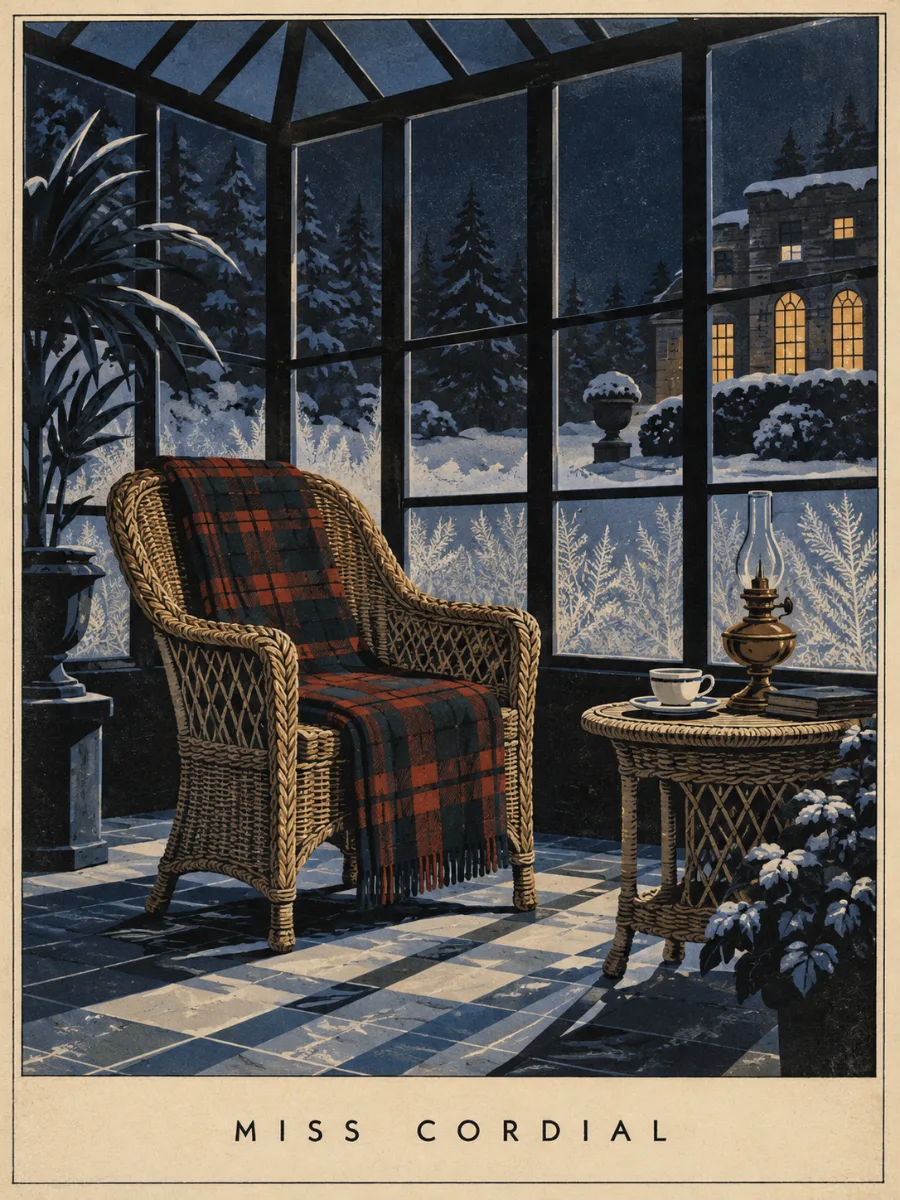
Inside it was as cold as out. The door on to the terrace stood wide open and the snow had come in as far as the middle of the room, in a thin rippled tongue, exactly like sand.
Emilia Sarrión was sitting in the wicker chair with her back to the door.
"Don't any of you touch her," the doctor ordered.
Nobody was touching her. Ada was still nailed to the threshold with both hands over her mouth. Damián appeared barefoot, in his shirt, and stopped dead three paces from the chair.
The doctor lifted her chin with two fingers and left it as it had been.
"Hours ago," he said. "In this cold I can't tell you how many."
Valmont did not move from where he stood. From there he could see three things, and he looked at them in order, unhurriedly, while the others talked around him.
He observed the standard lamp beside the chair, switched off, with its greenish porcelain shade and its flex hanging down. He observed the account book fallen face down on the floor and a shoe beside it, as though the foot had come away from it very slowly. And he noticed that on the dead woman's skirt, in among the folds, there was a very fine dust of snow that nobody had touched yet.
Because on top of the skirt, covering her from the shoulders to the knees, there was a tartan rug.
"At least she didn't die uncovered," Ada whispered, and burst into tears.
Ramona took her out of there without saying a word, with a firm hand on her back, and carried her straight off to the kitchen.
Doctor Roine crouched down beside the chair again. He put his face close to the dead woman's mouth, stayed like that a second longer than he needed to, and got up with difficulty, leaning on his knee.
"What is it?" Damián asked.
"Nothing is the matter, Damián."
"You smelled something, doctor. I saw your face."
"And I have answered you that nothing whatever is the matter."
Valmont then took the first step he had taken since coming in. He went to the little table on the far side of the chair and bent over it with his hands behind his back.
On it there was a saucer, and on the saucer a cup.
It was clean. Perfectly clean and perfectly dry, and to Valmont, who had spent thirty years valuing the belongings of the dead, that cup seemed the most inexplicable object in the room.
He shut the terrace door himself. It cost him a good deal of effort, because it did not in fact fit.
"Doctor," he said. "Would it be too much trouble to ask you to go up and fetch your bottle?"
Roine took eleven minutes to come back. When he came back he had the brown bottle in his hand and a different colour in his face.
"It was where it was supposed to be," he answered. "Locked up, in the cupboard in the passage, exactly where Señorita Renata left it."
"Well?"
The doctor held the bottle up to the light and turned it very slowly. The liquid moved down there, almost at the bottom of the bottle.
"And last night I gave ten drops to an old woman," he concluded. "There's half a bottle missing here."
Three Things Put Straight
Chapter 2
II
They moved Emilia Sarrión's body into the cold larder, which was the only reasonable place, and Doctor Roine locked the door with a key which he then left on the chimneypiece, in full view of everybody.
"Somebody will have to inform the Guardia Civil," he remarked.
"Somebody will have to reach Betanes first," Damián answered. "I don't propose to try it in this snow."
"Nobody is going to try it," Valmont put in. "And since nobody is going to try it, we have two fairly long days ahead of us. If it seems reasonable to you, I shall speak to each of you separately."
"And who exactly are you?" Renata asked.
"Aristide Valmont, court-appointed expert. Thirty years on the standing lists of three courts. When a magistrate needs somebody from outside to say what has happened to a house, or to a fire, or to what a dead man leaves behind, they send for me."
"That gives you no authority here."
"None at all, mademoiselle. I am a gentleman who arrived yesterday and did not know the deceased. In this house that is very nearly a virtue."
Nobody argued. Valmont installed himself in the library, which was the warmest room on the ground floor, and received them in whatever order took his fancy, which was neither alphabetical nor the order of the staircase.
The library had its walls lined with books nobody had opened in twenty years, arranged by size, and it smelled of damp and old ashes. Valmont drew two armchairs up to the window. Whoever sat opposite would get the blinding whiteness of the snow full in the face. It was an old and fairly disloyal procedure, and it had been useful to him for thirty years.
Damián Sarrión came in first and sat down without being asked.
"Last night you went to bed at what time?"
"At one, more or less. Perhaps a quarter past one, I couldn't say exactly."
"And what were you doing between eleven and one?"
"Drinking, monsieur Valmont, as everybody knows. It is what I always do between eleven and one."
"Alone?"
"Entirely alone. That too is a fairly settled habit."
Valmont wiped his hands with his handkerchief, carefully, although they had been perfectly clean since breakfast.
"Your cousin had sold the house," he said. "You live here."
"I lived here. Now I don't live anywhere."
"And did that strike you as equitable?"
"It struck me as very like her. Emilia was always right, do you understand? She was right in an unbearable and meticulous way, and she was right last night as well, and now she is in the larder, very cold and very quiet."
"You were fond of her."
Damián looked at him for a very long moment and then laughed, without any pleasure.
"I was terrified of her," he answered. "Which lasts longer."
When he had gone, Valmont sat still for a good while. Along the passage a pair of footsteps went away in no hurry at all.
Renata Oyón came in next and remained standing until Valmont pointed her to the chair.
"You keep the accounts of the house."
"I've kept them for four years, and I keep them well."
"Last night Señorita Emilia had the account book on the table throughout dinner, and she took it with her to the conservatory. Is that usual?"
"Every night, without missing one. She went over them before going to bed." Renata smoothed a non-existent crease in her skirt. "And yes, monsieur, she was going to audit them. Since you are going to find it out in any case, I'll save you the trouble."
"I'm much obliged to you. What would she have found?"
"Two hundred and forty pesetas a month for fourteen months. My sister is in a sanatorium at Vielsa and it costs exactly that."
She said it with her chin very high and without a tremor, and Valmont thought that woman had spent months rehearsing the sentence in front of a mirror.
"One last thing. The doctor's bottle."
"In the cupboard in the passage, locked. I keep all the medicines since Señorita Emilia asked me to."
"Why did she ask you to?"
"Because she didn't trust Señor Damián with a bottle of anything." She got up without being dismissed. "I have the key, monsieur, and the cupboard was locked this morning. Make what you like of that."
The manager shut the door behind her with an exaggerated delicacy which in that house amounted to slamming it.
Doctor Roine sat down heavily, with his knees apart, and spent a good while looking at his own open hands before he said anything.
"You smelled something this morning," said Valmont.
"Chloral hydrate. On the breath, unmistakable. It's a sweetish smell, something like an overripe pear, and it isn't to be confused with anything."
"And why did you keep it to yourself in front of everybody?"
"Because the bottle was mine, naturally." He raised his eyes. "And because it isn't the first time I've signed something in this house without looking at it too closely."
"Tell me about that, I beg you."
Roine took a long time to begin. When he began, he spoke headlong, like a man going down a hill.
"Eleven years ago the pavilion in the garden burned down. Señorita Emilia's father was inside, don Marcial, who slept out there when he had been drinking. I signed the death certificate without examining the body properly. I wrote asphyxiation by smoke and I went home."
"And was it asphyxiation by smoke?"
"In all probability it was. But I didn't verify it, and that is a different matter."
"What did they give you in exchange?"
"They forgave me a debt of two thousand pesetas, in full." The doctor passed a hand over his beard. "Last night, before dinner, Señorita Emilia asked me about that certificate. Eleven years without a mention of it, and last night she asked me."
Outside, the snowfall had dwindled to a suspended dust that never quite fell. Valmont stood watching it while the doctor gathered up his bag. That house had spent eleven years preserving everything, the way snow preserves footprints.
Ada Mun sat down on the edge of her chair, thoroughly uncomfortable and said yes to everything for five minutes together.
"What time did you go to bed?"
"At eleven, sir. As soon as I'd cleared away."
"And you didn't get up again all night?"
"No, sir. I sleep straight through, always."
"You are fortunate," Valmont observed pleasantly, and asked her nothing more.
The girl went out much relieved, with that disproportionate cheerfulness of somebody who has lied and believes it went well.
Ramona Casal was the last, and she came in still drying her hands on her apron.
"Sit down, madame."
"I'd rather stay standing, if you don't mind. I've spent forty years standing in this house."
"As you prefer. Did you take her the camomile last night?"
"Every night for twenty years. Camomile with honey, as soon as she withdrew."
"And did the two of you talk?"
Ramona stood looking at the window for a good while. Outside it was still snowing very slowly.
"We talked," she answered. "And since we're going to be shut up here, I'd rather tell you myself before anybody else tells you and it comes out worse."
"I shall be very grateful."
"It was Señor Damián who burned the pavilion." She said it in the same tone in which she had announced that dinner was at eight. "He was thirty and blind drunk and he fell asleep with a cigarette. When I got there he was sitting on the grass watching it burn and he couldn't remember his own name."
"And what did you do?"
"I got him into the house, washed him, changed his clothes and burned the ones he was wearing. And in the morning I said he'd been with me in the kitchen since ten." She smoothed her apron with both hands. "And that's what I've maintained for eleven years to everybody who has asked."
"And last night?"
"Last night Señorita Emilia told me she knew. I don't know how she found out, and now I can't ask her. She told me that as soon as the road was open she would go down to Betanes and tell the whole thing."
"And what did you answer?"
"I answered that she should do whatever she had to do." Ramona looked at him straight for the first time. "And then I said good night to her and went to bed, sir, which is what I do every night of my life."
When she had finished she was a good deal calmer. Valmont noticed it at once: her shoulders had loosened and she was breathing differently, like somebody setting down a bundle she had been carrying for too long.
"One more thing, madame. Did you bring Señor Damián up?"
"I brought them both up. Her from the age of six and him from the age of seven."
"I see."
"No, you haven't understood a thing." She picked up from the arm of the chair Valmont's empty cup, which had been there for half an hour, and carried it off without attaching any importance to it. "Both of them, sir. The two of them exactly the same."
Valmont lunched alone and very slowly, thinking about something else, and afterwards stood a long time in front of the drawing-room chimneypiece, straightening a candlestick that was not crooked.
In the middle of the afternoon Ada came looking for him along the passage and spoke to him very fast and very low.
"I didn't want to say it in front of everybody, sir."
"Say it."
"Señor Damián was up until terribly late. I saw the library light under the door at two in the morning, and I heard him open the library fireplace."
"Are you sure of the time?"
"Quite sure, sir."
"That's curious," said Valmont very pleasantly. "Because this morning you explained to me that you slept straight through the night."
Ada went red to the roots of her hair and went off the way she had come, without answering.
Valmont then went to the library and crouched down in front of the fireplace. He stirred the ashes with the poker and brought out three pieces of paper that had not burned completely. On one of them half a date could be made out. On another, half of a recognisable signature.
He sent for Damián and showed them to him without saying anything.
"Letters," said Damián after a moment. "From eleven years ago. Ramona wrote them to the old manager at the time of the pavilion, and the man died, and they came back here in a shoebox. I didn't know they existed until last month."
"And you burned them last night."
"I burned them last night, yes. At two in the morning." A muscle was moving under his eyelid. "Emilia told me after dinner. That she knew. That she would go to Betanes. And I went down and burned the only thing left in writing, and I swear to you that is all I did."
"You told me you went to bed at one."
"I lied to you, naturally. What would you have done?"
Before it got quite dark, Valmont wrapped himself up and went out on to the conservatory terrace through the door that did not shut properly.
The snow on the terrace was untouched, except for a strip close against the wall where the eaves had sheltered it from the wind. There, marked and very clear, were some small footprints going towards the corner of the house and coming back.
He stood looking at them for a good while, with his hands behind his back. Then he measured one against his foot, straightened up and went back inside.
The whole house had turned silent in an unnatural way. Nobody lit the lamps before they needed them. Nobody went up the stairs quickly. And conversations invariably broke off the moment Valmont appeared in a doorway.
That night five people dined and practically none of them spoke. As they got up from the table the doctor blocked his way in the passage.
"It's the nephew," he murmured. "Motive, a lie, and the fire lit at two in the morning. I've seen men hanged for a good deal less."
"Mon Dieu."
He said it very low and in his own language, and it was the only thing he said in his own language all week. The doctor stopped with his hand on the door handle.
"I beg your pardon?"
"Nothing. It escapes me when something really annoys me, and every year fewer things annoy me." Valmont put his handkerchief away. "It is perfectly possible that you are entirely right, doctor."
"But?"
Valmont stopped under the passage lamp and smoothed his moustache slowly with the back of his thumb. He took his time about answering.
"But I am not looking for whoever killed her, doctor, because almost anybody in this house could have done that," he said. "I am looking for somebody who came back afterwards, when she was already dying, and tucked a rug round her."
Three Things Put Straight
Chapter 3
III
He gathered them all in the drawing room after dinner, because it seemed to him the only room with enough chairs.
Ramona lit the fire without anybody asking her to and stood by the door, with her hands crossed in front of her apron. Ada sat on the footstool, very close to her, huddled up. The doctor took the big armchair. Damián stayed leaning against the chimneypiece, and Renata chose the chair furthest away from everybody, which was the one Valmont would have chosen.
"I am going to explain to you what happened last night," he began. "And I am going to tell it in order, because order is the only thing I have."
"Tell it quickly," Damián muttered.
"I shall tell it slowly, monsieur, which is a different thing and suits you better."
He put his back to the fire and took out his handkerchief.
"Are you going to wipe your hands now?" said Renata.
"I am, mademoiselle."
"You've been at it for two days. Every time somebody stops talking, out comes the handkerchief."
"I know." He wiped them slowly, finger by finger, without looking at her. "And nobody in this house likes it, and it does two things for me at once. Sit down, mademoiselle, this is going to take a while."
"First, the established facts. Señorita Emilia withdrew to the conservatory at a quarter to eleven with her account book. Ramona took her the camomile immediately afterwards, as she had for twenty years. At twenty past seven in the morning Ada found her dead in the wicker chair. The doctor calculates that she had been dead two hours, perhaps three."
"Frozen," Roine specified. "She died of cold, not of the chloral, and she died in the small hours. The chloral merely stopped her waking up."
"Just so. Somebody poured four times the dose into the camomile and then opened the terrace door wide. The thermometer on that same terrace stood last night at twelve degrees below zero. That was all that was required."
Nobody said anything. Renata had her eyes fixed on her own hands.
"Second, the anomalies," Valmont went on. "In that room there were four things that had no business being as they were, and I have been looking at them since yesterday."
He raised one finger.
"The lamp was off. Señorita Emilia always worked with a light. Nobody goes over accounts in the dark and nobody switches off the lamp in order to fall asleep in an armchair."
He raised a second.
"The cup was clean. Perfectly clean and perfectly dry, on its saucer. A cup of camomile with honey drunk at eleven does not look like that at seven in the morning. It is sticky and it has a ring. That cup had been washed and put back in its place."
Ada raised her face slowly.
"Third, the rug."
"What about the rug?" Damián asked.
"The rug is everything, monsieur. The rug is this whole business." Valmont put his handkerchief away. "And that rug was not in the conservatory. It was folded in three on the back of the sofa in this room, where it has not moved for years. Somebody came in here to fetch it, crossed the house in the dark with it over one arm and carried it to the conservatory. She was being covered up. Somebody tucked a rug round a woman who was freezing to death."
"She could have covered herself, I should think."
"She could not. And that is the fourth thing. Under the rug, on top of the skirt, there was an untouched dust of snow. The snow came in through the open door and settled on her over a couple of hours. And afterwards, on top of that snow, somebody spread the rug."
The doctor shifted heavily in his armchair.
"Dear God," he muttered.
"Yes. Somebody was in that conservatory while she lay dying. They did not wake her, they did not shut the door, they did not call for help. They tucked her up and went away."
Ramona was still by the door, not moving.
"Third, the psychology," said Valmont. "But first I am going to take off your hands what you have all been carrying about all day, because it is of no use to me and it is spoiling your faces."
He turned to Renata.
"You were diverting two hundred and forty pesetas a month to your sister's sanatorium."
"I've already told you so myself."
"And Señorita Emilia had known it for at least a year." Valmont took a folded sheet from the account book out of his pocket. "She had it noted down here, in her own hand, with the exact sum and one word beside it: leave. She did not intend to denounce you, mademoiselle. She intended to go on leaving it."
Renata stood looking at him with her mouth slightly open and could not get a word out.
"You, doctor, signed a certificate eleven years ago that you should not have signed. It is a disgrace and it is not a murder, and besides, you had no way of knowing she was going to ask you about it."
"I had not," Roine confirmed.
"You, Ada, did not go to bed at eleven. You went out on to the terrace at midnight."
The girl got to her feet all at once and sat down again.
"Your footprints are still there beside the wall, under the eaves. They measure the same as your shoe and they go as far as the corner of the house and come back." Valmont looked at her with real kindness. "On the other side of that corner is the lodge. I have not the slightest interest in the young man's name."
Ada burst into tears for the second time in two days.
"And you, monsieur Damián, burned at two in the morning some compromising letters from eleven years ago, because your cousin had discovered that you were the one who set fire to the pavilion. That makes you a man who burns evidence. Not a man who tucks up his victims."
"And what exactly does that mean?" Damián asked.
"It means that we can now talk about the only question that matters."
Valmont took two steps to the middle of the carpet. Without noticing, he straightened a candlestick on the chimneypiece.
"I never ask myself who could have done it, because last night almost any of you could have done it. I ask myself what sort of person did it in precisely this way."
He was silent long enough for it to become uncomfortable.
"Consider what that person did. They poisoned a cup of camomile and opened a door wide on to the ice. So far they behave like any murderer. But they switched off the lamp on the way out, because they had spent half a lifetime switching off lamps in this house and could not help it. They came back at two in the morning, saw the woman they were killing covered in snow, could not bear to leave her like that and tucked her up. Then they took the cup to the kitchen and washed it, because in this house dirty cups get washed. And when they had washed it they understood that the cup had to be in there, and they went back again, and set it clean on its saucer."
Nobody was moving.
"Three things," said Valmont. "Turning off a lamp, spreading a rug, washing a cup. Not one of the three was needed. Not one of the three would ever occur to a murderer. They are the three things put straight by somebody who has spent half a lifetime putting this house straight."
He put the handkerchief away again.
"And observe the irony. Washing that cup destroyed the evidence of the poison, and turned the cup into the evidence of who had put it there."
Damián moved slowly away from the chimneypiece.
"I am looking for a person who decided to kill and could not stop caring while they were about it. Somebody who did not run, who forced nothing, who accused none of you and prepared no alibi, because none of that so much as crossed their mind. Somebody who switches off, puts straight and tucks up without thinking. Somebody who has been doing exactly that in this house for forty years."
It was then that Ramona Casal moved away from the door.
She crossed the drawing room without looking at anybody, with the short steps of somebody who still has a great deal to do, picked up the coffee cup the doctor had left on the floor beside his chair and set it straight on its saucer. Then she smoothed the table runner, which was crooked.
When she raised her head, the five of them were looking at her.
"The coffee's cold," she said. "Nobody has drunk it."
"Madame," said Valmont very gently. "Sit down, I beg you."
And Ramona Casal sat down, for the first time since he had come to that house, slowly.
"She was going to take him down to Betanes," she said. "They were going to hang him, sir, my own child. I washed him when he was seven years old and taught him to eat with a fork, and she was going to go down to the village and say so."
"I know."
"I washed her too." Her hands were moving on her apron, looking for something to pick up. "That's what none of you understand. Both of them, the same. Last night she told me what she was going to do and I answered that she should do what she had to do, and I took her the camomile, and I had already made it up."
"And you came back at two?"
"I came back at two." Ramona looked at him straight. "She had snow on her, sir. As if she were out of doors."
She said nothing more, and Valmont asked her nothing more.
The snow in the pass took two days to give way. The Guardia Civil came up on Sunday morning with two mules and took Ramona Casal away before midday, and she asked leave to put the kitchen straight first, and they let her.
Valmont walked down to the motor car, which was still where the driver had left it.
Before leaving he went up to the first floor, because it seemed to him the proper thing. In the room at the end, Adela Sarrión was propped up on three embroidered pillows, looking at the window. Her hands lay on the counterpane and she had learned nothing at all in three days, because nobody had managed to shout it at her loudly enough.
"I am leaving, madame," said Valmont from the threshold.
The old woman turned towards the sound and smiled very politely.
"And who is going to bring me up my breakfast tomorrow?" she asked.
The end
Three Things Put Straight
What did this story leave you with?
Read next