Houses Do Not Stretch
Bellabrida is closed off by the fever and the flood has taken the bridge. Doña Casilda Mansilla is dead, and her will reaches the court with a new wafer and one line too many. Aristide Valmont must say whether that line is hers, and he must do it from the far bank of the river, with whatever crosses on Tuesdays and Fridays in the mail basket. The reader is handed the same papers on the same day he is: a sketch plan, six statements nobody could agree on, and a photograph.
Houses Do Not Stretch
Chapter 1
I
The bridge at Sardón had broken at the second arch, and what was left of it was a stone abutment with three bushes growing on top. Aristide Valmont stood looking at it for a long while from the bank. Below, the river ran brown and without a sound, which is how rivers run when they are carrying soil. Above, at the height of a man, a footbridge of rope and planks crossed from bank to bank, with a rope handrail on one side only and a wicker basket hanging from a ring at the exact middle of the span.
"That will hold one man and a sack," said the woman who was carrying his case. "Two men, no."
"I have no intention of crossing it, madame."
"Not that you could. On the other side there is the patrol, and on the other side there is the fever."
Her name was Amadora and she owned the inn, the last house before the river and the first one you saw coming from Sarnia. She gave him the upstairs room. It had a narrow window, and through it nine kilometres of closed valley and a road that climbed to a village he could not climb to.
Right at the top he could make out four roofs and the bell tower, and further to the left, a little apart from the rest, a long house with its front to the south. At that distance it was a pale smudge and nothing more. Valmont looked at it until his eyes tired.
"Is that Bellabrida?"
"That is Bellabrida. Two hundred souls and five dead." She put the case down on the bed and stayed in the doorway. "You are not from here."
"No, madame."
"Nor from Sarnia."
"Nor from Sarnia."
"You can tell by the way you finish your words," she said. "You finish all of them. Nobody here finishes anything."
"I am from Neuchâtel, which is in Switzerland and is of interest to nobody." Valmont set his hat on top of the case. "I have been away thirty years and by now it shows only in that and in my being too polite. Here they will take it for something else."
"Here they will take you for a priest."
"That would be a first."
Amadora went off to light the fire. Valmont unpacked slowly, which was the only thing he had to do until the mail came. He put his four books on the shelf. The magnifying glass and the tape measure on the table; the box of pencils beside the glass. Then he straightened the picture on the wall, which was tilted to the right, and stood looking at it without seeing it. It was a print of a ship. In thirty years on the lists he had gone up into mills, onto scaffolding, down wells and aboard two ships. They had always let him touch the thing he was to speak about. This was the first time he had been given one nine kilometres away.
He washed his hands, dried them, dried them again with the handkerchief he kept in his breast pocket, and went down to wait for the mail.
The mail crossed on Tuesdays and Fridays. A boy from Bellabrida brought it as far as the middle of the footbridge and left it in a basket tied to the rope. From the Sardón bank they hauled the basket across with a line. Then the sack was emptied into a trough. The sheets were pegged out afterwards on a washing line, one wooden peg each, above a tin of sulphur and formalin that was kept burning all afternoon, and there they hung for their two long hours. At the end of the two hours the paper came off yellowed, with the inks run at the edges. The smell stayed on the hands until nightfall.
The clerk of the court of first instance at Sarnia was called Abundio Pampín, was thirty-two years old, and regarded the whole business as a personal inconvenience.
"In normal times this is settled in a morning," he said, taking the sheets down one by one. "You go up to the house, you look at whatever you have to look at, you sign your report and you come back to Sarnia for lunch."
"And in these times, how long does it take?"
"In these times it takes as long as the mail takes." Pampín set the first sheet in front of him. "Tuesdays and Fridays, Señor Valmont. Whatever you ask for on Tuesday reaches you on Friday, and whatever you ask for on Friday reaches you on Tuesday. And on the thirtieth the cordon comes down and that is the end of it."
"And what happens on the thirtieth?"
"The magistrate charges whoever he has to charge, and you and I go home."
The first sheet was the court's instruction, typewritten, with two folds and the stamp run by the formalin.
Court of First Instance and Examination of Sarnia. — Estate of doña Casilda Mansilla Berdún, resident of Bellabrida, deceased on the ninth of the present month.
A holograph will attributed to the deceased having been presented before this Court, and challenged by her nephew don Nicasio Mansilla, who maintains that it is not written in its entirety by the testatrix, don Aristide Valmont, of the standing lists of this Court, is appointed handwriting expert, to the end that he give his opinion as to whether the document is written and signed throughout by one and the same hand, or whether it shows the intervention of another hand.
He is advised that upon the result of his opinion depends the validity of the will, and that, the same being declared void, the succession would pass intestate to the deceased's nephew and niece by blood, don Nicasio and doña Feliciana Mansilla, as next of kin.
The greatest brevity is urged, given the sanitary circumstances.
"The greatest brevity," Valmont read aloud. "Did you write that?"
"I wrote that." Pampín did not apologise. "The magistrate wants the report on Friday."
"The magistrate wants the report before I have seen the house."
"The magistrate cannot see the house, Señor Valmont. Nor you, nor I, nor the bishop. What is at issue here is a handwriting, and the handwriting is on the table in front of you."
And it was true that it was. The will had come on a sheet of deckle-edged paper folded in four. It was written on both sides, in a large sloping hand with a great deal of pressure behind it, the kind that pierces the paper at the accents. Valmont held it up against the light of the window before reading it. Then he read it.
At Bellabrida, on the first of November.
I, Casilda Mansilla Berdún, widow of don Casimiro Sárdoma, being ill but of sound mind, write this in my own hand so that it may serve as my will. I need no notary to say what is mine.
I leave the big house, the mill and the meadows of la Vega to the Sisters of Consolation, on condition that they put in this village a bed and a doctor, for we have been dying forty days without one. If in two years they have not done so, let it all go back to whoever the law says, and let their consciences answer for it.
I leave to Gaudencio Quirós, my gardener, the lower house with its garden, for him and for whoever he wishes after him. He knows why, and he owes no account of it to anybody, and likewise the two (2) meadows of la Vega that are called the upper ones, for having served me so well.
I leave to Benilde Ozores whatever is in the kitchen chest and thirty duros.
To my niece Feliciana I leave my gold watch and my thanks.
To my nephew Nicasio I leave nothing, because he has already been paid in my lifetime and he knows it.
This is what I want and it is written all in my own hand.
Casilda Mansilla Berdún
Valmont drew the table over to the window and laid the sheet so that the light fell across it. That is how the furrows of the stroke show, which is the first thing to look at and the last thing people notice. He took out the magnifying glass. He stayed with it a good half hour, saying nothing, working line by line and going back twice and three times. Pampín warmed his hands at the fire and watched the rain. It was not raining. He was watching the window.
"There are two hands," said Valmont at last.
"We knew that already."
"You suspected it, which is not the same thing." He turned the sheet over and held it out against the light. "Look here. The whole letter is written with an old pen. It leaves the ink heavy at the start of the stroke and dry when it lifts. The whole letter, except one line. The line about the meadows was written with a new pen, with less pressure and more ink. That is why it has run more in the formalin than the lines above and below it. The hand that did it imitates the letters well enough. It copies the spaces badly."
"And is that enough?"
"That is enough for a court, if the man who says it knows how to explain it."
Pampín moved away from the fire. He took out a small black-covered notebook and opened it, and the thing was so quick that Valmont understood he had brought the notebook ready from Sarnia.
"Then give it to me in three lines and I will take it tomorrow."
"No."
"What do you mean, no?"
"I mean no, monsieur Pampín." Valmont laid the magnifying glass on the table, quite straight, parallel to the edge. "Before that I want to know one thing. That line makes a present of two meadows to a man. Who is that man?"
"Gaudencio Quirós, the gardener of the house. Fifty-two years old."
"And?"
Pampín consulted the notebook, although he had no need to consult it either.
"And he did three years in Ocaña prison over a man who was found shot dead on a shoot, twenty-four years ago. And he is the one who brought the envelope down over the footbridge and put it on the table of the court on the twelfth. And he is the only person in that house to whom the paper, as it stands, gives anything worth money."
Valmont did not answer at once. He took the handkerchief from his breast pocket, wiped his fingers one by one and then looked at them, as though somebody had lent them to him.
"Can he read?"
"He signs. Reading, very little."
"Then he did not write that line."
"Nobody has said he wrote it," said Pampín. "If he had it written for him by somebody else, that is forgery already, and if it also turns out that the lady died in a hurry, then you have the other thing as well. The magistrate is quite clear about it and the village is a great deal clearer."
"The village is always a great deal clearer." Valmont folded the sheet along its old folds, without inventing any of his own. "I have signed reports of the kind you are asking me for before. About a burned house, for instance. A report of mine fits into three lines and weighs what a man weighs."
"I do not follow you."
"That is because I am not explaining myself." He put the handkerchief away. "What else is in the sack?"
There was more. Tuesday's sack held nine items and Pampín had pegged them up in order, like washing, one wooden peg each. They all smelt the same. Valmont wiped his fingers before unpegging the next one and wiped them again afterwards, and Pampín had the delicacy to say nothing.
There were three letters from the dead woman. The court had collected them at the house so as to have something to compare the writing with. Valmont read them in the order in which they came tied together.
Nicasio: I have had your letter and I do not intend to answer you about the tenancy. The meadows of la Vega yield what they yielded in your uncle's time and they do not yield one real more, and if they have told you otherwise in Sarnia it is because in Sarnia they lie even to say good morning. It will be four hundred or thereabouts, in a good year. Do not write to me again until Christmas. Your aunt, Casilda.
Señor don Lino: I have been waiting four days for you and you do not come up. I know you have eleven houses and two legs. I am not asking you to cure me, which at my age is foolishness, I am asking you to come up and to be seen coming up, for what the people here die of, above all, is that nobody comes up. They put me out on the balcony to take the sun until it goes, and from the balcony you can see the whole valley. You can see the road, you can see the broken bridge, and you can see who comes up and who does not. Come up on Thursday. Casilda Mansilla.
Dear Ramira: I am ill, but ill of the sort that keeps to its bed, not the sort that keeps to its chair. Nobody here tells me anything and I know everything. Feliciana washes me and combs my hair and sets me straight, and in eleven years she has not said one word to me that was not yes, señora. You see what a comfort that is. Give your daughter a kiss and do not come, for this is no place for it. Casilda.
"She wrote well," said Pampín.
"She wrote very well." Valmont laid the three letters side by side. "And note one thing: there is not a single number in any of the three. Four hundred or thereabouts. Eleven houses. Thirty duros. Eleven years. This lady has written figures out in words all her life, as it used to be done, and she has not put down a numeral even when she was talking about money."
"And what does that mean?"
"I do not know yet." He straightened the letters again, although they were straight already. "What is the last of it?"
The last of it was two small papers. The first was the memorandum of the town clerk of Bellabrida. It said that on the twelfth, at eleven in the morning, there had been received from the hand of Gaudencio Quirós, gardener, a sealed sheet with a wafer apparently recent. That the bearer said it contained the last will of his mistress. And that he had not opened it and would not have known how to.
The second was the notice of the Board of Health. It was printed on bad paper, the kind that drinks the ink, and it carried four numbered articles and an illegible signature at the foot. They had pasted one just like it on the door of the inn and another on the parapet of the bridge. Valmont knew it by heart already, but he read it again, which is a different thing from knowing it.
1. — The boundary of Bellabrida is closed. The mail shall cross on Tuesdays and Fridays and shall be fumigated on the Sardón bank.
2. — Nobody shall drink from the village well, which is to be stopped up. Water shall be taken from the upper spring and boiled.
3. — Upon a death occurring, notice shall be given to the orderly of the Board and burial shall proceed with quicklime within twenty-four hours.
4. — The mattress, the bedclothes and the garments of the sick person shall be burned, and the room in which the same has been shall be washed with bleach.
Valmont read the fourth article twice and laid it on top of the rest.
"Monsieur Pampín, I am going to ask you for something that will strike you as foolish."
"I am expecting it."
"I want a plan of the house."
Pampín stopped with his pen in the air.
"A plan? Señor Valmont, the lady was not killed by a house. What we have here is a line."
"The line was inside an envelope, and the envelope was inside a house that night, and that night the lady died." Valmont got up and went over to the window. From there, in the five o'clock light, he could see the road climbing between the rocks and, high above, four roofs and a thread of smoke. "I want the ground floor, the upper floor, the doors, the windows and the stairs. With measurements, if possible. And I want to know where each of the people who were in that house slept on the night of the eighth."
"That has to be asked for on Friday and it comes on Tuesday."
"Then ask for it on Friday."
The clerk wrote it down, breathing hard.
Downstairs, in the kitchen of the inn, three men from Sardón had been arguing for some time about the business of the Mansilla house. They argued with the confidence that comes of not having been there. One said they would bring the convict down tied. Another said not tied, handcuffed, and he would like to see who got him across the footbridge. Valmont could hear them perfectly from the table.
Pampín came to the end of his list and looked up.
"Now that I think of it, there is going to be a problem."
"Tell me."
"That up there, drawing, drawing properly, only one man can do," said Pampín. "The schoolmaster."
He left on the last bus for Sarnia. Valmont went up to his room, lit the candle and laid the nine sheets out on the bed again, in order of arrival, as the clerk had pegged them up. Then he leaned out. There was no light anywhere in the valley, not on the road, not in the long house at the top, because in villages under a cordon they economise even on paraffin. All that could be seen, far below, was the glow of the tin of sulphur, still burning alone on the bank.
Houses Do Not Stretch
Chapter 2
II
On the Friday it rained in earnest and the mail came in wet. It had to be dried before it could be fumigated and fumigated before it could be read. Not until six in the evening were the sheets on the table. There were fourteen of them. Pampín had come up from Sarnia on the country bus, his boots soaked through and in a considerably worse temper than on the Tuesday.
"I will warn you of one thing before you start," he said. "I have had to fetch this from the bank under an umbrella, and the magistrate has asked me twice about your report."
"And what did you tell him?"
"That the expert wants a plan." He sat down and stretched his legs towards the fire. "The magistrate laughed. He asked whether you would also like a brass band."
"Tell him the plan will do."
On top of everything came a note from the town clerk of Bellabrida, one Ventura Doiro, written in a small cramped hand of the sort that saves paper. Valmont read it slowly and then read it aloud, because it seemed to him the most important thing in the sack and he wanted to hear it.
Señor Valmont: as nobody here may leave his house or come together with anybody, I have done what occurred to me. I passed under each man's door a sheet with your questions, said I would be back in two hours, and in two hours I came back and collected it by the same way. None of them has seen what the other wrote, nor could he, because the houses are far apart and anyone who goes out is taken up by the patrol. I send them to you in the order in which I collected them. The schoolmaster asked me for extra paper for the drawing and I gave it to him.
"Nobody could improve on this," said Valmont. "Do you know what you have here, monsieur Pampín? You have six people who answered the same questions on the same day, at the same hour, without being able to look one another in the face or agree on a single comma. In a court of law you could not get that even by locking the witnesses up."
"And you, with six pieces of paper, are going to know who killed the lady."
"I, with six pieces of paper, am going to know what they cannot all of them be wrong about."
The drawing came separately, on two sheets of deckle-edged paper joined with a strip of paste. It was a painstaking piece of work. It had its title at the top, underlined twice, and at the foot a signature with its flourish. You could see that the man had enjoyed doing it. Valmont set it in the middle of the table and took the magnifying glass and the inkwell off it so that they should not cast a shadow.
SKETCH PLAN OF THE MANSILLA HOUSE, drawn up at the request of the Court by don Amaranto Lastra, national schoolmaster of this town. I state at the outset that I do it by eye and from memory, that I am no draughtsman, and that the measurements are such as seem right to me.
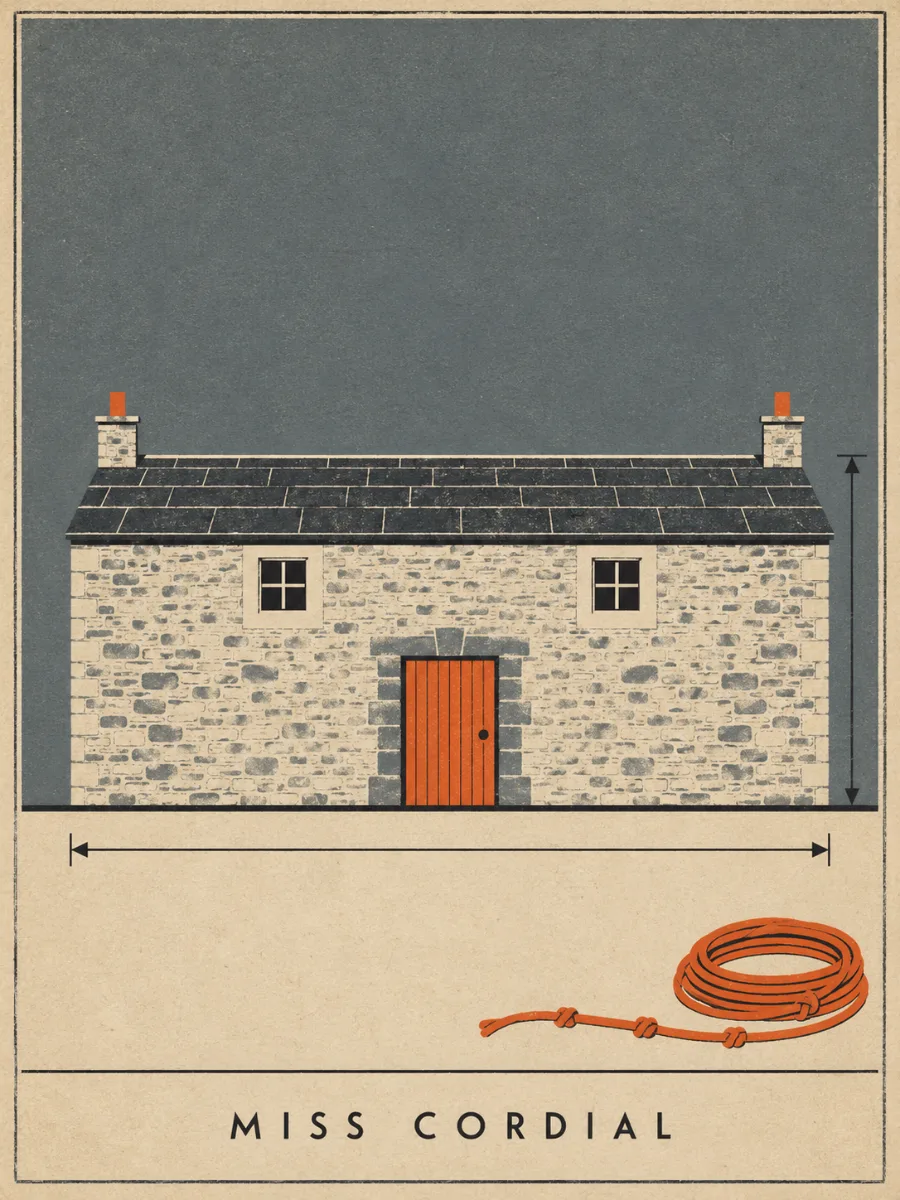
GROUND FLOOR. — Entrance hall, with the great door to the south. On the right hand of the hall, the kitchen, with its range, its cupboard and the way out to the yard. On the left hand, the parlour. Behind the parlour, the larder. At the end of the hall, the staircase going up, of wood and with its turn. Under the stairs, the little tool room. On the front there are two (2) windows, that of the parlour and that of the kitchen.
UPPER FLOOR. — The staircase comes out into a passage. Off the passage there are, on the left hand, my room; opposite, the room of doña Feliciana; and at the end, that of Benilde. The passage ends in a partition wall.
On the other side of that partition is the lady's room, which is the largest in the house and has two (2) windows on the front. That room is not entered from the passage. It is entered from the granary landing, which is where Gaudencio Quirós sleeps and where the ladder up to the loft stands.
DEPTH OF THE HOUSE: twenty-four feet, both below and above. FRONTAGE: thirty-eight.
This is all I can say and I sign it. — A. Lastra.
Pampín looked at it over Valmont's shoulder and whistled once, very low.
"Well, there it is."
"There is what?"
"That the lady's room, that night, could only be got into by way of where the convict slept." He moved away from the fire. "The schoolmaster writes it, and he has nothing to gain, and he writes it without anybody asking him. Señor Valmont, the magistrate reads this on Monday and on Tuesday we have a committal."
"That is likely."
"You do not see it?"
"I see a very well made drawing." Valmont smoothed his moustache with the back of his thumb and stayed silent a good deal longer than Pampín found comfortable. "Let us read the rest, since that is what you came out in wet boots for."
The statements came in the order in which the bailiff had collected them. Valmont separated them from the rest and laid them out in a row in front of him without reading them yet. It was a lifelong habit of his: to look at papers first as objects and afterwards as writing. One was notepaper, with a blue edge. Another was wrapping paper. Another was from a school exercise book. Two came on a sheet folded in half and one on half a sheet. Six people shut up in six houses, each writing on whatever came to hand.
The first was the niece's, in that round unhurried hand that convent schools give.
In answer to what is asked of me: on the night of the eighth I went to bed at half past ten, after settling my aunt for the night and giving her her glass. I slept straight through and heard nothing all night, and God knows that if I had heard anything I should have run to her, for I have been getting up for whatever was wanted these eleven years. I sleep wall to wall with her, so that I can hear her breathe. At half past seven I went in to her and she was cold already. We called Señor Carbajosa, who came at once, and he said what it was. My aunt had been six days with the fever and would not have anybody told. — Feliciana Mansilla.
"Wall to wall," said Valmont.
"That is a manner of speaking."
"It is a very odd manner of speaking for two rooms with a partition wall and a whole passage between them." He set the sheet down beside the sketch plan, squaring it against the edge. "Go on, we are doing well."
The second was the schoolmaster's. It filled two whole sides. It was written with a new pen, one of those that give out their ink generously, and with margins so even that they looked as if they had been measured.
In answer to what is asked of me: I have been five (5) years at this school and three (3) lodging in the house, since the roof of the school came down under the snows and the Town Council has not seen fit to repair it. I pay for my room punctually. On the night of the eighth I went to bed at ten, as I do every night, and did not get up again until seven. I heard nothing. The lady was a woman of character and treated me with every consideration, although she left me nothing in her will, which does not offend me, for I was nobody to expect it. As to the drawing that is asked of me, I have done it as well as I knew how, warning that I am no draughtsman. I remain at the disposal of the Court for whatever may be required of me. — Amaranto Lastra, national schoolmaster.
"An obliging man," said Pampín.
"A man who answers three things he was not asked." Valmont laid the sheet beside the previous one. "He was asked where he was. He tells us where he was, what he pays, what he does not inherit and how little he is offended."
The third was the cook's. It was written on wrapping paper, in capitals, without a single full stop, and with the words so crowded at the end of the line that they climbed on top of one another.
I NEVER LEFT THE KITCHIN ALL NIGHT FOR I WAS AWAKE WITH THE PAIN IN MY LEGS AND I LEFT THE FIRE IN AT THREE THE WOOD OF THE GALLERY SOUNDED WHICH IT ALLWAYS DOES AND I THOUGHT THERE IS THE MISTRESS UP AGAIN FOR SHE DOES NOT SLEEP AND I KEPT STILL SO AS NOT TO GO UP FOR WITH THESE LEGS I DO NOT GO UP AT EIGHT DOÑA FELICIANA CAME DOWN SAYING SHE WAS DEAD AND I HAVE NEVER TOOK ANYTHING OUT OF THAT HOUSE EVER. BENILDE OZORES.
Valmont read that through three times. The first time he laughed. The second he turned serious. The third he got up, went round the table and stood on the other side of it, looking down at the sketch plan from above, with both hands on the back of the chair.
"What is it?"
"That this woman ends by denying a theft that nobody has charged her with," he said. "That is one thing. And there is another."
"What?"
"That at three in the morning the wood of the gallery sounded."
Pampín looked at the drawing again. He looked at it carefully, following with his finger the passage, the partition wall, the granary landing and the two windows of the lady's room.
"There is no gallery here."
"Not on this piece of paper."
The fourth statement was the parish priest's, don Cipriano Neira, and it came written on a sheet folded in half, in the slow hand and straight lines of a man accustomed to filling registers.
I comply with what is asked of me. I saw doña Casilda for the last time on the first, which was All Saints, and I saw her sitting in the sun on the gallery, wrapped in her rug, because she used to say that in bed one dies the sooner. That day she told me she had written out in her own hand what she wanted done with what was hers and that she was easy now. She did not tell me what she had written and I did not ask her. On the ninth, at eleven in the morning, they called me and I buried her at one, with quicklime, in the new part. I know the notice says twenty-four hours and that they were not kept. I did it for what we have here and for no other reason, and I have accounted for it to the one I had to account to. The entry in the register bears the date of the tenth and that is the only fault I have to confess in this matter. — Cipriano Neira, parish priest.
"The gallery again," said Pampín.
"Again, and with the lady sitting on it." Valmont squared the sheet with the three before it. "And notice what the priest has done: he was asked about one night and he has confessed of his own accord an irregularity of date that nobody was ever going to look at."
"And what does that signify?"
"That in that house, this week, everybody is confessing the small sin." He sat down again. "It is what people do when they are afraid of being asked about the large one."
The fifth was the medical orderly's, and it was the shortest of them all.
Notice received at ten past eight on the ninth. I certified the death at half past eight. Cause: typhoid fever, with six days of progress. It is the fifth fatal case of this outbreak and I have eleven houses in my charge, with no assistant and no car. If the Court wants more detail, let it send somebody to do my work for a fortnight. — Lino Carbajosa, orderly of the Board.
"This one is furious," observed Pampín.
"This one is tired, which looks very like it." Valmont wiped his fingers with the handkerchief. "And nowhere does he say that he went up to the room."
The sixth and last came on a different paper, from a school exercise book, and the hand was the priest's again.
I write what Gaudencio Quirós says, he having asked me to because he cannot write connectedly, and it goes signed by him with his own hand at the foot.
He says the lady gave him the sealed envelope on the first in the afternoon, on the gallery, and said to him: this to the court at Sarnia when I am gone, and do not open it, you will have no need to open it. He says he carried it eleven days in his pocket and at night under his head, in the granary, and that he did not open it. He says that on the night of the eighth he slept as he sleeps every night and heard nothing, and that at night he does not hear because he has been deaf on the left side since the prison. He says that on the twelfth he went down over the footbridge and handed it in.
And he says I am to put down here, in these words, that the lady promised him once that when she was gone he would not have to ask anybody for anything, and that this is all he knows and all he wanted.
Gaudencio Quirós (his mark)
Nobody said anything for a while. Outside it was still raining. In the kitchen below, somebody was moving pots about with the calm of a house where nothing has happened.
Valmont put the gardener's sheet back on the table and smoothed it with the edge of his hand, twice, although it had not a crease in it. He was the only one of the six who had not written in his own hand. He was also the only one who had explained nothing about himself.
"He is the only one who has confessed nothing," said Valmont at last.
"He is the only one who has nothing to confess. He has it all on him already." Pampín took up his notebook and began to make his list for the week, which was a habit of his. "Let us see, Señor Valmont. With the paper standing, the house and the meadows go to the nuns and the niece keeps a watch. With the paper thrown out and the gardener committed for trial, it is perfectly clear who the villain of this story is and nobody asks anything more. And whoever put in that line, whoever he may be, has made the two of them a present of eighty thousand pesetas."
"Eighty thousand?"
"The meadows of la Vega, the mill and the house. Don Nicasio Mansilla has had them valued already." He took a telegram of the day before from his pocket and laid it on the table without any ceremony. "And he has them half sold already, which is worse. The man writes to me every day."
Valmont did not touch the telegram.
"Monsieur Pampín, bring me Tuesday's sheet with the notice on it."
"What for?"
"Because I want to wet it."
He wetted it. He laid the notice over the trough, poured half a glass of water on it, left it a minute and then hung it up beside the fire. The inks ran at the edges exactly as they had in the will, exactly as they had in the six statements, and the paper came out yellow and with the same smell. Valmont stood looking at it until it dried.
"That is one doubt finished with," he said. "The run ink on that line proves nothing. Everything that crosses that river comes out like this."
"I had told you that already."
"You had told me. Now I know it, which is not the same."
Amadora came up to take away the glasses and stayed, as she always stayed, with the tray propped on her hip. That woman had the gift of finding out everything without asking anything.
"Is it true they are going to bring the gardener down?"
"So they say in the kitchen, madame."
"Then it is wrong." She wiped the table, going round the sheets very carefully. "I have known that man since before the prison. And the lady died of what everybody is dying of up there this month."
"Have you had people in the village?"
"My sister-in-law. Twenty-one days with the fever, señor, twenty-one, and she came through it. She still had the spirit to ask for a broth on the last one." She shifted the tray to the other side. "That is the bad thing about it: it does not take anybody all at once. It wears them away. Two weeks, three weeks, and the whole house listening to them at night."
She went off with the glasses. Valmont sat for a moment with his eyes on the door. Then he gathered up the sheets one at a time and put them on their pile, and the sketch plan he left till last and on top of them all.
"I am going to ask you for one more thing for Tuesday."
Pampín shut his eyes for a moment before opening the notebook.
"Go ahead."
"I want the inventory that was made when the husband died, fourteen years ago. I want the inventory they drew up on the twelfth when they sealed the house. And I want the Board's list of the sick in the village, with the day each one went down and the day the ones who died, died."
"That is three things."
"It is three pieces of paper, and all three are written already. Nobody has to go anywhere to find them."
"And the drawing?" said Pampín, pointing at it with his chin. "The drawing is no use to you."
"The drawing is of the greatest use to me." Valmont straightened it a little, for it was crooked with respect to the edge of the table. "In this house there are six people who could not speak to one another, and two of them name a gallery. A woman of seventy-one sat on it to take the sun and a cook with bad legs hears it creak at three in the morning." He moved back from the table. "It is the only room in the house that is not drawn."
Houses Do Not Stretch
Chapter 3
III
On the wall of his room, pinned up with drawing pins, were the fourteen sheets from Friday, set out in three rows. Valmont had been two hours in front of them when the mail came, and he had slept little. The Tuesday had dawned clear and freezing, and by nine the smoke of Bellabrida could be seen going straight up, which is a sign of cold. Up there too people were getting out of bed.
Tuesday's batch held four items and weighed more than the two before it together.
The first was the inventory drawn up on the death of don Casimiro Sárdoma, fourteen years before. It ran to nine sides written on both sides of the paper, in the hand of a notary of the old school. Valmont read it all, without skipping a line, taking forty minutes over it. Pampín was bored after ten.
…Item, the principal house of the town, of thirty-eight feet frontage and twenty-four in depth, of rubble masonry with dressed stone at the corners, with its wooden gallery to the south on the upper floor, roofed with slabs, in good repair. — Item, the lower mill, with its wheel and two stones. — Item, the meadows called of la Vega, the upper and the lower… — Item, six casements to the south on the upper floor, with their shutters. — Item, twelve silver covers, one salver, two candlesticks, one jug, a coffee service of twelve pieces, one incense boat, one rosary with a silver setting…
"There is the gallery," said Valmont. "Written by a notary, fourteen years ago, when there was nothing here that needed covering up."
"A gallery is not a room."
"A gallery is not a room and, for all that, a man can walk along it." He ran his finger along the line. "Six casements to the south on the upper floor. A casement is one leaf of a window, monsieur Pampín. Two leaves to a window. That makes three windows."
"The schoolmaster draws two."
"The schoolmaster draws two."
Valmont took a pencil and wrote that sum in the margin of the inventory, in small figures, and then crossed it out and wrote it again lower down. It was the first time in a week that he had allowed himself to spoil a document of the court.
The second item was the inventory of the twelfth, made when the house was sealed. It had not been written by a notary but by Ventura Doiro the bailiff, in his small hand and with his habit of saving paper. It was much shorter than the other and much sadder. The lists of houses where somebody has just died always are.
On the upper floor. — The lady's room: iron bedstead without mattress or bedding, the same having been burned by order of the Board; night table; washbasin; one empty chest; two chairs; one mantel clock, stopped. — Room of doña Feliciana: bed, chest of drawers, holy pictures. — Room of the schoolmaster: bed, table, books, inkwell and paper. — Room of Benilde: bed and trunk.
On the gallery. — Six curtain hooks, without a curtain. There is not found the esparto mat that appears in the previous inventory, nor the unbleached linen curtain of the same. They say it was all burned with the rest.
In the parlour. — Two candlesticks. There are not found the salver, the jug, the incense boat, four covers nor the rosary with the setting, which appear in the inventory of the estate.
Pampín read that twice and brought his open palm down on the table.
"There it is! They have emptied the old woman of her silver!"
"They have emptied the old woman of her silver," Valmont repeated, without raising his voice.
"Four covers, the salver, the jug, the incense boat and the rosary. No Board of Health burns that. That has gone out through the door."
"It has gone out through the door little by little, and not on the night of the eighth." Valmont pushed his chair back and stood behind it. "A person who steals the silver all at once takes the twelve covers. Here four out of twelve are missing, and the incense boat is missing, and a rosary is missing. That is not a theft, monsieur Pampín, that is a wage."
"Then we have somebody stealing in that house."
"We have somebody stealing in that house and have had for some time, and that will bear looking at. Where is silver sold about here?"
"Not in Sardón, certainly."
They put it to Amadora that same afternoon, since that was what they were in her inn for. Amadora was plucking a chicken and answered without looking up, in the way one answers what one knows perfectly well.
"A dealer comes up from Sarnia once a month, señor. He puts up in this house and eats here. He buys copper, silver and old saints."
"And do the houses up there sell to him?"
"The houses up there all sell to him and none of them tells anybody. " She threw a feather on the fire. "From the Mansillas it was the niece who came down, until October, when all this was closed off. Once a month, with her bag, and it always weighed less going back."
"Do you know that or are you supposing it?"
"I know it because I have served the pair of them coffee at the same table." Amadora turned round at last. "And I have never told anybody, for here each of us ruins himself as he pleases."
They went back up with the inventory. Valmont laid it on the table, stood in front of it with his hands behind his back and waited for the clerk to sit down.
"A family disgrace," he said. "That is what everybody is going to see in this paper, and that is what it is. Now look at the line above it for me."
"Which one?"
"The one about the gallery."
Pampín looked. He took a moment.
"Six hooks without a curtain," he read. "And a mat missing. Well, and what of it? They have burned half the house. It says so there: it was all burned with the rest."
"Read me the fourth article of the notice."
The clerk did not have to look for it, because he had it in the same pile and because he had been reading that paper every day for a week.
"The mattress, the bedclothes and the garments of the sick person shall be burned, and the room in which the same has been shall be washed with bleach."
"The room in which the same has been," said Valmont. "The lady had been six days in her bed. In that house there is one room and one only where the sick woman had been, and of that room they burned what had to be burned, which is written up there: the mattress and the bedding. Nobody orders the curtain of the gallery burned. Nobody orders the burning of an esparto mat that has been fourteen years on the floor of a place people walk through." He leaned on the back of the chair. "And yet somebody burned them, and did not do it in secret, because it is set down as the most natural thing in the world: they say it was all burned with the rest."
"Perhaps they took fright and burned more than they needed to."
"Perhaps." Valmont smoothed his moustache with the back of his thumb. "That is the first reasonable explanation I have heard this week, and I thank you for it. Let us see whether it holds."
Valmont spent a long while with the two inventories open side by side, going from the one of fourteen years ago to the one of the twelfth and back again. It is slow work and it is nothing at all like what people imagine. It consists of reading two lists of things and waiting for one of them to tell you what it is missing. Outside, the river could be heard.
The third item was the Board of Health's table, on a sheet folded in three and with one column crooked, because the man who copied it was no hand at making tables.
BELLABRIDA OUTBREAK. — Return of fatal cases.
Ramiro Cela, 44 years. First symptoms, 9 October. Death, 30 October. Twenty-one days. Aurora Vieites, 12 years. First symptoms, 14 October. Death, 1 November. Eighteen days. Manuel Cela, 7 years. First symptoms, 16 October. Death, 5 November. Twenty days. Josefa Roade, 68 years. First symptoms, 21 October. Death, 6 November. Sixteen days. Casilda Mansilla, 71 years. First symptoms, 3 November. Death, 9 November. Six days.
Note by the undersigned: in the first three I have corrected the date of first symptoms in accordance with what the families have declared to me, the same not being properly recorded in my first return. — L. Carbajosa.
Valmont put his finger under the last line and left it there.
"Six days."
"The others are longer," Pampín allowed. "But she is a woman of seventy-one, Señor Valmont. The old go sooner."
"The one of sixty-eight took sixteen. The child of twelve took eighteen." He lifted his finger. "And look at what the orderly does here: he takes the trouble to give notice that he has corrected three dates. Why does a man who is furious and has no time take that trouble?"
"Because he is a tidy sort."
Valmont was slow to answer. He went over to the window and stood a while looking at the smoke of the village, which at that hour of the afternoon no longer went straight up. Then he came back to the table and put his finger on the orderly's note, on the line about the three corrected dates.
"Because he is afraid that somebody will do this same sum and ask him why his patients all began to sicken the day after he arrived in the village." Valmont pushed the table of figures aside. "This man has spoiled our numbers out of vanity and nothing else. Which means that the only date of any use is the one he has not touched, and that is the lady's, because for that one there was no earlier return to correct."
The fourth item was the thinnest of them all and came by itself, without an envelope. It was the certificate of previous convictions of Gaudencio Quirós Baldomir, aged fifty-two, born and resident in Bellabrida. Three years and a day. Homicide by negligence. A shoot on the Mansillas' high pasture, twenty-four years before. A man shot dead in the belly. And a gun which, according to the judgment, was the prisoner's own.
"Was the gun his?" asked Valmont.
"So it says."
"A gardener with a gun of his own."
"In villages everybody has a gun."
"In villages everybody has a gun and almost nobody has the master's." Valmont read the sheet again. "Whose was the high pasture?"
"Don Casimiro Sárdoma's."
"And who was shooting over it that day?"
Pampín sat with his notebook open and wrote nothing.
"That it does not say."
"No, it does not say." Valmont laid the certificate beside the will, so that the two papers touched at the edge. "And now read me again what the lady left this man in her will, and read it slowly, for I know you have it by heart."
"The lower house with its garden, for him and for whoever he wishes after him. He knows why, and he owes no account of it to anybody."
"He knows why." Valmont sat looking at the line. "That woman was paying a debt of twenty-four years ago, monsieur, and she paid it in the exact words that would spare the man who collected it from having to explain anything to anybody. And immediately afterwards, in the same line, somebody added two meadows. Two meadows that nobody had promised him."
"Or that were promised him as well."
"Then we should have before us the worst paid and worst written man in this province." Valmont pushed the certificate of convictions aside. "What time do you make it?"
"Half past twelve. Why?"
"Because there is a noise downstairs."
There had been a noise downstairs for a quarter of an hour: chairs, boots and a voice giving orders without getting up. Two guards had arrived with a sergeant from Sarnia and they were eating in the kitchen. Amadora was serving them with a face Valmont had not seen on her in eight days. The sergeant had the order in a large envelope. At two in the afternoon, on the bank of the river, Pampín read it aloud to Valmont, because the sergeant had no intention whatever of handing it to an expert witness.
Committal and remand in custody of Gaudencio Quirós Baldomir, for forgery of a document, and subject to whatever the examination might yield touching the circumstances of the death of doña Casilda Mansilla Berdún.
"The magistrate has decided not to wait for your report," said Pampín, and it showed that the sentence had taken him some while to prepare. "He says that what there is will do to commit him and that the report can come later."
"The magistrate is right about the first."
"And about the second?"
"About the second as well, unfortunately." Valmont was looking at the footbridge. "A report of mine will serve to convict a man. You have seen that. What it will not serve for is to let him go."
They brought him down at a quarter past three. First the bailiff crossed. Then two men of the village with a basket. Last, Gaudencio Quirós, who walked ahead of the patrol and unbound, because nobody crosses that footbridge bound. He was a big stooped man, with his beret on and a jacket that was short on him. He crossed slowly, holding on with his left hand to the rope of the handrail, watching the planks. On the other side, at the top of the bank, the whole village had stopped to watch him. There were about twenty of them: the ones who could leave their houses.
On the Sardón bank they were waiting for him with the handcuffs. The sergeant put them on him there and then and without any roughness, the way one puts the packsaddle on a mule one has known all one's life.
Valmont was ten metres off and did not move from where he stood. He had been seven days working on that man and this was the first time he had seen his face. He looked older to him than the papers said, and he had the hands of a man who has dug all his life, and it seemed to him too that he had no intention of defending himself.
"Señor Quirós."
The man lifted his head and turned his good side towards him.
"You tell me."
"Did you burn the curtain from the gallery?"
"I burned the mattress and the bedding, which I was told to, and I carried it down to the river in a bundle and it shamed me." He swallowed. "Not the curtain. The curtain was taken down on the Sunday morning and when I went up it was gone already."
"Who took it down?"
The guards were pulling at him now. Gaudencio Quirós took two steps and turned his head, and gave the one answer he had given all week without anybody's ordering it out of him.
"I did not take it down, señor. I swept that house, I did not clean it. You will see that if you go there."
Nobody on the far bank moved while they were putting him into the car. There were the twenty from the top, and there were also, lower down, three women who had come down to the water's edge and who shouted nothing. In villages, men who come back from prison are always watched as though they were on the point of going back again.
They took him off along the Sarnia road in the same car the sergeant had come up in. Valmont stayed on the bank until the engine could no longer be heard. Then he said something under his breath, in his own language, and it was the only thing he said in his own language in that whole week.
"On l'a déjà fait une fois."
Pampín, who was standing beside him, turned round.
"What was that?"
"Nothing."
"No, forgive me, you said something. Say it in a language a man can understand."
"I said that it is cold on this bank." Valmont set off towards the inn, and did not open his mouth again until they were inside with the door shut. "Monsieur Pampín, take your notebook. I am going to ask you for four things for Friday and all four will strike you as ridiculous."
"I am used to it by now."
"The first: a rope of thirty metres, the sort used for washing lines, with a knot at every metre. Have it made down here, this afternoon, and sent over tomorrow in the basket."
Pampín wrote that down without comment, which was, in him, a form of protest.
"The second: that the bailiff go up to the house with two neighbours who are not the schoolmaster, and that they draw up the sketch plan again, but measuring with the rope. Let the two neighbours be people who have already had the fever, and let Señor Carbajosa give his permission in writing, so that nobody can tell me afterwards that the paper was got up in defiance of the notice. The rooms, the depth of the house, the frontage, and the distance from the back wall to the front on the upper floor. Let all three sign it."
"That is going to sit very badly with don Amaranto Lastra."
"I hope it does. The third: the photograph."
"What photograph?"
"The Board of Health photographs the houses in an outbreak for its reports. They do it all over Spain and they will have done it here." Valmont sat down and drew the candle closer, although there was light still. "If there was a death on the ninth, that house has been photographed. I want that plate or I want the print, and I want to be told the day and the hour it was taken."
"And the fourth?"
"The fourth is for you alone." Valmont looked up. "Find out for me who was shooting on the Mansillas' high pasture the day Gaudencio Quirós got his three years."
Houses Do Not Stretch
Chapter 4
IV
The fourth batch came on the Friday at four and was the smallest of them all. Three items and a rope. The rope came coiled and with its thirty knots counted. It came back dirty with mud and with one end wet. They had used it in earnest.
The first paper was the new sketch plan. It was signed by Ventura Doiro the bailiff, a carter called Rogelio Sanín and the blacksmith's wife. It had no drawing at all: it was a list of measurements, written out in a column, in the same small hand as always.
Measured with the knotted rope on Thursday morning, in the presence of the three of us who sign.
Frontage of the house, thirty-eight feet. Depth, from the back wall to the eaves in front: twenty-four feet.
Upper floor, measured inside room by room, from the back wall to the front wall: the lady's, twenty feet. Doña Feliciana's, twenty. The schoolmaster's, twenty. Benilde's, twenty.
I state that from the front wall of the rooms to the eaves there are four feet more, which is what the wooden gallery projects, and that this house has had the gallery all its life and the whole town knows it.
I state also that the lady's room is entered by two doors: one giving on to the gallery, like the other three rooms, and another giving on to the granary landing. And that from the gallery one goes down to the yard by a wooden stair of six steps, the last being of stone.
And I state the last because you order it and not for pleasure: on the upper floor there are three windows to the south, and not two.
"Four feet," said Pampín.
"Four feet."
"Twenty and four, twenty-four." The clerk did the sum twice in his notebook, as though arithmetic might behave differently the second time. "And the schoolmaster drew the rooms taking up the twenty-four."
"The schoolmaster drew a house that does not exist, and he drew it well." Valmont put the two sheets side by side. "He took four feet off it. That was all he had to do. With four feet less, that house has no gallery. With no gallery, the rooms do not connect on the outside. And with no connection on the outside, the lady's room can only be got into by way of where the man who is now in Sarnia slept."
"Houses do not stretch," Pampín muttered.
"Houses do not stretch. Drawings do."
The second item was a stiff envelope with two pieces of card, and between the two pieces of card, the photograph. A note from the Board's doctor came with it. It said that the houses in an outbreak were photographed by order from above. That one had been taken on the tenth, at half past twelve.
Valmont set it down beside the candle, although the sun was coming in.
It was a long stone house, with its front to the south and the great door in the centre. On the upper floor, along the whole front, ran a wooden gallery with its balustrade. Behind the balustrade three windows and two doors could be counted. At the right-hand end a wooden stair went down to the yard, with the last step of stone. At the foot of the stair there was a paving of six or seven large flagstones. One of them was of a pale grey that the others did not have.
"Do you see that?" said Valmont.
"I see a house."
"Look at the flagstone at the foot of the stair."
Pampín brought his nose close to the card.
"It is paler."
"It has been scrubbed." Valmont turned the photograph over and turned it back again. "There is typhus in that house, people do not leave their rooms and not even the kitchen gets scrubbed. The notice orders one place only to be washed with bleach, and that is the room where the sick person has been. And there is a flagstone scrubbed with bleach in the yard, under a stair, twenty metres from that room."
The clerk sat down slowly, without letting go of the card.
"Did she fall down the stair?"
"She fell down the stair or she was fallen down the stair, and that is a difference nobody will ever be able to settle, because that woman was buried in quicklime nineteen days ago." Valmont wiped his fingers with the handkerchief. "I am not going to say what doña Casilda Mansilla died of. I do not know and I cannot know. I am going to say something else, which I do know: that she did not die in her bed, that what was burned in that house was not what the notice orders, and that the paper a man is to be committed for trial over was written by somebody who lived inside it."
The third item was half a sheet from Pampín, written by himself in Sarnia, and he had brought it without being asked in front of the sergeant.
On the Mansillas' high pasture, that day, don Casimiro Sárdoma and two friends of his from Sarnia were shooting. Gaudencio Quirós was acting as beater. The gun appears in his name in the proceedings from the second day. In the first police report it appeared in don Casimiro's name and is struck through. Quirós's mother was an inmate of the hospital at Sarnia, paid for by the house, from the following year until she died.
Valmont read that twice and laid it face down on the table, which was his way of putting something away.
"Monsieur Pampín, can you get the magistrate to come to this bank tomorrow?"
"To this bank?"
"To this bank, at the foot of the footbridge, at eleven in the morning. With the sergeant and with yourself. And I want the bailiff to have on the other bank at that hour the five people who wrote the statements, which is four, because the fifth is in Sarnia and the sixth is dead." Valmont began gathering up his papers. "And whoever in the village wishes to come, which will be the whole of it."
"Señor Valmont, the magistrate is not going to come down to a river and shout."
"Then tell him the expert does not sign his report."
Pampín looked at him for a long moment. Then he wrote in the notebook, shut the notebook and went off to catch the bus without saying goodbye, which was the nearest thing to a yes that he knew how to manage.
Saturday dawned with fog and the fog lifted at ten. By a quarter to eleven there were people on both banks.
On the Sardón side stood the magistrate from Sarnia, a small chilly man in an overcoat too big for him. With him, the sergeant, two guards and Pampín with his notebook. Amadora had come down too, with her shawl on, leaving the inn empty for the first time in five years.
On the Bellabrida side, at the top of the bank, there were eighty or ninety people. The bailiff had given orders the night before that nobody was to come down who had not been summoned, and by half past ten it was plain that nobody was going to obey. Don Lino Carbajosa went up twice to tell them to stand apart. The second time he stayed up there with them. In front of them all, ten metres of water away, stood Doiro the bailiff and Neira the priest with their hands in their sleeves. Benilde the cook had sat down on a stone, because she could not stand for long. Amaranto Lastra the schoolmaster wore a black overcoat and held his hat in his hand. And beside the schoolmaster, in mourning and very straight, with a scarf over her head and her gloves on, stood Feliciana Mansilla.
Valmont placed himself at the edge of the water, with the basket of the footbridge on his left and the papers under his arm. He did not raise his voice more than he had to. The river ran without a sound and, with the fog lifted, one bank could hear the other better than in a room.
"I shall begin with what is not in dispute," he said. "Doña Casilda Mansilla wrote a will on the first of this month. She wrote it in her own hand, sealed it, and gave it to Gaudencio Quirós on the gallery of her house, in front of nobody. On the ninth she died. On the twelfth that envelope reached the court at Sarnia with a new wafer and with one line too many."
"We know that already," said the sergeant.
"Yes, sir. And now I shall say what we do not know, which is longer and more useful." Valmont took out the first paper. "That line was not written by doña Casilda. It was not written by a notary. And it was not written by Gaudencio Quirós, who cannot. It was written by somebody who was inside that house that night, and that person is listening to me at this moment."
On the far side nobody moved. Somebody coughed at the back, in the second row.
"I shall explain how I know it, because if I do not explain it, it is worth nothing, and I sign nothing I cannot explain." He held up the will. "On this paper, the lady writes out every sum in words. Thirty duros. The meadows of la Vega. In three letters of hers that I have here there is not a single numeral: four hundred or thereabouts, eleven houses. That woman never wrote a figure in her life."
He turned the sheet towards the far bank, although at that distance nobody could read it, and it was a gesture for the magistrate as much as for them.
"And in the added line it says: the two, in brackets two, meadows of la Vega. A number written twice, in words and in figures, the way minutes are written, and school registers."
He took out the sketch plan.
"On this drawing, made by eye by a man living in the house, it is set down: on the front there are two, in brackets two, windows. And lower down, again: the lady's room has two, in brackets two, windows on the front."
He took out the schoolmaster's statement.
"And on this sheet, written the same day the drawing was lettered: I have been five, in brackets five, years at this school and three, in brackets three, lodging in the house." He lowered the paper. "A handwriting can be imitated, gentlemen. With patience it can be imitated very well. What nobody imitates is his own habits, because he does not know he has them."
The schoolmaster did not move. He held his hat in both hands and looked at the water.
"Now the house," said Valmont. "Señor Doiro, have you the rope there?"
The bailiff raised the knotted rope above his head.
"Hold it between two of you, taut, and count twenty knots in front of all those people."
They did it. The carter took one end and the bailiff the other. They counted aloud up to twenty. At that distance the length of rope stretched out on the grass could be seen quite plainly, and the piece left over, hanging.
"Twenty feet. That is the measurement of the rooms on the upper floor, measured the day before yesterday by three neighbours." Valmont pointed at the loose end. "And now count four more, which are what there is from the wall of those rooms to the eaves. Four feet of projecting timber, with its balustrade, across the front of the three windows, and a stair at the end of it going down to the yard."
He looked at the magistrate and then looked again at the far bank.
"On the drawing I have in my hand, those four feet do not exist. And without those four feet, the room where that lady died can only be got into by the place where the man you have committed for trial in Sarnia slept." He paused. "This whole story fits into four feet of timber."
"An error in the drawing," said the magistrate, and it was the first thing he had said all morning.
"An error in the drawing that takes away exactly what needs taking away, my lord, and takes it away on the one paper in the file that nobody can contradict, because the rest of them wrote blind." Valmont held up the cook's sheet. "This woman writes that at three in the morning the wood of the gallery sounded. The priest writes that he saw the lady sitting on the gallery on the first. Doña Casilda herself writes in a letter that they put her out on the balcony to take the sun. The inventory of fourteen years ago says: house of thirty-eight feet frontage, with its wooden gallery to the south. Four papers, and not one of them could speak to another."
He crouched and took the photograph out of the stiff envelope. He put it in the basket of the footbridge, pulled on the line, and the basket went along the rope to the middle of the river and from the middle to the other bank.
"Pass it from hand to hand," he said. "Slowly, and all of you."
The photograph took a quarter of an hour to go round the first row and part of the second. Nobody said anything while they were looking at it. Then they all began to say it at once, and the bailiff had to raise his arm twice.
Feliciana Mansilla did not take it. When her turn came she passed the card to the woman beside her without lowering her eyes to it, and afterwards settled her gloves, first the right and then the left, pulling at each finger.
"In that photograph," said Valmont, "there are three windows, there is a gallery, there is a stair and there is a scrubbed flagstone at the foot of the stair. It was taken on the tenth at half past twelve, by the Board, for a report that had nothing whatever to do with this. It is the only item in the whole file that nobody has written."
"My grandfather built that gallery!" shouted a man from the third row. "The whole town knows it!"
"And why has nobody said so until today?" asked the magistrate, without turning round.
"Because nobody was asked about the gallery, my lord. They were asked where they slept, and they all told the truth." Valmont waited for the bailiff to lower his arm. "That is what comes of asking under a door: you are answered what is on the paper."
He waited until they were quite silent.
"And there remains the question you have put to me four times this week," he went on. "If somebody in that house wanted that paper not to stand, why did they not burn it? An envelope burns in two minutes and nothing is left."
"That is just it," said the sergeant.
"Because a burned paper is a missing paper, and a missing paper is looked for. Don Nicasio Mansilla had already written to the court asking after his aunt's will. The priest knew it had been written and knew it from her own mouth." Valmont held up the empty envelope. "If that envelope disappears, there is an investigation, there are questions and there is a whole household giving evidence for a year. If it turns up and does not stand, there is none of that. There is no will, the law says who inherits, and on top of it there is a guilty man with a record to keep the court occupied. It was never a question of the paper being lost. It was a question of its turning up broken."
He took out the town clerk's memorandum and read it right through, slowly.
"Received from the hand of Gaudencio Quirós a sealed sheet with a wafer apparently recent. Gentlemen, that man carried the envelope eleven days on him and eleven nights under his head. If he had wanted to open it, he would have opened it. And if he had opened it, why would he go and close it again with a new wafer? Nobody seals what he can hand over open. A new wafer is put on only by somebody who needs the envelope to go on looking sealed, and that is never the man who is carrying it."
Out in the middle of the river, the basket of the footbridge moved slowly, empty.
"I am going to say now what sort of person I am looking for, and I want to say it before the name, because the name matters least and you will forget it." He laid the papers down on the grass at his feet. "I am not looking for anybody who planned this. There is no plan here. I am looking for a person who did not bring typhus to this village, nor break the bridge, nor write the line, nor sign the death certificate, nor dig the grave, nor order the bedclothes burned. All those things were happening already. They were handed to her ready-made. And she used every one of them."
Nobody on the far bank moved.
"This is a person who in the whole of this week has put nothing of her own into this file. Not one long lie, not one of those alibis that are prepared beforehand. Four lines, and only one of them is false." Valmont held up the sheet with the blue edge. "Another says: I sleep wall to wall with her, so that I can hear her breathe. And that one is true, and that is why it is written without thinking. The two rooms touch. On Señor Lastra's drawing they do not touch: there is a partition wall and a whole passage in between. That lady had not seen the drawing. She could not have seen it. She wrote her house down as it is."
On the far side, Amaranto Lastra the schoolmaster sat down on the ground. He did not faint and he did not say anything: he bent his knees and sat down on the wet grass with his hat on top of them, like a man who has been standing a long while.
"I rule the others out and say why, which is what ought to be done," Valmont went on. "Doña Benilde Ozores did not leave the kitchen. And in her statement she ends by denying, without anybody having asked her, that she ever took anything out of that house. That is what a person writes who has just taken something, and I do not know what she took and I do not want to know. What I do know is that whoever robs a drawer that night stays shut in the kitchen, which is exactly what she says she did."
Benilde covered her face with her apron.
"Don Cipriano Neira buried her within the twenty-four hours and put the register entry back a day so that it should not show. Don Nicasio Mansilla has sold two meadows that were not his yet. And Gaudencio Quirós burned a mattress he was told to burn and carried it down to the river in shame. That lady owed him something from twenty-four years ago and she paid him in a house with its garden, and she wrote it in such a way that he should not have to explain it to anybody. The meadows she did not leave him. The meadows were put on top of him by whoever wanted this paper not to stand, and they very nearly cost that man the prison a second time."
"Don Lino Carbajosa certified a death without going up to the room, and he has been doing it for a month. There is not a man in this province who would have done it better with eleven houses and two legs."
"They are all hiding something," said the magistrate.
"They are all hiding something, my lord. That is normal. Even the silver from that house explains itself: it has been going down to Sardón in a bag for years, one piece a month, and in this inn there is somebody who has served coffee at the same table to the dealer and to the woman who was selling it to him. That is a family disgrace and it is not a murder. I have spent four days being careful not to confuse the two, because the one covers the other the way a curtain covers a wall."
He held up the inventory of the twelfth.
"What is not normal is for somebody to disinfect a place where there has been no sick person. On the gallery: six curtain hooks, without a curtain. And the mat is missing. The notice orders the burning of what is in the sick person's room, and from the room what had to be burned was burned. Nobody ordered the curtain of the gallery burned. Nobody ordered the mat of the gallery burned. And nobody ordered the flagstone in the yard scrubbed."
He waited. On the other side nobody said anything.
"I am going to tell you now about the night of the eighth, and I shall say first which part I can prove and which part I cannot, because otherwise this would not be a report, it would be a novel." Valmont laid the inventory down with the rest of the papers. "I can prove that the line was written with a different pen and with a habit that in that house has one owner only. I can prove that the house has a gallery and that somebody rubbed it out of the one drawing a magistrate was going to read. I can prove that what the notice did not order burned was burned, and that a flagstone in a yard was scrubbed. That is the papers, and that I sign."
"And what you cannot prove?" asked the magistrate.
"What I cannot prove is what happened between three and seven in the morning, and I shall never be able to prove it, because that lady was buried with quicklime four hours after she died and that too was ordered by the notice." He paused. "I believe the envelope came out of the granary that night. I believe it was opened over steam in a room where there was a pen, an inkwell and paper, which is the only room in the house that has them, according to the inventory of the twelfth. I believe doña Casilda heard the wood of the gallery, as the cook heard it from below, and that she came out. She was seventy-one years old, six days into a fever, and she had every reason in the world to come out. I believe there were words on that gallery. And I believe she fell down that stair, or was helped to fall down it, and that she lay four hours dying in her bed while two people waited downstairs for it to get light so that they could say it had been the typhus."
Nobody interrupted him.
"The last thing I believe is the one that matters least and that I like least: that nobody planned any of this. This is not a thought-out crime. It is a cheap one."
He took a step towards the water.
"That curtain was taken down by somebody on the Sunday morning, and it was said in front of me by a man who had already been committed for trial and who had nothing to gain by saying it. That morning there were four people in that house. One has not climbed stairs for years and writes so herself. Another is the man who went up afterwards and missed it. The third is sitting over there, on the grass." Valmont waited. "That leaves you, madame."
Feliciana Mansilla raised her head for the first time.
"I cannot cross this river. Nor can his lordship. Nobody here is going to lay a hand on you today, nor tomorrow, nor on the thirtieth." He made the shortest pause of the whole morning. "But I want you to tell me why you took it down, because I have had that question since Tuesday and I am not leaving this bank without hearing the answer."
Feliciana Mansilla did not answer.
She stood quite still for a moment, with her hands in front of her, looking not at Valmont but at the empty basket hanging in the middle of the river. Then she turned to the schoolmaster, who was still sitting on the grass, and said something to him that was not heard on the other bank. Pampín, who was young and had a sharp ear, said that night at the inn that it had been: you did not know anything either, Amaranto.
And she set off up the hill.
She did not run. She went up the middle of the road, through the people, with the short step of women in mourning, and the eighty or ninety inhabitants of Bellabrida drew aside in front of her as she came, saying nothing to her and not touching her, and closing up again behind.
Amadora settled her shawl.
"And that is all?" she said. "She just walks away?"
"She just walks away," Valmont answered. "Into a village of two hundred souls, with the ways out shut until the thirtieth, where they have just read out aloud what she did. There is no county gaol that shuts better than that, madame, and I assure you I do not say it with any pleasure."
He stood watching her climb until he lost her behind the first house. Then he picked up his papers from the grass, put them in order, and the photograph he put away between its two pieces of card.
"Monsieur Pampín, now you may take out your notebook. The report runs to three lines and it has been waiting since the first Tuesday."
"And what does it say?"
"It says that the will of doña Casilda Mansilla is written and signed in her own hand, except for one line that is not hers." Valmont put on his hat. "And that that line was not written by the man it benefits. The court has not asked me for that last part, but I am going to put it in all the same."
The end
Houses Do Not Stretch
What did this story leave you with?
Read next