The House Ate the Staircase
The Círculo Mercantil of Sarnia is opening its new dining room, its electric light and a whole house bought from the neighbours, and on the night of the opening sixty members watch a white shape cross the glass screen at a height where there is no floor. Before the coffee, a doctor is found dead at the bottom of the well of a demolished staircase. The court sends an expert to say whether the man could have fallen on his own. The door was found locked, the key was found hanging on its hook, and in the porter's book there is no line for the return.
The House Ate the Staircase
Chapter 1
I
At seven in the evening, Victorina Sedano had twenty-two white jackets laid out on the table of the linen room. One of them had a streak of whitewash down the right sleeve.
"Again," she said. "And these are washed on Fridays, not on Tuesdays. Tonight twenty-two have to go out to the dining room, and all twenty-two clean."
Natividad leaned over the pile without letting go of the iron.
"It will be the painters, señora. On Monday they were at the whitewash until all hours and they left the floor ruined."
"The painters gave the last coat on Monday and they gave it in the passage, which was the only thing left of the whole job. The dining room has been whitewashed for three weeks. And nobody comes back from the dining room marked."
"Well, everybody goes through the passage."
"Nobody goes through the passage but don Eloy, and don Eloy does not lean on walls. This is last night's, and it is the only one, and I have four words to say to the owner of that sleeve."
"And can I not wash it now and dry it under the iron?"
"It shrinks. Have you ever seen a jacket washed in a hurry?"
The jackets were numbered inside the collar in red thread, from one to twenty-two. Each number had had its man for four years, and each man had two jackets: the everyday one and the spare, which was kept ironed on the bottom shelf. Victorina set the marked one aside, wrote down the number in her book, took its twin from the shelf and sent all twenty-two down to the dining room, which was what she did every night of her life since the Círculo had had a dining room.
On the top shelf the week's bundle was waiting, wrapped in a pillowcase and tied with a tape. It was two women's nightgowns, a shawl and four handkerchiefs, all of it marked with a fourteen in ink and all of it of a cloth that was no longer sold in Sarnia.
"And whose is that?" Natividad asked.
"The fourteen's."
"Yes, but whose?"
"Nobody you know. The bundle goes up on Friday and comes down on Saturday, and it has been going up and coming down for two years. I asked once."
"And what did they tell you?"
"Not to ask." Victorina tied the tape with two turns and left it where it was. "I have not asked again. And you are not going to ask either, because tonight there are sixty covers and this is no time for conversation."
The Círculo Mercantil of Sarnia was opening its rebuilt rooms that night. The work had taken fifteen months. They had bought the house next door, the Requejo house, and joined the two together at the first floor. Inside they had new electric light, a service lift and a kitchen with two ovens, and a new dining room twenty metres long with its end wall closed off by a screen of opal glass, which was what everybody was going to look at.
Behind that glass lay the corridor of the first floor of the old house. And the corridor of the old house was higher than the dining room. Victorina knew it because she had gone up that staircase a thousand times when she was in service with the Requejos, and the first time she crossed the new passage she had very nearly pitched forward on her face.
In the porter's lodge, Leandro Cifuentes was cleaning the glass of a frame with his sleeve. Inside the frame were the names of the committees since ninety.
"Señora Sedano. Tell me one thing: who thinks of putting the street bell behind a padded door?"
"The architect."
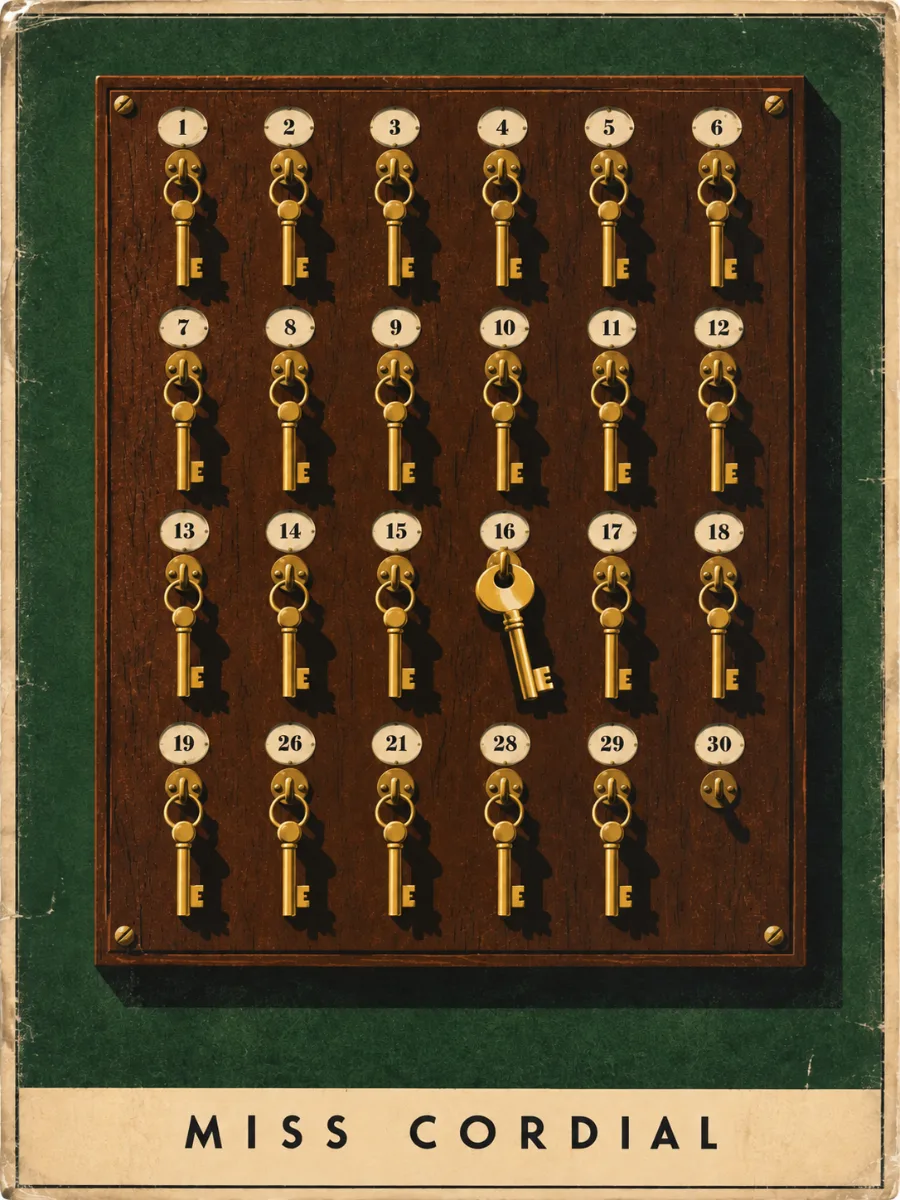
"The architect. And we are the ones who pay the architect." He nodded at the board of hooks behind his back, with the keys hanging and the numbers painted above them. "And another thing. Now I have a book. The members take a key and they sign, and they bring it back and they sign. The servants do not sign, because each of them has his own and nobody shows it to me."
"And is that not better than it was before?"
"It is the same as before with more paper. Look at the fourteen."
The hook of the fourteen had a single key on it, large and new.
"There are two of the fourteen," said Cifuentes. "This one and the one don Eloy has carried about him for two years. The committee gave it to him and he does not let go of it to sleep. If I ask don Eloy for the key of the fourteen, don Eloy answers me good evening."
"And what do you want it for?"
"For nothing. What I want is for every key in this house to be on my board, and they are not."
"And do you not tell the committee?"
"I told them last year in writing. No doubt they read it."
At nine o'clock the kitchen smelled of burnt butter and onion. Felisindo Vara was calling out the order of service standing on a crate so that all eight of them could hear him. He had come from Madrid for twelve hundred pesetas and he said so twice a day.
"Consommé at a quarter past ten, when they sit down. Hake in green sauce at half past ten. Sorbet, and Modesto takes the sorbet round, because I want don Eloy in the dining room. Roast at eleven o'clock sharp." He struck the crate with his heel. "At eleven o'clock sharp, gentlemen. Not at five past. Sixty poulards wait for nobody, and I do not serve a cold roast in front of the civil governor."
"And the dessert?" asked Bautista, who was sixteen and had hands black with coal.
"Dessert at twenty past eleven. And you to the coal cellar at half past eleven, because the range runs out on me halfway through. Oh, and the fourteen's tray at half past eleven, the same as every night."
"I take that one up," said Eloy Pardiñas from the doorway.
He had been standing there for some time, with the cloth folded over his forearm. He wore his jacket buttoned to the throat. He was a dry man of fifty-odd, who spoke little and walked without making any noise, and he had been eleven years in the dining room of the Círculo.
"You take that one up every night," the cook answered. "That is why I say it."
"And who has supper at half past eleven in this house?" asked Natividad.
"The fourteen," said Felisindo Vara, and got down off the crate. "And you, to your own business."
When Eloy had gone, Natividad came over to the fire and lowered her voice as far as a voice can be lowered in a kitchen with eight people in it.
"What frightens me is the other thing."
"What other thing?" said Victorina.
"The business of the house next door. Ask Ramira, who was scrubbing the corridor on Sunday and heard her talking to herself."
"Heard who talking to herself?"
"The ghost, señora. Ramira says she talks all night and says things. She says the house ate the staircase. She says that underneath her bed people go past and have their dinner. And she says they have taken away her pictures and left her the hooks."
"That is three absurdities one after another."
"And the night watchman saw the light last week, walking about on its own in the shut-up house. And don Filiberto saw her on Thursday crossing the glass of the dining room. High up, at the height of the cornice, where there is no floor. And you have never seen anything, señora?"
Victorina did not answer. The Requejo house had been shut for two years, with the shutters up and the street door nailed. The lady had gone to Viana with a cousin before the sale. That was what was said, and Victorina had said it too. Lately it sounded a little stranger to her every month.
Aniceto Requejo arrived at ten minutes to ten with his overcoat on and would not give it up.
"Cifuentes, the key of the fourteen."
"Sign here, don Aniceto."
"I am signing, man, I am signing." He signed standing up and awkwardly, and the stroke came out shaking. "It is a moment. My aunt has some bank papers she has not signed and they are being fetched tomorrow."
"As you say."
He went up through the passage and came down at two minutes to ten, with his overcoat unbuttoned and the face of a man who has just been arguing in a low voice. He handed back the key and signed the line for the return. Then he went into the billiard room and stayed there. Victorina was going by at that moment towards the linen room with two stained napkins, and she saw him sign the second time as well.
In the service corridor, in front of the newly whitewashed passage, Onésimo Lecue had don Restituto Grijalba by the lapel of his dress coat. He was holding him almost amiably.
"Five weeks, don Restituto. Five weeks that frame for the service lift has been sitting in the station at Valladolid. And it does not come out of there because it has not been paid for."
"Not tonight, Lecue."
"Tonight, yes, because tonight is when you are pleased with yourself. There you have the mouth of the old staircase wide open, with its four-metre well. I can put a board across it and I will, but a board is not a frame."
"Put the board across it."
"And the lintel of the passage I dropped two handspans on my own account, because otherwise the floors did not meet. The architect has not found that out yet. Everything you have here I have solved for you like that, and I am owed fourteen thousand pesetas."
"Speak to the treasurer on Thursday."
"I shall speak to the treasurer on Thursday," said Lecue.
He let go of the lapel and smoothed the coat with two strokes of his hand, as though the coat were his own.
At a quarter past ten sixty-two people sat down. Victorina stayed in the service doorway with the linen list in her hand, and she looked at the dining room the way one looks at a thing one has helped to raise. The electric lamps gave a fixed white light that had nothing to do with the light of the oil lamps, and at the far end the opal glass of the end wall shone like a wall of ice.
Don Restituto Grijalba gave a toast with the consommé. He spoke of the future of Sarnia, and of youth, and of the founding members who were no longer with them. He did not speak of the fourteen thousand pesetas.
The hake came up in the service lift at half past ten and Eloy served it, plate by plate, beginning at the top table.
At twenty to eleven, don Amando Verdial folded his napkin, got up from his place, said something in Grijalba's ear and went out into the hall. He asked for the key of the fourteen, signed the book and took the candlestick from the counter.
"There is no light in the old house, doctor," said Cifuentes. "Take matches as well."
"It is a matter of ten minutes."
Verdial was sixty-eight and weighed more than was good for him, and he went up the six steps of the passage with his head bowed and the candlestick held out in front of him. Victorina watched him go and went back to her list.
What happened next was talked about all night, and they all told it the same way. At a little after twenty to eleven, a light crossed behind the opal glass of the end wall. It crossed slowly, from left to right, at the height of the cornice, and behind the light there went a white, broad shape, blurred and without a face, above where the floor ought to have been.
At the young men's table somebody laughed. A lady at the top table crossed herself with her spoon in her hand.
"There she goes," said don Filiberto Osuna, rather loudly. "There you have her again."
"It is the doctor, who has gone up with a candle," said Grijalba. "Serve the sorbet."
They served the sorbet. The light did not cross back.
At eleven o'clock sharp the roast came in through the service door, and it came in steaming. Victorina stood aside to let it pass and looked at the dining room clock. She had bet Natividad it would come out on time and had won two reales. Eloy carved standing at the sideboard, in front of the whole table, which was how it had been done at the Círculo since the year ten.
"Don Eloy," said don Filiberto Osuna, who had the sideboard in front of him and had already had three glasses, "you are wearing a white sleeve. This house is still wet paint."
Eloy looked at his right sleeve. It had a streak of whitewash from the elbow to the cuff.
"It is the building work, don Filiberto. Everyone who walks about here carries something off."
"Then charge it to Lecue, since that is what we pay him for."
There was laughter at the two lower tables. Eloy went on carving. As he lifted the joint the sauce jumped and fell on his sleeve, exactly on top of the whitewash, and he wiped it with his cloth without looking at it and said nothing. It seemed to Victorina that the man carved better that night than he had ever carved.
The dessert went out at twenty past eleven. At half past eleven Eloy took up the fourteen's tray in the pantry: the covered tureen, the bread, the glass of water and the napkin folded in a square. He went up through the passage. Victorina watched him go by as she had watched him go by seven hundred times, and went on counting napkins.
At twenty-five to twelve, Bautista came up from the coal cellar without the coal.
He came up the service stairs without opening his mouth and stopped in the frame of the kitchen door, white, with the empty bucket hanging from his hand. Felisindo Vara had to ask him twice what was the matter.
They told Grijalba in his ear, in the same spot where the doctor had spoken in his ear an hour before. Grijalba had the coffee moved to the lounge and shut the dining room doors. Five men went down to the coal cellar with the kitchen lantern.
Don Amando Verdial was on the floor, under the well of the demolished staircase. His head was against the bricks and one leg was bent in a way in which no living man's leg bends. The candlestick was a metre away, out. The candle had snapped in two.
"We must go up from above," said Grijalba. "We must see where he fell from. Cifuentes, the key of the fourteen."
Cifuentes went to the board. He stopped in front of it and said nothing for quite a long time.
The key of the fourteen was hanging on its hook.
They went up. The door of the passage was locked. They opened it, and upstairs, on the landing, there was nobody. The mouth of the old staircase was still open in the floor, as it had been open for five weeks.
When they came down, Cifuentes had the key book open on the counter and his finger on a line. He was looking at the page the way a man looks at a sum that will not come out.
"Here is don Aniceto's, at ten minutes to ten. And here is the return, at two minutes to ten. And here is the doctor's, at twenty to eleven." He lifted his finger. "And here there is nothing. Here there is no line for the return."
The House Ate the Staircase
Chapter 2
II
On Wednesday at half past nine, don Fulgencio Arriaza was waiting in the hall of the Círculo with an oilcloth briefcase and his hat on. The man who came in through the revolving door was short and broad, with a very well kept grizzled moustache, and he uncovered before he greeted anybody.
"Aristide Valmont, at your service."
"Fulgencio Arriaza, clerk of the court of first instance." He handed him a paper folded in three. "Read it here, it is short."
The appointment was. The court wanted to know two things. Whether the well of the demolished staircase was in a fit state to be walked past, and whether the fall on its own accounted for the death of don Amando Verdial.
"The Círculo says the building work was badly closed off," Arriaza added. "The contractor says the committee stopped the work because it was not paying. And the dead man's nephew has already put in a claim for damages. You have three gentlemen blaming one another and a man in the mortuary."
"And what does the Guardia Civil say?"
"The Guardia Civil says that a gentleman of sixty-eight went up to a dark house with a candle. You do not have to be very clever to say that, and that is why everybody is saying it."
Don Restituto Grijalba came down at ten, shaved and in mourning, and was courteous for four minutes together.
"Valmont? Are you French?"
"Swiss, monsieur. From Neuchâtel, which is Switzerland although they speak French there. I have been thirty years away."
"Monsieur," Grijalba repeated. "Here they will take that for airs."
"Very likely. It is the one word I have not managed to lose in thirty years, and at this stage I no longer try."
They went down to the coal cellar with the lantern, because the electric light did not reach the cellars of the old house. The floor was of brick laid on edge. On top of the brick there was coal dust and a dark stain the size of a plate. Valmont crouched down and stayed there a long while without touching anything, lighting himself with the lantern alone.
"Has the body been moved?"
"Doctor Melgar took him away at one," said Arriaza. "Fracture of the base of the skull. He says that with that height and that floor nothing else is needed."
"And he is right, monsieur. With that height and that floor nothing else is needed." Valmont nodded at a shape propped against the wall. "Is that the candlestick?"
"That is where it was, a metre from the man. The candle snapped in two."
Valmont picked it up by the foot and stood it upright on a stool. He looked down at it for a good while. Then he wiped his fingers with his handkerchief, although he had not dirtied them on anything. He measured the well with a tape, from the floor to the edge above.
"Four metres twenty," he said. "That is a good deal."
They went up the service stairs and into the first floor through the door of the fourteen. It had been standing open since the night before, because the court had ordered it left so. Valmont stopped at the six steps and measured them one by one. Then he measured the lintel, and the width of the passage, and the height of the dado of the glass screen. He wrote it all down with a pencil, and now and then he lifted his head and looked through the glass towards the empty dining room, which from there seemed curiously low.
"The floors of the two houses are not at the same level," he said.
"One metre ten," answered Lecue, who had been behind them for some time without anybody calling him. "One metre ten of difference between the first floor of this house and the first floor of the one next door, and I solved that with six steps and by dropping the lintel two handspans. You tell me how else it is solved."
"It is not solved any other way, monsieur."
"There. Put that in your paper." Lecue had big hands and he rubbed them together without stopping. "And put in another thing, which is the one that matters. That man was killed."
"Why do you say that?"
"Because the opposite ruins me. If that man fell on his own, the mouth of that well is mine and the judge is mine and the lawsuit is mine. If he was pushed, the mouth of the well does not matter to anybody."
"You are the first honest man who has told me why what he says suits him."
"I am a builder. What I know is that I nailed that board with four nails and there it still is. And I know that on Tuesday I had supper in my own house and went to bed at ten, and that I had not been invited here."
And there it still was. Valmont pushed it with both hands and the board did not move. He ran his finger over the four nail heads and wrote down carefully board whole, four nails, no give. The mouth of the old staircase, on the other hand, was wide open in the floor of the landing. It was a square pit waiting for a frame that had been five weeks in a railway station.
"There is one thing that does not fit," said Valmont, still on his knees.
"Say it."
"Not yet. When I say it, monsieur, I am going to say it in front of all of you."
The president's office had a large table, a framed plan of the rebuilding and a picture of the harbour at Vigo. Valmont straightened the picture with two fingers before sitting down and Grijalba pretended not to see him do it.
"You were saying."
"Tell me what doctor Verdial went up to do on Tuesday night."
"He went up to see to something about the house."
"At twenty to eleven, between the fish and the roast, at the opening dinner of your Círculo?"
"It was the moment there was." Grijalba moved the inkstand a centimetre. "I told him to, if that is what you want to know. I told him so at the table, and I did not get up from that table all night, and sixty people have seen that."
"And what was there to see to?"
"An examination. There is a lady upstairs under interdiction, and on Friday the coach from the Berruguete asylum is coming to take her away, and for the transfer a certificate of recent date is needed. Verdial was the doctor who signed the file two years ago. It was a matter of ten minutes."
Valmont said nothing for quite some time. He smoothed his moustache with the back of his thumb and looked at the framed plan on the wall.
"Explain it to me slowly, monsieur. I am an expert on one thing, not on two, and I have just learned that a person lives in this house."
He explained it in eleven minutes and in the voice one uses to read out a deed. The house next door had belonged to doña Sinforosa Requejo, a widow without children. Two years ago the family council had her declared incapable, the nephew sold and the Círculo bought. The price was low and everybody was satisfied. In the deed there was a clause: the lady kept the right of habitation in the two rooms of the top floor for as long as she lived. The members did not know about her.
"Why do the members not know about her?"
"Because a club with a dining room of sixty covers does not advertise that it has a lady upstairs who talks to herself at night. And now, on top of it, the members see her through the glass and say she is a ghost, and half the province is laughing at us."
"And on Friday the ghost is over."
"On Friday the ghost is over and two rooms are free that the committee wants for the private dining rooms. Do not look at me like that, it is all done on paper and signed by a judge."
"I am not looking at you in any way, monsieur. It is the face I have."
When he came out of the office, Valmont stopped in the corridor in front of the framed plan, because it was the only place in the house where the two houses were drawn together. The draughtsman had put in the six steps of the passage and had not put in the mouth of the well, which on the plan was still a whole staircase.
The statements took up the afternoon and were taken in the small lounge. Corporal Arteche sat to one side with his legs stretched out and Arriaza wrote on sheets of official paper. Valmont asked little and always the same thing, and by the fourth statement the corporal was no longer hiding his boredom. He was a man of forty who had had his idea since the first night and did not propose to change it for a short foreign expert.
He asked Modesto Rey who had taken the sorbet round and Modesto answered that he had, and that don Eloy was in the pantry with the roast.
He asked Bautista why he had gone down to the coal cellar at half past eleven. The boy answered that the cook had ordered him to at nine, in front of everybody.
He asked seven members the same thing and the seven answered the same. They had gone out into the hall between the fish and the roast, to smoke or to the telephone, and monsieur Cifuentes was at his counter with the book in front of him, as he was every night of his life.
He asked Eloy Pardiñas about the passage.
"How many times did you cross the passage on Tuesday night?"
"Once, sir. At half past eleven, with the lady's supper. The same as every night."
"And you did not go up before?"
"Not before. Before that I was in the dining room and in the pantry, and at eleven I carved the roast in front of the whole table. Sixty people saw that."
"Sixty people saw it," Valmont repeated. "Thank you, monsieur."
Eloy went out and shut the door without a sound. Corporal Arteche yawned openly and said that this was wasting the afternoon, and that the nephew had debts and was the only one who gained anything by the doctor's death.
The key book was on the counter of the porter's lodge, open at Tuesday, and Valmont read it twice with his finger. Aniceto Requejo's two lines, with his hour out and his hour back. Don Amando Verdial's line, at twenty to eleven. And underneath, the next line, which was already Wednesday's and in another hand.
"Tell me one thing, monsieur Cifuentes. How many keys come back to that board in a day without anybody writing anything?"
"All the servants' keys. The servants do not sign."
"And how many servants come into the lodge?"
"All of them. This is the way through to the yard."
"And how many of them hang the key on its own hook, with its number, without anybody telling them to?"
Cifuentes took longer to think than Valmont had expected.
"Don Eloy," he said at last. "Don Eloy and I. The rest leave it on the counter, and I shout at them, and the next day it is the same."
Aniceto Requejo came at seven with a young lawyer who did not open his mouth. He began by denying that he had gone up on Tuesday and admitted it inside five minutes. His signature was twice in the book and the book was on the table.
"I went up at ten minutes to ten. I came down at two minutes to ten. Eight minutes."
"And at twenty to eleven, monsieur?"
"At twenty to eleven I was in the billiard room, with seven gentlemen, and I did not move from there until we were all called. Ask any one of them."
"What did you go up for?"
"So that my aunt would sign a bank paper."
"And is your aunt in a condition to sign a bank paper?"
Aniceto took his time answering and answered badly.
"My aunt is in Viana, with a cousin. The paper was a manner of speaking."
"Monsieur, your aunt is twelve metres from this chair, and you went up to see her on Tuesday with the key of the fourteen, and you signed for it twice in your own hand. Choose one of the two things and keep to it."
The young lawyer put a hand on his arm. Aniceto stood up and left without choosing either.
Señora Sedano came up from the linen room with the bundle tied in a pillowcase and put it on the table without having to be asked twice.
"Two nightgowns, a shawl and four handkerchiefs. It goes up on Fridays and comes down on Saturdays, and it has been the same for two years."
"Whose linen is this, madame?"
"The fourteen's."
"The fourteen is a door."
"The fourteen is what the ink says and it is what they told me. I asked once, two years ago, and they answered that I was not to ask." She straightened up. "And I have not asked again, and that is the whole of what I have done, and I have not slept since last night on account of it."
"Madame, you have washed and ironed the linen of a living person for two years. That is more than the rest of this house has done."
Cifuentes gave him the key at eleven at night. He gave it unwillingly and in writing, after reading the court's appointment slowly.
"The lock of the fourteen was put on by me two years ago, by order of the committee. A new lock, keyed on both sides, and two keys, and in this house that is not spoken of."
"Who takes up the tray?"
"Don Eloy. Every night at half past eleven, and he brings down the tray from the day before, and he has not missed a night, not even the day he buried his mother."
He waited in the service corridor for the tray to go up and for the man who took it up to come down. At twenty to twelve he crossed the passage with a candlestick in his hand. He went up the old staircase of the Requejo house, which creaked on the fourth step and did not creak on any other. Upstairs there was a corridor with three doors. Two were boarded up. Under the third there was a line of light, and from inside came a woman's voice talking quietly and alone.
He knocked twice and waited.
"Come in, man, it is open."
It was a small room with an iron bedstead, a chest of drawers, a lighted oil lamp and a brazier that had gone out. On the round table there was a tray with the tureen uncovered, the bread and the glass of water. Behind the tray there was a very small lady with a shawl over her shoulders and her napkin on. She was seventy-eight and ate slowly, the way people eat who are in no hurry at all.
She looked him up and down, without haste, and put down her spoon.
"You are not the one with the tray," she said. "Do you come from the court?"
The House Ate the Staircase
Chapter 3
III
"I come from the court, madame."
The room was two and a half metres wide and smelled of a brazier that had gone out. Valmont sat where she told him to, on the rush chair on the other side of the round table, and stayed ten minutes without asking anything.
Doña Sinforosa Requejo ate slowly and talked between spoonfuls. She had small clean hands and her nails cut short. The shawl was the one Victorina Sedano washed on Fridays.
The room was clean and tidy and there was not a speck of dust on the chest of drawers. The bed was made with two blankets and a crochet counterpane. There was a workbasket on the chair, a basin with its jug and a wall almanac from the year before, fixed up with a drawing pin. On the window ledge there were three pots of dead geraniums, and the window had its shutter closed from the outside and had not been opened for two years.
"You will tell me if I am boring you. I talk a great deal because I only talk to one person."
"You are not boring me, madame."
"Madame." She laughed with her mouth shut. "The men from the factory in Bilbao used to call my husband that and it made him furious."
On the wall opposite, above the chest of drawers, the paper was darker in four places. They were four clean rectangles the size of a tray, and in the middle of each there was a picture hook with the hook turned up.
"And those four?" Valmont asked.
"Four prints of the months of the year. December and January are missing, which are in the corridor, and those two they have not taken because they are black with smoke and are worth nothing." She wiped her mouth. "You are the first person who has asked me about it. I tell everybody and nobody asks me."
"And who do you tell?"
"The one with the tray. And before that the builders, when the builders were here, who came and went for fifteen months and half the province has been through here. I do not say who. I say what there was and what there is."
She began to list it quietly, like somebody chanting an inventory, and there was no resentment in her voice. The silver tureen with the handle of leaves. The twelve pieces of cutlery in their case. The two candlesticks from the dining room downstairs, that came up when the work started. The mantel clock that struck the hours twice. Her mother's lace, that was in the chest wrapped in tissue paper.
"And then they say I say it for the sake of saying. Tell me one thing: if somebody takes a clock away from you, do you not say so?"
"I would say so, madame."
"Well, I said so. And they put it in a paper."
Valmont smoothed his moustache with the back of his thumb and stayed silent longer than was comfortable. On the floor, under the chest of drawers, there was a ring of dust in the shape of a clock foot.
"Madame, do you know what day it is today?"
"Thursday, since a while ago. San Julián struck twelve with you already sitting in that chair, and the tray came up on time, at half past eleven." She raised a finger. "On Tuesday they asked me that too, do you know? A fat gentleman came with a candlestick and made me put out my tongue. He asked me what day it was, and I told him Tuesday. He asked me the year and I told him. He asked me who was governing and I told him, and I also told him what I think about that, which he had not asked me."
"And what did the gentleman do?"
"He went very serious. I showed him the hooks and he stood looking at them a long while, and afterwards he told me that on Friday he would come back with a notary. And he went off down the stairs with his candle."
"What time was that?"
"Before my supper. A little before. In this house I know the hours by the tray and by the bells of San Julián, and that night the bells struck eleven when the gentleman had already gone."
Valmont took out his handkerchief and wiped his hands, although he had not dirtied them on anything.
"And that night's supper, madame. Did they bring it up to you on time?"
"On time. But he did not come in."
"Who did not come in?"
"The one with the tray. In two years he has not once failed to come in. He puts the tray on the table for me, he lights my lamp, he says to me 'here you are, señora' and he takes away the one from the night before. On Tuesday he left the tray on the chest of drawers, from the doorway, and said nothing, and he had no light with him." She passed her napkin over her mouth. "I thought the house would be very busy with the party."
Arriaza brought out the file on Thursday at ten in the morning, on a table in the courthouse. It was a bundle of forty-one sheets sewn with twine, with the corners frayed and the entry stamp crooked. Nobody had asked for it in two years.
There was the order of the family council, with six signatures. There was the nephew's application. There was the evidence of two neighbours and of a maid who was no longer in service in the house. There was the deed of sale, with the clause about the right of habitation in the two rooms of the top floor for as long as the interdicted lady lived. And there was the inventory of the lady's movable goods, made by that same court two years before, with ninety-four numbered entries.
And there was don Amando Verdial's report, which took up three sheets.
Valmont read it twice. The doctor described a patient with a delusion of persecution, hostility towards her relatives and loss of the judgement needed to administer her own affairs. He said the patient maintained that objects were being removed from the house. He said the patient asserted that footsteps and voices were heard underneath her rooms. He said the patient spoke of a staircase that did not exist. He said, finally, that she obstinately refused to receive her nephew.
"Monsieur Arriaza. Does it state here the day on which doctor Verdial went up to examine her?"
"It states what it states." Arriaza ran his finger down the margin. "Here it says 'visited at her home'. It does not say the day."
"And the lady did not appear before the judge?"
"She did not appear. There is a minute saying that in her condition it was not appropriate."
"So that two years ago a doctor signed three sheets of paper about a woman, and the first time he went up to see her was the night before last, between the fish and the roast."
Arriaza did not answer. Valmont laid the bundle down on the table and squared it with the edge. Then he said something in French, very quietly. It was the only thing he said in his own language in all the days he was in Sarnia.
"Quelle honte."
"What was that?"
"Nothing. A word from my own country, monsieur, which here is not needed at all."
Grijalba received them at midday and spent fifteen minutes explaining that everything had been done according to law. Then his manners ran out.
"What do you want me to tell you? That it was a pretty business? It was not a pretty business. The lady had nobody to live with and the house was falling down, and the nephew needed to sell, and this house needed to grow, and all of that came together in the same month."
"And you were on the family council and buying the house."
"I was on the family council because her husband was treasurer of this Círculo for twenty years. I do not put that on a poster, but I do not hide it either."
"You hide it from the members."
"The members do not want to know. The members want a handsome dining room." He loosened his collar. "And on Friday at nine the coach comes from Berruguete, with two attendants and a sister, and this is over. And I am not going to lose any sleep."
Corporal Arteche arrested Aniceto Requejo on Thursday at four in the afternoon, in the billiard room of the Círculo and in front of eleven members. He did it very politely and without any doubt at all.
"He has debts. He lied twice. He went up on Tuesday and signed the book twice. And if the aunt comes out of the asylum in her right mind, the sale collapses and he answers for it with what he has not got." The corporal put on his tricorne. "And now they tell me things are missing from the top floor. Well, there you are: the one who went up was him."
"The one who went up was him for eight minutes, monsieur, two days ago."
"He would have carried something off in two years."
Aniceto Requejo came out of the billiard room between two guards with his overcoat over his arm. He did not look at anybody. In the revolving door he stopped for a moment, as though he had forgotten something. The eleven members went back to their tables at once. By five the whole of the calle Mayor knew, and by six there were twenty people on the pavement opposite looking at the front of the Círculo.
"You are an expert on the thing," said the corporal, patiently. "And the thing is a hole in a floor, and there is the hole. Write your paper and leave the rest to me."
"And if the paper says that the man did not fall on his own?"
"Then I have the nephew, and I still have him. And if not, I have the lady upstairs, who was ten paces away and there is no telling what a woman like that does." Arteche shrugged. "But that one is settled for me on Friday by the coach from the asylum."
Valmont went up for the last time that afternoon with the court inventory in his hand and a candle from the lodge. He took two hours and a half. He read the ninety-four entries by their numbers. He looked for each one in the two rooms, in the corridor and in the chest, patiently and without skipping any. He marked with a pencil stroke what he found and with a circle what he did not.
At the end there were thirty-one circles.
They were the tureen, the twelve pieces of cutlery, the two candlesticks, the mantel clock, the four prints, the lace and nine more pieces of little value. Everything missing was silver, metal or cloth. Nothing missing was heavy or bulky, and all of it would go under a cloth or inside a tray.
Doña Sinforosa watched him from the bed, with her shawl on and her feet up on a stool.
"Do you see?" she said. "And they say I cannot count."
"You count better than the court, madame. Tell me one thing more and then I shall let you sleep. When your things were taken, did you ever hear a noise at night?"
"Never. In this house there is no noise at night." She pulled up her shawl. "The only thing to be heard here at night is the dining room downstairs, which is underneath my bed and has its dinner until all hours."
He came down at nine. In the small lounge were Grijalba, Lecue, Arriaza and the corporal, and the whole Círculo had its lights on and not a member inside.
"Gentlemen, tomorrow I shall not be able to sign the report," said Valmont. "I want three things and all three of them are yours to give."
"Ask," said Grijalba.
"The first. Tomorrow night I want Tuesday's dinner served in this dining room. The same menu, the same hours and the same hands. Consommé at a quarter past ten, fish at half past ten, roast at eleven o'clock sharp and the fourteen's tray at half past eleven."
"With sixty members?"
"With the five of you it is enough. What I need are the ones who serve, not the ones who eat."
"And the second?"
"That until tomorrow night nobody whitewashes, nobody scrubs and nobody washes anything in this house. Not a floor, not a wall, not a cloth. And that señora Sedano lock the linen room and keep the key."
"Tomorrow is Friday," said Grijalba. "On Fridays the dining room linen is washed."
"I know it, monsieur. That is why I am asking you today and not tomorrow."
Corporal Arteche laughed for the first time in three days.
"And the third?"
"That the coach from the Berruguete asylum should come on Saturday and not on Friday. One day, monsieur. I shall ask you for it in writing if it is needed."
The House Ate the Staircase
Chapter 4
IV
The coach from the Berruguete asylum was put off to Saturday. The court signed the order on Friday morning, unwillingly, and Corporal Arteche brought it to the Círculo in his pocket without saying a word.
On Friday at nine at night there were eleven people in the dining room of the Círculo and fifty-seven empty chairs.
At the top table five sat down. Grijalba, don Filiberto Osuna, who was the treasurer, Onésimo Lecue, Corporal Arteche and don Fulgencio Arriaza with his papers.
Standing, beside the service door, were Eloy Pardiñas with his jacket on, Modesto Rey, Bautista the kitchen boy and Leandro Cifuentes. Victorina Sedano stayed in the doorway with the key of the linen room in her fist.
At the head of the table there was one chair more, with its place laid, and nobody asked who it was for.
"Gentlemen, this is not a trial," said Valmont. "I am judging nobody. I have to tell the court whether that man could have fallen on his own, and for that I need the whole of Tuesday night, with its hours. Let us begin at nine, if you please."
Dinner was served as it had been served on Tuesday.
The consommé came in at a quarter past ten. The hake came up in the service lift at half past ten. At twenty to eleven Arriaza read out the line in the key book, with the hour and the dead man's signature. Valmont took the candlestick from the counter and put it on the tablecloth, unlit.
"So far, monsieur Arteche, we are all agreed. At twenty to eleven, don Amando Verdial goes through that door with a key and a candle. Now begins what nobody looked at."
"Nobody looked at anything because there was nothing to look at," said the corporal.
"Was there nothing to look at, or was there nobody looking?" Valmont opened his notebook. "There was half an hour. The fish was served at half past ten. The roast went out at eleven o'clock sharp. Between the two the sorbet was taken round, and the sorbet was taken round by monsieur Rey. Say it again, I beg you."
"I took the sorbet round," said Modesto. "Don Eloy was in the pantry with the roast."
"He was in the pantry. Nobody saw him in the dining room in that half hour, and nobody missed him, because his place at that hour is precisely the pantry." Valmont closed the notebook. "Gentlemen, this house has a magnificent clock and it is not the one on the wall. It is the order of service. Everybody knows where everybody else has to be at every hour, and that is why nobody looks at anybody."
He had the roast served at eleven o'clock sharp and Eloy carved it, standing at the sideboard, in front of the top table and all the empty chairs. Nobody ate.
"Now the tray," said Valmont. "Madame Sedano, will you tell these gentlemen when the passage was whitewashed?"
"On Monday, and only the passage. The jamb and the lintel. The dining room has been whitewashed three weeks and nobody comes back from the dining room marked."
"And what happens to linen that goes through there?"
"That it comes back with the right sleeve white. On Monday I had one come back marked, and I said so in this house before anybody had died."
Valmont asked for five identical trays with the same weight on them: the covered tureen, the bread, the glass and the napkin. They went up one at a time, with a candlestick in the free hand. They went by the passage and the old staircase and came down the same way. Modesto went up. Bautista went up. Cifuentes went up. Lecue went up, protesting, and last of all Corporal Arteche went up, protesting more.
"Not you, monsieur Pardiñas," said Valmont, without turning round. "You stay where you are."
The five came back with a white streak on the right sleeve, from the elbow to the cuff.
"And what does that prove?" said Grijalba. "That happens to anybody who goes up."
"It proves that it cannot happen to anybody who does not go up, monsieur. It is the other way about, and it is all I need."
"It is the lintel," said Lecue, looking at his arm. "It is the lintel, which I dropped two handspans. You have to duck your head, and as you duck, with both hands full, the tray hand goes to the jamb. There is no other way of getting through there."
"There is no other way, monsieur. And whoever goes through is marked, and every servant in this house has known that since Monday."
Corporal Arteche was rubbing his sleeve with his handkerchief, uselessly, and looking at nobody.
"And now, gentlemen, put out the lights in the dining room."
They put them out. The dining room was left in a grey darkness. The opal glass of the end wall began to glow little by little, as though day were breaking behind it. Then a light crossed, from left to right, at the height of the cornice. Behind the light there went a white, broad shape, blurred and without a face, floating above where the floor ought to have been.
Don Filiberto Osuna got up out of his chair without knowing he had done it.
"There she is again."
"There she is," said Valmont. "Give us the light."
They gave it. Valmont crossed the passage, and was four minutes, and came back leading by the arm a very small lady with a shawl over her shoulders. He sat her in the chair at the head of the table, which was precisely what it had been laid for. He passed her the glass himself.
"Gentlemen, doña Sinforosa Requejo, who lives twelve metres from this table and whom not one of you had ever seen. The corridor she walks along is one metre ten higher than this floor, and that is why, from here, anybody crossing it with a candle passes through the air. That is the whole of the ghost. The rest of it you have supplied yourselves."
Doña Sinforosa looked over the whole dining room, taking her time, beginning with the lamps.
"Well, it has turned out handsome," she said. "And was all this made out of my house? The yard used to be here."
Valmont wiped his hands with his handkerchief and stood behind his chair without touching it.
"The facts, monsieur Arriaza, and take them down as I give them to you. Don Amando Verdial went up at twenty to eleven to examine this lady in order to sign a transfer. He examined her. He asked her the day, the year and who was governing, and she answered all three correctly, and there is a witness to that, who is herself. Before he left they showed him four empty picture hooks on a wall, and he said that on Friday he would come back with a notary."
"That is what she says," said the corporal.
"That is what she says, and the bells of San Julián struck eleven when he had already left the room. So that don Amando Verdial was alive and on his feet a few minutes before eleven, and at twenty-five to twelve he was at the bottom of the well with the candle snapped in two. The candle went out as it fell, gentlemen. That means he fell walking, with the light burning, and not after a long while in the dark."
"So he fell. Is that what you are going to write?" said Grijalba.
"Now the anomalies. There are three and not one of them belongs to the building work. My report on the well is going to be very short, because it is the only thing I have been asked about. That well is badly closed off and monsieur Lecue will answer for it before whoever is entitled to ask him. And that well killed nobody."
Lecue sat very straight in his chair and said nothing.
"The first anomaly. The door of the fourteen was found locked. A man who falls down a hole does not lock the door afterwards."
"And would it not close by itself?" said the corporal. "There are doors that catch."
"It is keyed on both sides and you have opened and shut it fourteen times in three days. It does not close by itself."
"Then are you telling me somebody shut him in?"
"The second anomaly is better. The key was found hanging on its hook, with its number, in the porter's lodge, on the other side of that door. And in the book there is no line for the return." Valmont put the open book on the tablecloth. "Think about it slowly, gentlemen, because it is the whole question. Somebody came out of there, locked the door and hung the key where it belonged, and wrote nothing. What sort of person does that?"
Nobody answered.
"A member does not do it, because a member signs and besides he puts the key in his pocket without thinking. Nor does a thief, because a thief throws the key down the well and has done with it."
"Then who?"
"Somebody for whom that board is a duty of every day and that book is no affair of his. Monsieur Cifuentes, how many people in this house hang a key on its own hook without being told to?"
"Two," said the porter, with an odd voice. "Don Eloy and I."
"And you did not move from that counter all night, because between twenty to eleven and eleven seven gentlemen went past you, and the seven have said so."
"And her?" said the corporal, nodding at the head of the table. "She was ten paces away."
"This lady has no key, monsieur. And even if she had one: to hang it on that hook she would have had to come down the six steps in the dark and cross the service corridor in the middle of dinner, among the waiters and the dishes, to a porter's lodge she has never set foot in and a board she does not know exists. In that corridor, at that hour, nobody looks at a white jacket. A lady in a nightgown everybody would have looked at. And monsieur Requejo was in the billiard room with seven gentlemen from two minutes to ten, which is the only thing he has done properly in two years."
"And me?" said Grijalba. "Say it as well, while we are about it."
"You did not get up from that chair all night and sixty people saw it. What you have done is not a crime, monsieur: it is a clause hidden from your own members and a coach ordered for a Friday. You will answer for that somewhere else."
Grijalba turned in his chair very slowly. Eloy Pardiñas was still standing by the service door, with the cloth folded over his forearm.
"The third anomaly is the whitewash." Valmont raised his hand towards señora Sedano. "Madame, the key of the linen room, if you would be so kind."
Victorina opened the linen room in the corridor and came back with a folded white jacket. She unfolded it on the top table, in front of everybody, with the number in the collar face up.
"The eleven," she said. "Don Eloy's, because every number has had its man for four years. This is Tuesday's. Monday's I set aside at seven for the whitewash, and this is the spare, which left my shelf clean and ironed. The jackets are washed on Fridays, and today is Friday, and this one has not been washed because this gentleman had the linen room locked."
The right sleeve had a streak of whitewash from the elbow to the cuff, and on top of the whitewash, dry and dark, a splash of sauce.
"The whitewash underneath. The sauce from the roast on top." Valmont did not raise his voice. "The roast was carved at eleven o'clock sharp in front of sixty people. And don Filiberto then told this man, out loud and with the best intention in the world, that he was wearing a white sleeve. So the whitewash was there before eleven. And at half past eleven, when he took up the tray, he had been wearing it for half an hour."
"I did say that, yes," Osuna murmured. "And what good does it do you now that I said it? I said it for the sake of saying."
"Monsieur Pardiñas, on Wednesday, in front of the corporal and the clerk, you answered a question of mine. I asked you how many times you had crossed the passage on Tuesday night. Will you repeat what you said?"
Eloy took a moment.
"I said once. At half past eleven, with the lady's supper."
"The same as every night," said Valmont. "And that last part was true."
He moved away from his chair and stood in front of the table with his hands still.
"Gentlemen, I never ask myself who could have done a thing. Half the house could have done it. I ask myself what sort of person did it in exactly that way. And this was done by a man who killed at a quarter to eleven and served the roast at eleven o'clock sharp. Hot and on time, in front of sixty members, and putting up with a joke about his sleeve."
"A man who did not run, who did not shout, who did not move the body, who touched nothing down below and who planted no evidence on anybody. And who afterwards, at half past eleven, with a dead man at the bottom of the well, took up a hot supper because at half past eleven this lady has her supper."
Doña Sinforosa put her hand to her mouth.
"That man could not leave a key off its hook, and there it is. He did not kill out of hatred, gentlemen; he killed because on Friday a notary was coming to count the ninety-four entries of an inventory, and thirty-one of them are missing upstairs."
Eloy Pardiñas put out two fingers and straightened a piece of cutlery on the top table that was out of line. He did it before they said his name, and without looking at his hand.
"Don Eloy," said Grijalba, and did not know how to go on.
"Don Restituto sent him from the table, while I was serving the hake: to go up now, that it was the moment. And I went up after him," said Eloy, very calmly, as though he were going on with a conversation in the kitchen. "He told me on the landing. He told me the lady was saner than I was and that that wall was a disgrace. And he told me about the notary." He was quiet for a moment. "I did not think anything, sir. I put my hand on his chest and he was already down there."
"And afterwards, monsieur?"
"Afterwards the roast had to go out."
Nobody said anything for quite a long time. Corporal Arteche stood up with his tricorne in his hand, and he did it without any hurry, almost carefully.
"The silver is with a junk dealer in the calle de la Sal," Eloy added. "The lace is not. The lace I sold in Valladolid, and of that there is nothing left."
On Saturday morning, at nine, the coach from the Berruguete asylum arrived at the door of the Círculo with two attendants and a sister. It went away empty again at twenty past nine. Arriaza took away the file sewn with twine so that another judge should see it, and he promised nobody anything, because a clerk of the court does not promise. Aniceto Requejo came out of the cell at eleven and did not go up to see his aunt.
Valmont stayed one more day in Sarnia and wrote his report in his room at the inn. It came to nine sheets about a well four metres and twenty centimetres deep, a board with four nails and a lintel dropped two handspans.
That night, at half past eleven, he took up the tray himself. The covered tureen, the bread, the glass of water and the napkin folded in a square. He went in, put it on the round table, lit the oil lamp and spent three minutes talking about Neuchâtel, which is in Switzerland and where it is also very cold in November.
Then he said good night until the next day. And on his way out, without knowing he was doing it, he straightened an empty picture hook with two fingers.
The end
The House Ate the Staircase
What did this story leave you with?
Read next