Houses Die of Heat
In December, in Norilsk, the sun does not rise. Block Seventeen has split open from top to bottom, and its tenants know that if the crack is the climate's doing, the block will be declared unsafe and they will finally go to the mainland. A reinsurer in Zürich sends a Swiss expert who speaks no Russian to say whether the ground gave way or was made to. That night the black purga begins and nobody can go out. Next morning the man who was going to show him something is found frozen in the basement, his arms round a pipe that burns.
Houses Die of Heat
Chapter 1
I
The plane from Krasnoyarsk touched down at Alykel at twenty to one in the afternoon, in a blue light like dusk. In December, in Norilsk, the sun does not rise, and the day is that blue spell between two nights. Zoya Andreyevna Kulik was waiting behind the barrier with a piece of card lettered in French in felt pen. She had spent twelve years teaching that language to children who would never use it, and this was the first time she had used it herself.
Thirty passengers came out, nearly all of them from the Combine, with grey faces from the flight and duty-free carrier bags. The last was a short, broad man in a cloth overcoat that was no use for anything and a hat that was of even less use. He had a grizzled moustache, very well kept. He read the card twice, took off his hat and made her a small bow.
"Aristide Valmont, at your service."
"Zoya Kulik. I'm your interpreter." It came out with a textbook accent, and she heard it. "They told me a Frenchman was coming."
"A Swiss, mademoiselle. From Neuchâtel. We speak French there, but France has not noticed yet."
She laughed before deciding whether she should, and he seemed pleased that she had. She took his suitcase without asking. He did not let go of it, and for a while they carried it between them, like something awkward.
The outer doors opened and the air went up Zoya's nose like a nail. They crossed the car park with the suitcase between them, and when she climbed into the warm van her glasses turned white all at once. She sat with the suitcase on her knees, unable to see a thing, and laughed again.
"Don't worry, monsieur. Here they don't mist up: they freeze. When you've been outside and you come into the warm, they go white in a second, and they take a minute to clear. Meanwhile you're blind."
"Then allow me to offer you my handkerchief."
She took it, although it was no use at all. She got out her phone to let the Combine know they were on their way. The screen said forty per cent, then it said ten, and then it went dark by itself in her hand.
"Don't worry about this either. Phones die of cold here in five minutes. You have to keep them inside, against your body."
"I shall bear it in mind, mademoiselle. I have not brought one."
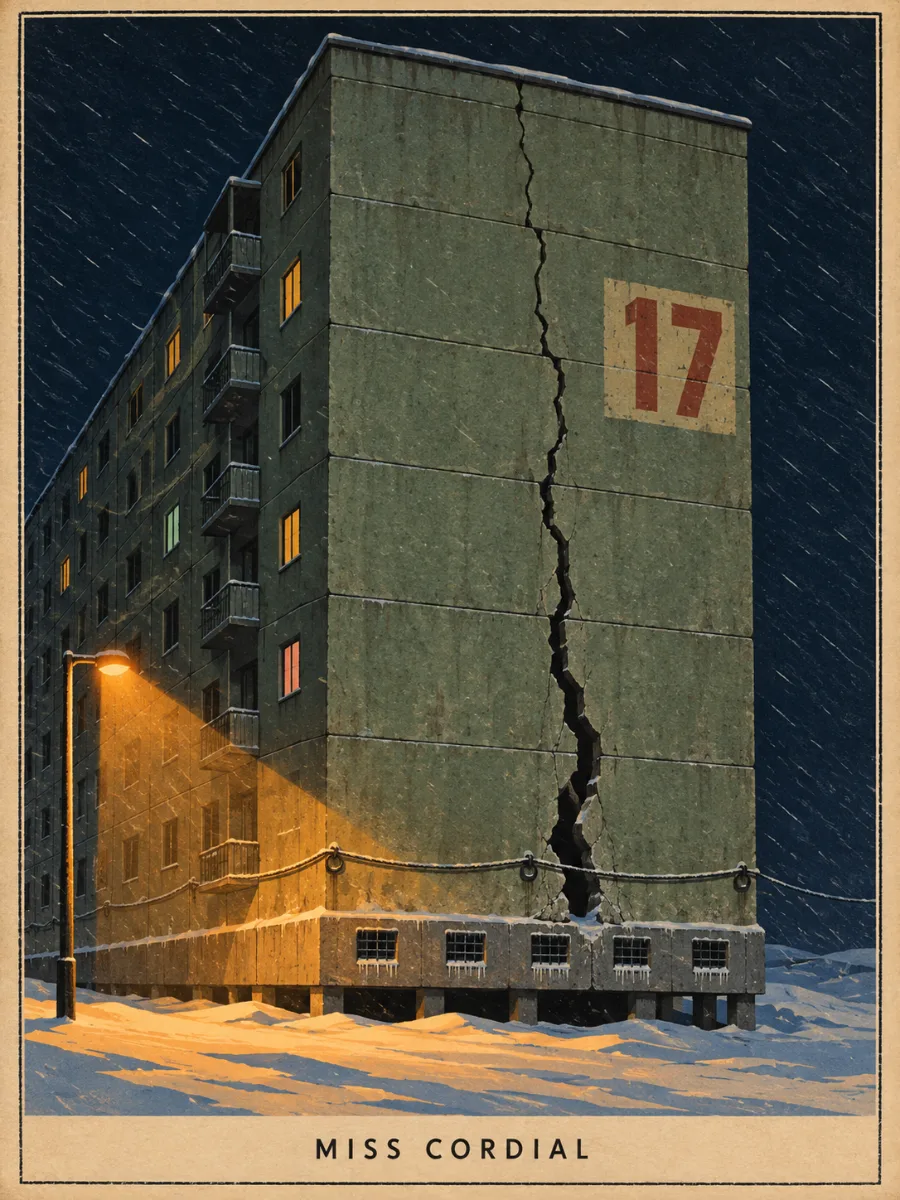
The Combine's van was white, with the heating full on and a driver who did not say a word in thirty-five kilometres. The road ran straight across a plain of bluish snow, between posts with orange lights. Far off to the left the chimneys of the Combine burned like candles on a cake. Then the town appeared ahead, a row of identical blocks with their windows lit, green and yellow and here and there pink. Each had its number painted on the end wall, very large, so that it could be read from a distance in a blizzard.
"In the report they sent me from Zürich," he said, "a Russian word comes up a great deal. Materik."
"The mainland." Zoya took off her glasses, clear now, and wiped them out of habit. "There's no road out of here to anywhere. You go to the rest of Russia by plane, and everything that isn't this we call the mainland, as if we lived on an island."
"And does everyone want to leave?"
"Everyone who can. Anyone with fifteen years in the north has the right to a certificate, which is a flat on the mainland. There's a waiting list of eleven years, or twelve. If a block is declared unsafe from natural causes, the people in that block go to the front of the list."
"And if the cause is not natural?"
"Then they don't go in front of anybody. The insurer doesn't pay, the Combine patches it up as best it can and the tenants go back home."
Valmont smoothed his moustache with the back of his thumb and looked out of the window for a while.
"In that case, mademoiselle, everyone in that block is going to be very fond of me."
Block Seventeen had nine storeys and six entrances, and the seventeen painted on its end wall in brick red on a yellow ground. The crack began at the roof and ran down between two columns of windows to the plinth. At the top it was a black line. At the bottom, on the ground floor, you could have put your hand in it. Along the front of the building a thick rope had already been strung at chest height, from entrance to entrance, fastened to iron rings.
Galina Petrovna Dubova was waiting for them at entrance 2, in a mink hat and with a plastic folder held against her chest. She was seventy and talked without stopping, and Zoya's glasses froze again as soon as they came in. Zoya translated about a third of what she said, and chose that third carefully.
"She's the house elder," she explained. "The one who sees to everything. She says she's got a flat ready for us here, in entrance 2, for you and for me. With the purga that's coming neither we nor anyone else will get to the hotel."
"Tell her it is very kind of her. And the tenants from the empty entrances, where has she put them?"
"Around the other entrances. She says there are plenty of empty flats, it's the only thing this town has plenty of. And she says we'll have supper at her place, in entrance 5. The entrances don't connect inside, so we'll have to go out along the rope. She says even her granddaughter does that here."
The flat had belonged to someone who had gone to the mainland two years before and left the furniture. There was a calendar from that year in the kitchen, a plastic plant in the window and a rug on the wall. Galina had gathered there the people who had to meet the Swiss, and she named them one by one without letting go of the folder.
Oleg Savich Rebrov was the engineer from the Combine's foundations service. He was forty-six, with a leather briefcase and the company jacket, and he gave Valmont a damp hand. Nastia Gromova was a cashier at the supermarket and had lived on the ground floor of entrance 4 until the crack opened. She had her son Tima by the hand, eight years old, who could not take his eyes off Valmont's moustache. Rustam Nazarov, the plumber from the housing office, stayed in the doorway with his cap in his hand, and there was no getting him to come in. And Vera Ilinichna Soboleva sat in the only armchair, in a grey shawl and glasses with very thick lenses, and coughed.
"Vera Ilinichna knows more about ground than anyone in this town," said Galina. "Thirty-five years at the permafrost station. She used to live in Three, right above the crack, and now we've got her here across the landing from you."
"That was before," Vera replied. "Now all I know about is coughs. And queues: I've been eleven years in the one for the mainland, like everyone."
Arkadi Fomich Lavrov came last, smelling of cold and vodka, in a hat with earflaps and stiff in the knees. He was the thermometer man. For forty years he had been going down under forty blocks, and he did not take off his coat.
Then they began to ask questions, and they all asked the same thing. Galina wanted to know when the gentleman would sign. Oleg said the Combine needed the report before the end of the month. Nastia came over with the boy and asked Zoya quietly whether it was true that if the Swiss said it was the climate, they would all be going. Zoya translated all of it, the last part too.
"Tell them I shall sign when I know," Valmont replied. "And that I shall say the same to the people who pay me as to them."
She translated it, and there was a silence. Only Arkadi spoke, from the hallway, without taking off his hat.
"Then to know it you have to go down. Nobody up here finds out anything."
At three o'clock they went out along the rope towards entrance 3. Valmont, Zoya, Oleg and Arkadi went, and behind them, without anyone asking her, came Vera Ilinichna in her shawl. Rustam was last, with a torch. The snow was already beginning to run along the ground, fine as flour. The plant room was a room at street level, beside the porch, with its own iron door and a padlock. Oleg opened it with his key. Inside it was thirty degrees and full of the noise of water, and Zoya's glasses went white again. She waited on the threshold for them to clear, and meanwhile she heard Oleg begin to explain in Russian, without her, things that Valmont could not understand.
There were thick pipes lagged with sheet metal, dials with needles and a red handwheel the size of a plate.
"Rustam put this valve in after the crack," said Oleg, and Zoya translated. "It cuts off the pipes for entrances 3 and 4, nothing else. It doesn't touch the other entrances. If the crack splits a pipe, you close it here and half the building doesn't flood."
"And entrances 3 and 4 are empty," said Valmont.
"Empty, but warm. It's the first thing I ordered when they were cleared: an empty building is heated just the same. If a pipe freezes, the section bursts in a night, and then there really is nothing left to examine."
Strapped to the wall with a cable tie was a small grey box with a little screen, and a cable ran from it down past the edge of the hatch.
"That's a logger," Oleg went on. "The probe is down below, against the section pipe. It records the temperature of the pipe every hour, so we know if the section is freezing. It hasn't got an alarm. They never paid for the alarm."
In the floor, in a corner, there was a steel hatch with a ring and a heavy bolt.
"The bolt goes across from above," said Oleg, and shot it with his foot. "So the kids don't go down."
They went down an iron ladder, Arkadi first with the lamp and then the others: Valmont, Zoya, Oleg, Vera and Rustam last, with his torch on. Below there was one metre forty of headroom and you had to go bent double. There was no wind, but the cold was the cold of the street, still and whole. The ground was covered in a hard frost that crunched. The piles rose out of it in rows, grey and round, as far as the light reached, and above them ran the heating pipes lagged in sheet metal.
Arkadi talked, and Zoya translated as best she could. She did not know how to say vechnaya merzlota in French, and it was Vera who whispered it to her from behind: permafrost, which is the same in every language.
"Here houses don't die of cold, monsieur," said Arkadi. "They die of heat. The ground has to be frozen. As long as it's frozen, it grips the piles like a fist. If it gets warm, it lets go of them. This whole hole is here so the ground stays as cold as the street."
"How many piles has the block?" asked Valmont.
"A hundred and eighty, driven twelve metres into the ground. And six wells to tell how the ground is doing around them."
"And who reads the wells?"
"I do. For forty years now, this one and thirty-nine others."
He showed them three things with the lamp. The first was a steel tube driven into the ground, with a screw cap. That was the well. The second was a chain with thermometers tied to it every metre, which he took out of a case and let drop into the well. The third was a vent in the plinth, a square hole with a grille, through which the orange light of the street lamps came in and around which a white crust of ice was growing, like a beard.
"The steam off the pipes freezes in its mouth," said Arkadi. "A vent that breathes has a beard. One that doesn't breathe has nothing."
"How often do you come down here?" asked Valmont.
"Every week, monsieur. Monday mornings, which is when my knees hurt least."
Oleg looked at the ground. Arkadi read the wells one by one, slowly, with the lamp between his teeth. When he came to the fourth he was silent for longer than he needed to be.
"Minus nought point four at three metres," he said at last. "It ought to read minus five."
Nobody answered. Valmont took off a glove, laid his bare hand on a pile and kept it there a moment. Then he wiped it with his handkerchief, although he had not dirtied it on anything.
A little further on, under what had been the ground floor of entrance 4, two vents were stuffed with rags. One was a child's jumper with a dinosaur on it. Arkadi pulled them out with a snort and threw them on the ground.
"There's always someone whose feet are cold."
Beyond, some twenty metres off, there was a plastic tape tied from pile to pile and a sign hanging from it.
"Nobody goes past there until it's been shored up," said Oleg. "That's the area under the porch of entrance 3. The worst of the crack is there."
Bolted to a pile beside the first well there was a steel box with a padlock. Valmont asked if that was where the readings book was kept. Arkadi said yes, the book had always lived down here, because a book of wells is written beside the wells. Valmont asked if he might see it.
"I'll show it to you tomorrow, all clean," Arkadi replied.
Oleg looked at him for a moment and said nothing.
Afterwards they went up to the fourth floor of entrance 3 to see the crack from inside. In the kitchen of an empty flat it crossed the wall from top to bottom, with frost along its edges, and through it you could see the kitchen of the flat next door. In the room at the back a window had been left ajar. Vera went straight to it and slammed it shut.
"Who's left this like this?" she said to Rustam, in Russian and very loud. "In this town nobody lets a pipe freeze."
"It wasn't me, Vera Ilinichna. I shut them all when I go by, can't you see I shut them?"
"Well, whoever it was."
Zoya translated it for Valmont, who looked at the closed window and said nothing. On the way down the stairs Arkadi dropped back to wait for Vera and Rustam, who were coming last. Zoya was ahead and heard them.
"Tonight I'm going down to read properly," he said. "The way you taught me, Vera Ilinichna."
"With those knees, Arkadi Fomich."
Zoya did not translate it. It seemed to her an old people's matter, and Valmont did not ask.
At six the kitchen radio said that from eight o'clock a black purga was in force over the whole municipality. It was forbidden to go out into the street, the airport was closed and there would be no buses or school. Oleg would not get home before eight, and Galina put a blanket for him on the sofa in the sitting room. With the purga there was no going to supper in entrance 5 either, and at half past seven she turned up herself along the rope, with a pan of soup wrapped in a towel and her face red from the wind.
At ten, from the kitchen window, they saw a small light moving along the front of the building. It was Galina, with a torch on her forehead, holding the rope with one hand. She stopped at entrance 3 and then at entrance 4, and at each she passed a chain through the door handles and closed a padlock.
"What is madame doing?" asked Valmont.
"Locking the empty entrances. Since the crack people have been stealing copper from the flats, and she locks them every night at ten. She opens them at eight."
"From outside?"
"From outside. The people inside don't live inside any more. Who's going to want to get out of an empty entrance?"
Oleg went out twice that night. The first time was at half past nine, for a smoke, and he came back after twenty-five minutes. The second was at half past ten. Valmont had gone to his room and Zoya was marking exam papers at the kitchen table when her phone rang, inside her jumper. It was twenty to eleven.
"Zoya Andreyevna, it's Lavrov." The voice echoed, as if inside a pipe, and behind it you could hear the wind. "Bring the Swiss to the plant room tomorrow at nine. Someone's taken the book. But what I want to show him isn't in the book."
"Arkadi Fomich, where are you?"
The line went dead. She rang twice and got no tone. She thought he was drunk and most likely at home, and that by the next day he would not remember. She did not wake anyone.
At twenty past eleven the door of the flat opened and Oleg came in with snow up to his shoulders and in his eyebrows. He shook himself in the hallway without looking at her.
"I went out for a smoke in the entrance hall."
Zoya was pouring herself tea. The steam from the glass misted her glasses for a second and was gone at once. When she could see again, Oleg was already on the sofa with the blanket up to his chin.
At five in the morning she was still awake. Nor was Valmont asleep; he appeared in the kitchen in a checked dressing gown with his moustache combed as if for Mass.
"My body asks the time every twenty minutes, mademoiselle, and here nobody answers it."
"It's the polar night. People from outside get it the first week. We get it all our lives, but we've stopped asking."
She made him tea. He drank it slowly, with both hands round the glass. From the kitchen you could see the sitting room through the open door. Oleg was snoring on his back on the sofa, with the blanket slipped off to one side. Valmont got up without a word, pulled the blanket up to his chest and sat down again.
"Why did you leave Switzerland?" she asked.
"I shall tell you that the day you tell me why you stay here."
"My mother is buried here. And nobody on the mainland needs French either."
"That is half of it, mademoiselle. And the other half?"
"It's the half you tell."
He bowed his head slowly, as though she had proved him right about something. At two minutes past five, down below, the door of the entrance hall gave a loud bang, and then another, and went on banging in the wind, every little while, as they talked. The wind sounded at the window like a sheet on a line.
At fourteen minutes past five the door gave one last bang and fell silent. A minute later they heard footsteps on the stairs, slow ones, and a cough. Valmont went to open the door of the flat. On the landing stood Vera Ilinichna, with her coat over her nightdress and snow on her shawl. Her glasses were completely white and she was feeling for the lock of her door with her hand out in front of her.
"I went down to the entrance hall," she said in Russian. "The door was banging."
Zoya translated it. Valmont offered her his arm and led her the four steps to her door, and put her key into the lock for her, because she could not find it. Vera said "thank you, Frenchman" and shut the door.
They went back to the kitchen and did not go to bed again. They talked about Neuchâtel, about the lakes, and about a teacher of Zoya's who had once been to Lausanne. At half past six Oleg was still snoring on the sofa, with the blanket where Valmont had left it, and they were still at their tea.
At a quarter to nine the three of them went out along the rope towards the plant room: Valmont, Zoya and Oleg, who had woken in a bad temper and did not want to go. The purga was still blowing. You could not see the next entrance. Arkadi was not at the door, and the door did not have its padlock on. Inside it was the same heat and the same noise as the afternoon before. The hatch was closed and the bolt drawn back.
Oleg lifted it with one hand.
They went down. Arkadi's lamp lay on the ground beside the first well, out. The steel box was open. They followed the row of piles as far as the plastic tape, and the tape was broken. Beyond it, under the porch of entrance 3, Arkadi Fomich was sitting in the frost with his arms round a pipe. He had torn off the sheet metal and the lagging along a metre of it, and his face was pressed against it.
Zoya touched his hand. It was frozen like a stone. She touched the pipe, and snatched her hand back at once, because it burned.
Houses Die of Heat
Chapter 2
II
The purga let no one through all morning. Oleg rang the Combine from the plant room, tucking the phone inside his jacket between calls, and the Combine said nothing was to be touched. He rang the police and the police said they would come in the first lull. Then he sat down on a pipe with his head in his hands and did not speak again.
Valmont would not leave the plant room. He sat on the second rung of the ladder, with his hat on his knees, like a man waiting for a train. Zoya sat down beside him because she did not know where else to put herself. Down below, twenty metres off, Arkadi was still holding the pipe, and overhead the wind could be heard against the iron door.
"He rang me last night," she said suddenly. "At twenty to eleven."
He did not move.
"Tell me what he said. In the same words, if you can."
"He said: 'Zoya Andreyevna, it's Lavrov. Bring the Swiss to the plant room tomorrow at nine. Someone's taken the book. But what I want to show him isn't in the book.' I asked him where he was and it cut off. I rang twice more and got no tone."
"And what did you think?"
"That he was drunk and at home." She took off her glasses and wiped them, although there was nothing wrong with them. "I didn't wake anyone."
"Nor would I have done, mademoiselle."
It was the first time she had translated herself, and she found it harder than translating other people.
At two the two of them went along the rope to entrance 2 to fetch a flask of tea. As they came in Zoya's glasses went white, as always, and she waited for them to clear. Then they stayed a quarter of an hour downstairs, by the letterboxes, watching through the glass of the door to see if the wind was dropping, and when they went up to the flat she did not have to take them off.
At three the wind dropped all at once, the way a door shuts, and twenty minutes later a four-by-four with wheels a metre and a half high came down the street. Out of it got a stout man in uniform and a fur hat and a small woman with an aluminium case. He was Captain Belyaev. She was Dr Inna Kim, the duty pathologist, and she did not take off her hat to say good afternoon.
The captain looked Valmont up and down and asked Zoya who the Frenchman was. She explained who he was and who had sent him.
"Zürich," the captain repeated. "Well, tell the gentleman from Zürich that this is a drunk in a basement. It happens every winter. They go down to read a thermometer with a bottle in their pocket and sit down for a moment's rest."
Zoya translated all of it. Valmont inclined his head amiably.
"Tell the captain he is very probably right, and that I have come for the ground and not for the man."
The captain was a little disarmed, and went down with the doctor. They were below for forty minutes. When they came up, Dr Kim took off her gloves beside the red handwheel and spoke without looking at anyone, in the tone of someone dictating.
"Hypothermia. Died between one and four. Blood alcohol moderate, a little more than a man of his age drinks to go down into a basement at forty below, and a good deal less than it takes to be unable to climb out. The nails of the right hand broken. And burns on the left side and the arm, with no vital reaction."
"He put his arms round the pipe and burnt himself," said the captain.
Zoya translated both things, the doctor's and the captain's, and did not know how to say "vital reaction" in French. She said it as best she could. Valmont listened with his hands behind his back.
"Ask the doctor one thing only, mademoiselle. Whether the burns are from before or after."
Dr Kim looked at Valmont for the first time.
"After. When he was burnt he could no longer feel anything, because there was nothing left in him to feel. What that means is not my business. I say what happened to the body."
"Tell her that in my trade we say the same about things," Valmont replied.
Zoya translated it. The doctor shut her case without answering, but before she left she shook his hand.
The captain let the Frenchman go down because he saw no reason to stop him, and went down after him. Zoya went down with Valmont because without her he could ask nothing, and Oleg went down last. Valmont stopped on the ladder before he reached the ground and shone Oleg's torch on the underside of the hatch. The steel was covered in scratches, many of them, fine and parallel, and on the edge there was a dark, dry stain.
"Blood," said Zoya, in Russian and in French.
"The frost sticks the hatch," said the captain. "In the cold it grips the frame. He was drunk and couldn't push."
Valmont said nothing. He wrote something in a small notebook with an even smaller pencil.
Oleg and the driver of the four-by-four had carried the body up in a tarpaulin, and on the pipe the stripped length remained, with the grey lagging on the ground and the sheet metal bent back to one side. Arkadi's lamp was still beside the first well. The steel box was still open, and it was empty.
"What was kept in there?" asked the captain.
"The readings book," said Oleg. "A book bound in green oilcloth, like all the station's books. I sign it every month."
"And where is it?"
"I don't know. It was in there yesterday, and Arkadi wouldn't show it to the gentleman."
They went past the broken tape. Valmont went first, bent at the waist, with his hat in his hand so as not to knock it on the pipes. He stopped behind the porch of entrance 3, where Arkadi had been sitting, and shone the torch carefully along the plinth, from one side to the other.
There were six vents in a row. Through all six the orange light of the street lamps came in, just as it did through all the others. But the others had their white beard of frost around them, and these six had nothing. They had bare concrete, dry, as if just swept. In the grille of one there were a few crumbs of yellow foam, the size of a grain of rice. In front of them, in the frost on the ground, were the marks of Arkadi's knees.
Valmont stood looking for a good deal longer than was comfortable. Then he turned to Zoya.
"Here houses die of heat, mademoiselle. Monsieur Lavrov explained it to me yesterday, down here. These six have not breathed for a long time."
"What did he say?" asked the captain.
Zoya translated it for him. Oleg had turned the colour of the concrete.
"They were stopped up," Valmont went on. "From outside, behind this porch, where nobody sees them. And somebody unstopped them very recently, because they have not yet had time to grow a beard."
"And what's that got to do with a drunk?" said the captain.
"Nothing, captain. That is my part, which is the ground. Yours is the man, and I do not meddle in that."
The captain looked at him again, with less contempt and more weariness, and said that he would take statements upstairs from everyone who had seen the dead man the afternoon before. The Frenchman could listen if he liked.
He took the statements in the kitchen of the flat in entrance 2, with his hat on the table. Zoya sat beside Valmont and translated them for him in a low voice, one by one.
Galina Petrovna brought her folder. In it was the petition for the building to be declared unsafe, with the signatures of the nineteen families from the two empty entrances, and she showed it before anyone asked. She said she had watched television all night, as she had every night since her husband died. She said that at ten she had locked entrances 3 and 4 with the chain and at eight she had opened them again. Arkadi Fomich had a key to the plant room, and the plant room had a door to the street, so he had no need of any entrance to go down.
"Who else has a key to the plant room?" asked the captain.
"The engineer. Rustam, the plumber. And Arkadi, God rest him."
Valmont asked Zoya to ask her whether she knew what the section valve was.
"What valve?" said Galina. "I don't know anything about pipes. You'll have to ask the engineer, or Rustam, he's the one who puts them in."
Oleg gave his statement second, standing, with his briefcase under his arm. He said he had not been down to the basement all night. He said what he had said the night before, in almost the same words.
"I went out twice for a smoke in the entrance hall. That's all."
Zoya translated it. She remembered the snow on his shoulders and in his eyebrows, and said nothing. Valmont looked at her for a moment, as if he had noticed something in her face, and he said nothing either.
Vera Ilinichna gave hers sitting down, in her shawl. She explained the business of the vents to the captain better than Valmont had, with a schoolmistress's patience, and explained in passing why a stopped vent has no beard. Then she said she had slept all night.
"At five I went down to the entrance hall, because the door was banging. On the way up I met the Frenchman on the landing. My glasses had frozen and I couldn't see, and he took me to my door."
"Is that true?" the captain asked Valmont.
"It is true," Valmont replied, when Zoya had translated it. "Madame could see nothing at all."
Rustam did not appear. Galina said he slept at a hostel at the other end of town, and with the purga who could say. Nobody had seen him since the afternoon before.
That left Nastia Gromova, who had no reason to give a statement, since she had not seen Arkadi since the meeting. She arrived alone, without the boy, when the captain was already buttoning his coat. She had come along the rope from entrance 1, with snow in her hair and red eyes, and she stood in the kitchen doorway without daring to come in.
Valmont stood up. He went to his room and came back with a child's jumper folded over his arm, the one with the dinosaur, which he had picked up from the floor of the basement. Zoya had not seen him pick it up, and did not know when he had done it.
"I believe this belongs to your son, madame."
Nastia took the jumper and burst into tears where she stood, with the jumper against her face. She told it all at once and without anyone asking her anything. Since last winter she had been stopping the two holes under the boy's room with rags, because the floor was frozen and the boy coughed at night. She did it from outside, in the autumn, and took them out in the spring. Nobody had told her, but she knew it wasn't allowed. And when the crack opened she knew it had been her, that she had broken the building all by herself for a child's cold feet, and that because of her nineteen families would never get to the mainland.
Zoya translated all of it, slowly, because she had a lump in her throat as well.
"Tell madame to sit down," said Valmont.
Nastia sat down.
"Tell her that a few rags under a bed are a child's cold feet, and that half the town has done it. That Monsieur Lavrov took them out yesterday in front of me and said there is always someone whose feet are cold. And tell her that the holes that killed the ground are not under anybody's room. They are under a porch, behind a staircase, where nobody sleeps. And they were not stopped with rags."
Nastia looked at Zoya while she was saying it, and then looked at Valmont, and stopped crying all at once, like a child who has forgotten why it was crying.
"It wasn't me?"
"No, madame. You were cold, and in this town that is no crime."
The captain had listened to all of it with his coat buttoned. He said that buildings were no business of the police and drunks were. That the thermometer man had gone down alone at night, in the middle of a purga, with a hip flask, and had died of cold. And that nobody need worry about the book, it would turn up.
"What's this book like?" he asked all the same, from the door.
"I've told you," Oleg replied. "Green oilcloth covers."
They left at six, in the four-by-four, before the lull ended. At a quarter past six the wind came back.
In the evening Nastia came over with some cabbage pies, and this time she brought the boy, wrapped in three scarves. Tima sat down in front of Valmont and looked at his moustache for a long while, with his inhaler in his hand.
"Does the sun come up in Switzerland?" he asked.
Zoya translated it.
"Every day, monsieur," Valmont replied. "Even on Sundays, which is when it is needed most there."
Tima thought about it very seriously and said he didn't believe that.
"And here, when does it come back?" asked Valmont.
"In January," said Tima. "For a little bit, and then more."
They left at nine, along the rope, and at ten Galina went by with the torch on her forehead to put on the chains.
At half past ten Oleg opened his briefcase on the kitchen table to get out his phone charger. He was in a hurry and opened it wide. Zoya was opposite, washing up the glasses, and her eyes strayed without her meaning them to. Among the Combine's papers the corner of a book bound in green oilcloth was sticking out.
Houses Die of Heat
Chapter 3
III
She told Valmont the next morning, in French, while Oleg was in the bathroom with the tap running. She had not decided to. It came out as she was pouring his tea, whole and all in one go: the briefcase open on the table, the Combine's papers, and the green corner among them. And while she was at it, she told him too about the snow on Oleg's shoulders and in his eyebrows at twenty past eleven on Thursday, when he said he had been for a smoke in the entrance hall.
"Thank you, mademoiselle. It will have cost you something to tell me, and I shall not forget it," he said.
Nothing more. He drank his tea, dried his moustache with his handkerchief and waited for Oleg to come out of the bathroom with his hair combed and the Combine's jacket on. Then he stood up.
"Monsieur Rebrov, may I have the book you are carrying in your briefcase?"
Zoya translated it. Oleg stood still in the middle of the kitchen with the towel in his hand. Then he opened the briefcase, took out the book and put it down on the table without quite letting go of it.
"I went down at half past nine," he said. "Through the plant room, with my key. I took it out of the box and came up. Arkadi hadn't gone down yet."
"Why did you take it?"
"Because yesterday, when you asked him for it, he said he'd show it to you tomorrow, all clean. And I've signed it every month for nine years. I wanted to know what I'd signed."
Zoya thought of the call at twenty to eleven. Someone's taken the book, Arkadi had said, and he had been alive to say it. She did not say so aloud.
Valmont sat down and opened the book. It was columns of figures written by hand in blue biro, a page to each week, the six wells in six columns and the four depths for each well. He asked Zoya to read him well 4, at three metres, on the first Monday of December in each year. She turned the pages backwards.
"This winter, minus five point three. Last winter, minus five point three. The one before, minus five point three."
"Now the second Monday."
"Minus five point one. Minus five point one. Minus five point one."
"And the winter before those three?"
She searched backwards, page by page, with the tip of her finger.
"Minus five point four. And the second Monday, minus five point two."
Valmont went on asking for figures for a while, well by well, and she went on reading. The decimals for this winter were last winter's, and last winter's were those of the winter before. Further back than that, every year was different.
"Monsieur Lavrov did not go down," said Valmont. "For two winters he has been copying the same one."
Oleg sat down opposite, heavily, with the towel still in his hand.
"Arkadi copied and I signed, yes. I sign forty books a month, for forty blocks. Do you know what that's like? Nobody reads them." He passed his hand over his face. "And he used to say Vera Ilinichna had taught him that in December the ground doesn't move. That with his knees he shouldn't go down. That he should copy last year, it was the same thing."
Zoya translated it. Valmont wrote something in the small notebook and underlined it twice with the pencil.
"And at half past ten, monsieur, when you went out the second time?"
"To the entrance hall, I've told you. For a smoke, same as the first time."
Zoya translated that too, and this time she translated it looking him in the face. Oleg did not look at her.
"And this has happened once before," he went on, louder, as though someone had accused him of something. "It's not the first time a block has opened up in this district. It happened to Eleven, twenty-seven years ago. And that time it was the tenants."
He took out his phone and searched the Combine's archive, which had been scanned in its entirety three years before. It took him a while. Then he passed the phone to Zoya with a document open, and she read it aloud, first in Russian and then in French.
"Report on the deformations of Block Eleven. Cause: obstruction of the vents of the podpolie by the occupants of the ground floor, with the aim of raising the temperature of the floors. Thaw induced. The declaration of unsafe condition from natural causes is not applicable." She turned to the last page. "Signed: V. I. Soboleva, chief technician, permafrost station. Assistant: A. F. Lavrov."
No one said anything for a while. Across the landing a door opened, and Vera's cough came nearer along the passage. The wall was paper-thin.
She came in without knocking. She sat down on the chair Valmont gave up to her and settled her shawl. She did not ask for the phone.
"I signed that," she said. "I was thirty-nine. Arkadi carried my lamp."
She told it in a calm voice and without having to be asked twice, and Zoya translated it sentence by sentence. The ground-floor tenants of Eleven had had freezing feet and stopped up the vents with rags, just like the girl from entrance 4. Two winters. The ground warmed and the block opened. She went down, saw the rags and wrote what she saw. She wrote "induced", because it was the truth. The insurer did not pay, the block was not declared unsafe and the forty families were not sent to the mainland: they were shared out around Kayerkan, which is this same place with another name and more smoke.
"I wrote what was there," she finished. "And then I lived here twenty-seven years seeing them in the street."
Valmont listened without moving, with his hands folded on the book. When she had finished he smoothed his moustache with the back of his thumb and was silent for longer than was comfortable. Zoya waited for him to say something so that she could translate it.
"Would you sign it again, madame?"
"You sign what's true, Frenchman," Vera replied. "And then you live with it."
He bowed his head very slowly, as though that were not an answer meant for him alone. He did not explain it, and Zoya did not ask.
At twelve he asked Oleg to read him the logger. The three of them went out along the rope to the plant room, with the wind side-on and the snow driven into their eyes. As they came into the heat Zoya's glasses went white, and she stood still by the door until they cleared. Oleg held his phone up to the little grey box on the pipe and the phone read it off by itself.
"Read it to me, mademoiselle. Hour by hour, from ten o'clock on Thursday night."
Zoya took the phone, still warm from Oleg's pocket, and found the table.
"Thursday, ten at night, eighty-eight degrees. At eleven, eighty. At twelve, forty. At one, twenty-two. At two, fourteen. At three, seven. At four, one. At five, nought." She stopped, and went on. "At six, eighty-six. At seven, eighty-eight."
"The eleven o'clock again."
"Eighty. At ten, eighty-eight, and at eleven, eighty."
"Somebody closed that valve a little before eleven," said Valmont, and pointed at the red handwheel without touching it. "And somebody opened it again between five and six in the morning. While it was closed the pipe down there cooled to nought, and a man had his arms round it."
Oleg had leant against the wall, between two dials, and his forehead was wet with sweat.
"I've got a key to the plant room," he said quietly, to nobody. "And at eleven I was out in the street."
Zoya translated it. Valmont did not reply.
In the afternoon lull the four-by-four with the big wheels came back. Captain Belyaev was in a better temper than the day before, because he had brought something. In the short lull that morning he had sent two men to look for the book, and they had opened the empty flats in entrances 3 and 4. In the junk room on the ground floor of entrance 4 they had found a blanket, a foam mattress, an electric kettle, a photograph of two children and a Tajik passport that had expired in July. The room had a big radiator, and the mattress was pushed up against it.
Rustam was in the back seat, handcuffed, with his cap in his hand, just as he had been on Thursday in the doorway of the flat. They had found him in the housing office in the next block, asleep on top of a desk.
"He's got a key to the plant room," said the captain, counting on his fingers. "He put in the section valve himself, the engineer told me that. He was sleeping in the entrance next door. On Friday morning he cleared off without a word. And he's got no papers."
They sat him down in the kitchen of the flat in entrance 2. Rustam spoke a careful, slow Russian, with his cuffed hands on his knees, and Zoya passed it on to Valmont in French.
He said that since the summer the hostel would not let him in without papers, and that since the entrance was cleared he had been sleeping there. He went in at nine and came out after eight, when there were people about in the street. That on Thursday night, at about eleven, he had begun to hear knocking in the radiator. Knocking with something made of iron, like a spanner against a pipe, every little while. That the radiator had been going cold. That at half past eleven he had got up to go and look, and the door of the entrance would not open, it must have frozen. That he had not called anyone, because who calls the police without papers. That the knocking had stopped at half past one or a little after. And that at ten past five the radiator had given a great bang, the way it does when the water comes back, and turned hot, and he had fallen asleep.
"Entrance doors don't freeze," said the captain. "Fairy tales."
"Where did they find the blanket, captain?" asked Valmont.
"I've told you. In the junk room in entrance 4."
Valmont noted it down meticulously in the small notebook and shut the notebook.
The captain stood up and took Rustam by the elbow. Rustam did not resist, and let himself be led meekly to the door. As he passed Valmont he looked at him as if he had no idea who this gentleman was or why he had asked about the blanket.
Then Valmont said something in French. He did not say it to Zoya. He said it to the captain, quietly and very clearly, and he did not ask her to translate it.
"C'est trop facile."
It was the only sentence he spoke in his own language to someone who was not her, and the only one he did not ask her to translate. The captain stopped in the doorway and turned to Zoya.
"What did he say?"
"He says it's cold," Zoya replied.
"Then he'd better wrap up, this isn't Switzerland."
They left with Rustam before the lull ended. Valmont stood at the window watching the red lights of the four-by-four until the snow covered them.
"Why didn't you ask me to translate it?" she asked.
"Would you have translated it, mademoiselle?"
"No."
"That is why I did not ask you."
At a quarter to ten they went down to the entrance hall to wait for Galina. She came along the rope, with the torch on her forehead and the chains over her shoulder, as she did every night. Valmont asked her for three things.
Zoya translated the first: that tonight she should lock the entrances at ten, as always.
She translated the second: that on Sunday at five in the morning they should all be in entrance 2, with their coats on. Everyone who had been in the flat on Thursday, and the captain, and the doctor, and Rustam. And that she should tell Dr Kim first, because the captain would come if she did.
The third she translated twice, because the first time Galina thought she had misunderstood.
"And that everyone who wears glasses should bring their glasses."
Houses Die of Heat
Chapter 4
IV
At twenty to five on Sunday morning the purga was beginning to ease. The wind could still be heard, but it no longer carried your voice away. Valmont, Zoya, Oleg and Captain Belyaev went along the rope to the plant room of entrance 3, and the captain was in a bad temper because he had been got out of bed to look at a hatch.
"Monsieur Rebrov, would you be so good as to go down," said Valmont.
Oleg went down the ladder to the frozen ground and stayed below, bent over, with his head almost touching the steel. Valmont closed the hatch over him and asked the captain to shoot the bolt with his own hand. The captain shot it with his foot, as Oleg had done on Thursday.
"Now push, monsieur."
They heard Oleg push from below, first with one hand and then with both, and then with his back. The hatch did not move, and then Oleg struck the steel with his fist and the blow rang in every pipe in the room.
"Draw the bolt, captain."
The captain drew it. Below, Oleg lifted the hatch with one hand and put his head out, red in the face and with frost in his hair.
"The frost doesn't stick anything," the captain muttered, looking at the steel, and he did not say it to anyone.
At five they were all in the flat in entrance 2, with their coats on, because Valmont had asked for it that way. Galina had sat down in the armchair with her folder. Nastia had Tima asleep in her arms, wrapped in a blanket. Vera was on the kitchen chair in her shawl. Rustam was standing by the window, between two young policemen, without handcuffs. Dr Kim had stayed in the hallway with her case, like someone who did not mean to stay. Oleg was drying his hair with his hand, and Valmont remained standing in the middle of the sitting room, with Zoya beside him. The captain had come because the doctor was coming, and the doctor because she wanted to know what a Swiss who asked the right questions was going to do with her burns.
"Madame Galina, have you brought the glasses?"
Zoya translated it. Galina took from her folder a pair of reading glasses on a cord and said they were the only ones she had. Valmont took them, thanked her and turned to Vera.
"May I have yours, madame?"
Vera took them off slowly and gave them to him, and without them her eyes were small and bare, like someone else's. Valmont gave Vera's glasses to one of the young policemen.
"Leave them downstairs, in the entrance hall, on top of the letterboxes, and come back for them in ten minutes. Nobody is to touch them."
The policeman looked at the captain, and the captain told him to do as the Frenchman said.
Then Valmont began, and Zoya translated each sentence into Russian as soon as he finished it. She did it aloud, in front of everyone at once, for the first time in four days.
"I shall begin with what nobody disputes. Monsieur Lavrov went down to the basement on Thursday night, through the plant room, with his key. When Monsieur Rebrov came up with the book, after half past nine, he had not yet gone down. At twenty to eleven he was alive, because he rang Mademoiselle Kulik from below. He died between one and four. And the hatch cannot be opened from below with the bolt across. It opens with one hand when the bolt is not. The captain saw that for himself this morning."
"We all know that already," said Galina.
"Yes, madame. That is why I begin there."
Nobody said anything more, and Zoya waited a moment before she went on translating.
"Now, what does not fit. A man who has lived forty years in this town does not die of cold with his arms round a heating pipe. And yet that is how we found him. The doctor says the burns came after he was dead. Is that so, doctor?"
"That is so," said Dr Kim from the hallway.
"Mademoiselle, read them the pipe's hours."
Zoya read them again from Oleg's phone, in Russian, slowly. Eighty-eight at ten. Eighty at eleven. One at four. Nought at five. Eighty-six at six.
"The pipe went cold while he was alive and warm when he was dead," said Valmont. "Somebody closed the valve a little before eleven and somebody opened it between five and six. Nobody lives in that section, so nobody could have felt the cold and opened it by chance. And whoever opened it also drew the bolt on the hatch, so they knew it was across. Nobody opens a valve they do not know is closed. It is the same hand."
"And who is it?" asked the captain.
"Not yet, captain. First I shall tell you what kind of person I am looking for."
He took out his handkerchief and wiped his hands, although they were not dirty. Galina looked at him impatiently, and he went on wiping them.
"That person did not lay a finger on Monsieur Lavrov. Did not go down. Did not strike him. Did not push him. Shot a bolt and turned a wheel, and let the north do the work. And afterwards opened the valve again. At five in the morning. With a dead man underneath."
"And what's so strange about that?" asked the captain.
"Everything, captain. If the valve had been left closed, the pipes of entrances 3 and 4 would have frozen and burst before seven. Nobody would have repaired that section. It would have been declared unsafe for certain. And a man dead of cold beside a burst pipe would have surprised no one. Letting the pipes freeze gave that person everything they wanted." He paused. "They could not do it. I am looking for a person who had spent two winters killing this building with heat, who killed a man with cold without touching him, and who at five in the morning could not bring themselves to let a pipe freeze."
Zoya translated all of it, without changing a word, and when she had finished her mouth was dry.
"In this building there are three people like that," he went on. "Monsieur Rebrov, who told me on Thursday that an empty building is heated just the same."
"I never…" Oleg began.
"I am not accusing you of anything yet, monsieur. Monsieur Nazarov, who put in that valve and sleeps up against a radiator. And Madame Soboleva, who on Thursday scolded Monsieur Nazarov about a window left ajar and told him that in this town nobody lets a pipe freeze. The three of them also knew the valve existed, because all three were in the plant room when Monsieur Rebrov showed it. Madame Galina was not there, and did not know what it was. Madame Gromova was not there either."
Nastia held the boy tighter against her.
"Monsieur Lavrov went down to read properly, for the first time in two winters, and he saw six vents stopped up behind the porch of entrance 3. That is why he died. Whoever stopped them wanted what all of you want, which is to leave. But they wanted it in such a way that it would look like the climate, because if it looks induced nobody leaves. That is something very well known to anyone who has seen, once before, what happens to the tenants when it does not look like the climate."
Vera did not move, and without her glasses she was looking at a spot on the wall where there was nothing.
"Now the hours. A little before eleven, when the valve was closed, Monsieur Rebrov was out in the street. He went out at half past ten and came back at twenty past eleven with snow up to his eyebrows, and said he had been out for a smoke in the entrance hall. It does not snow in the entrance hall." Valmont turned to him. "Where were you, monsieur?"
Oleg looked at Galina, and Galina looked at the folder on her knees, as if the answer were written there.
"At my place," said Galina, before he could open his mouth. "In entrance 5. He came to collect the envelope."
"What envelope, madame?"
Galina told it red in the face and without raising her eyes. Forty thousand roubles a family, from the nineteen, for the engineer to push the papers for the unsafe declaration and put them at the top. She had given it to him on Thursday at twenty to eleven, in her kitchen, and he had stayed to count it until a quarter past eleven. She had watched him count the notes twice, with the television on.
"It's true," Oleg replied, very quietly. "And it's the only thing I've done."
"I believe you, monsieur. And between five and six in the morning, when the valve was opened, you were snoring on that sofa. Mademoiselle Kulik and I were in the kitchen with the door open, and we saw you. I pulled up your blanket, which had fallen off."
The captain looked at Oleg and then at the sofa, for a long time, as if the sofa could give a statement.
"Monsieur Nazarov says that at half past eleven he tried to get out of entrance 4 and the door would not open." Valmont turned to the other young policeman. "Would you go out and look at the door of entrance 4, monsieur? It is a quarter past five."
The policeman looked at the captain and went out, and it took him four minutes to come back. He came back with frost in his eyebrows and said something in the captain's ear, but said it loud enough.
"Chain and padlock, on the outside."
Galina put her hand to her mouth, because she understood before Zoya had finished translating it. She had done it at ten, as she did every night, in front of anyone who cared to watch, and she had not known that a man was asleep inside.
"What time do you take them off, madame?" asked Valmont.
"At eight," said Galina. "Always at eight."
"From ten until eight, then. Monsieur Nazarov could not get out to close anything or open anything. He heard Monsieur Lavrov knocking on the radiator and could not go. The only thing he did not do was call someone, and that is no business of this room."
Rustam slowly lowered his head, and one of the policemen, without anyone telling him to, moved a step away from him.
The first policeman came back just then with Vera's glasses in his hand. He was holding them by the arms, delicately, like something that might break if you looked at it, and they were clear. Valmont held them up to the light and showed them to everyone.
"Ten minutes in the entrance hall, and not a breath of mist. Can you all see from there?"
He gave them to Zoya with both hands.
"Now, mademoiselle, be so good as to take them out into the street for three minutes."
Zoya went towards the door of the flat with the glasses in her hand. Then Vera spoke, from her chair, without turning round.
"In the case, girl, at forty below they crack."
She took a glasses case from her coat pocket and held it out into the air, blind, towards where she thought Zoya was. Zoya took it. Valmont said nothing, but he smoothed his moustache with the back of his thumb.
Zoya went down the stairs, out into the entrance hall and opened the street door. Outside there was no purga any more, only a low, broken wind and the orange light of a street lamp on the snow. She took the glasses out of the case and held them in her open hand for three minutes, counted on the clock of her phone, until the phone died. After that she counted herself, with aching fingers, put them in the case and went up.
In the sitting room, in front of everyone, she took them out of the case, and the glasses turned white in her hand as if someone had thrown flour on them.
"On Friday at a quarter past five in the morning Madame Soboleva came up those stairs with her glasses like that," said Valmont. "I offered her my arm because she could not see the lock. She told us she had gone down to the entrance hall because the door was banging. But in the entrance hall glasses do not freeze: Mademoiselle Kulik spent a quarter of an hour by the letterboxes on Friday and went upstairs without taking them off. They freeze in the street. At two minutes past five the door of the entrance hall began to bang because someone went out and did not leave it latched, and it banged for twelve minutes. Whoever goes down to shut a banging door shuts it as soon as they get there. This one stopped banging at fourteen minutes past five, a minute before madame came up the stairs: she shut it on her way back, not on her way down. And at ten past five the water came back into the pipes. Madame Soboleva was out in the street long enough to go to the plant room, which Monsieur Lavrov had left without its padlock, open the valve, draw the bolt and pull out six foam plugs behind the porch of entrance 3, on her knees in the snow."
Nobody moved, and Zoya had the glasses in her hand and did not know what to do with them. She went over to Vera and gave them to her, clear now. Vera put them on, and for a moment she looked at Valmont through lenses that were still wet.
"You're very polite, Frenchman," she murmured.
"Swiss, madame."
"Whatever you are. At my age it's all the same to me where anyone comes from."
She denied nothing. She said her daughter lived in Anapa, and that from the kitchen window you could see the sea. She said she had two grandchildren and had seen them twice. And there she stopped, as though the rest were not hers to tell. The captain asked her about the plugs and she told him the purga had taken them.
Dr Kim picked up her case and was the first to leave, without saying goodbye to anyone.
On Sunday at two o'clock the first plane in three days left Alykel. Zoya went with Valmont to the departure gate in the Combine's van. Valmont had signed his report at seven that morning, at the kitchen table and with his own pen, and it said "induced". There would be no declaration of unsafe condition from natural causes, the insurer would not pay, and the Combine would put cooling pipes into the ground under Seventeen and patch it up as best it could. The nineteen families would not be going to the mainland. Galina had gathered up the petition from the table without a word. Oleg had given her back the envelope on the landing, in front of everyone, and she had taken it without counting it. Rustam was let go at midday, without papers and without a bed.
At the gate, Valmont took off his hat.
"Mademoiselle, I owe you something."
"What's that, monsieur?"
"The other half. You told me why you stay here, and I have not told you why I left. One day I shall tell you."
He straightened her glasses on her nose, where her hat had knocked them crooked, and went out onto the apron. Zoya went with him as far as the foot of the steps and ran back to the terminal. As she came in her glasses turned white and she stood still by the glass, blind, waiting.
When they cleared he was already at the top of the steps and turning towards the glass to raise his hat to her. Behind him came two passengers from the Combine with their carrier bags, and behind them, between two policemen, Vera Ilinichna was climbing the steps in her grey shawl, on her way to Krasnoyarsk. She was the only tenant of Seventeen who reached the mainland.
The end
Houses Die of Heat
What did this story leave you with?
Read next